
The 8 Best Employee Check-In Apps in 2026

Written By: Mark Fairlie
Last Updated August 24, 2026
Keeping track of when each employee starts and finishes work is difficult, especially for companies whose staff work different hours or in different locations. Maintaining accurate records and spotting when something isn’t right gets even harder the more staff you onboard.
Employee check-in apps give workers an easier way to record their time and managers a better way to keep track of it. I reviewed the eight leading apps in the market, identifying their strengths and weaknesses. I’ve also highlighted the best use case of each app to help you shortlist the most suitable option for your business.
| Platform | Best for | G2 rating | Free trial | Starting price |
|---|---|---|---|---|
| Buddy Punch | Verifying who checked in, when, and where | 4.8/5 | 14 days | $4.99/user/month |
| Jibble | Free employee check-in app | 4.7/5 | 14 days | Free plan available; contact Jibble for paid plan pricing |
| ClockShark | Clocking in a whole crew from one phone | 4.7/5 | 14 days | $9/user/month |
| Homebase | Recording meal and rest breaks accurately | 4.6/5 | 14 days | $24/location/month |
| Hubstaff | Clocking in without an internet connection | 4.4/5 | 14 days | $4.99/user/month |
| When I Work | Stopping early clock-ins | 4.4/5 | 14 days | $2.50/user/month |
| QuickBooks Time | Staff checking in to different customer jobs | 4.5/5 | None | $10/user/month |
| Jobber | English- and Spanish-speaking crews | 4.6/5 | 14 days | $149/month |
1. Buddy Punch – Best for verifying who checked in, when, and where
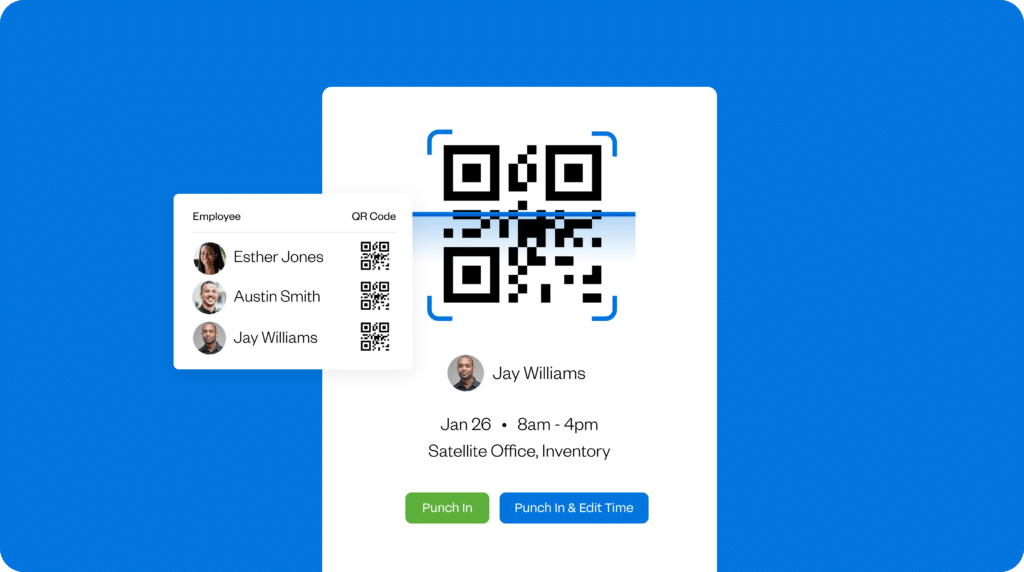
In a 2025 survey of 1,000 US workers, 3% said they have got colleagues to clock in or out for them, while 7% said they had claimed more hours than they actually worked. Buddy Punch is a good option for teams looking to prevent time theft.
I like how Buddy Punch gives managers multiple ways to check who, when, and where a member of staff clocked in or out. Here’s how it does that:
- Who: Start by giving each employee their own login, PIN, or QR code. If you need stronger proof, you can get them to take a photo at the time of clock-in. If you need more than one staff member to check in via the same device, like a kiosk, have them scan their own QR code as well as take a picture. You can also stop them from using an unapproved device — useful for offices or shops where staff should only clock in from a company computer on site.
- Where: Use GPS to record where staff log in from. Other options include geofencing, which lets them punch in only when they’re physically at an approved location, or IP Address Locks, which lets them clock in only through your workplace internet connection.
- When: Every clock-in and clock-out appears on the employee’s time card, so you can see exactly when they started and finished.
Manager control on Buddy Punch is impressive. You can set up alerts when someone misses a punch-in or when they clock in or out too early or too late. You can then open that individual’s time card, see what happened, and correct the time entry if needed.
If an employee claims they couldn’t punch in, open the Employee Error Log to see whether the problem was their location, device, internet connection, or allowed hours.
Pros
- The app gives you multiple ways to check who clocked in as well as their location and time.
- See why an employee was blocked from clocking in with the Employee Error Log.
Cons
- Staff using geofencing can’t clock in or out on a web browser.
- Only admins can set or change geofences and device locks, managers can’t.
Pricing
Buddy Punch’s plans start at $4.99/user per month plus a $19/month base fee that covers the cost of all admin users you add to the platform.
Learn more about Buddy Punch
- Start a free trial — no credit card required
- View pricing
- Watch a video demo
- Take an interactive product tour
- Request a personalized demo
2. Jibble – Best free employee check-in app

If you’re looking for a risk-free way to see if a digital check-in system works better for your team than a manual one, Jibble offers a free service. You don’t need a credit card to get started, and you can add as many users as you like.
Staff clock in and out using the mobile app, a web browser, a desktop app, or a shared kiosk. If you already use Slack or Microsoft Teams, they can punch in and out there too.
You can check each employee’s hours from one dashboard, split into daily, weekly, and monthly timesheets. If you need the figures elsewhere, like payroll, export the records in CSV or Excel format.
The amount of features you get is generous: automatic timesheets, payroll-ready reports, leave policies, and public holiday settings.
But there are limits that stop the free app from growing with your company. One kiosk runs on only one device at a time, there can be only one active work schedule and no more than two active geofences, and there’s no way to split staff into groups by location, department, or team. If you like the app and want those features, you’d have to switch to a paid plan.
Pros
- There’s no limit on the number of users on the Free plan.
- Get premium features like GPS, facial recognition, and timesheets at no cost.
Cons
- You’re limited to one kiosk per device, which may be a problem if staff need to clock in at different places.
- Free accounts are limited to one work schedule and two active geofences, and you can’t split staff into groups.
Pricing
Sign up and access all features for free before deciding whether to continue with the free account or upgrade. Jibble doesn’t publish its prices online. To get an instant quote, log into your account and go to Organization Settings, then Subscriptions.
3. ClockShark – Best for clocking in a whole crew from one phone

Crew members working at the same site don’t always carry their own smartphones. ClockShark gets around this problem by letting a supervisor clock in everyone on their team from a single handset.
First, the office admin picks the workers on a crew member’s team and gives the team leader access to the Crew Clock feature. When the crew arrives, the team leader opens the Off the Clock list and selects the workers who are there on site. Finally, they choose the job and task for each worker.
With everyone now clocked in, ClockShark moves them all across to the On The Clock list. This records exactly how long each worker has been clocked in, ideal for keeping track of the whole crew from one screen.
When it’s time for a break, the leader can select everyone or just the crew members stopping from the same phone. I also like how you can move part of the crew to another job or task while everyone else keeps working as normal.
At the end of the day, crew leaders clock workers out the same way. If they make a mistake — for example, they clocked someone out too early — a manager can correct the timesheet later. All of these changes are kept in the log, so there’s a record of what happened on site.
Pros
- Clock in multiple workers from one device, including staff who don’t have smartphones.
- Manage workers’ breaks, job changes, and clock-outs individually or as a team.
Cons
- If a leader logs in a crew member along with themselves, this can cause time record issues.
- When the crew leader is away, you need to grant someone else access to Crew Clock to log the team in and out.
Pricing
ClockShark charges $40 per month plus an additional $9 per month per user. Billing is monthly.
Learn more about ClockShark
- Read our in-depth ClockShark review
- Compare Buddy Punch vs. ClockShark
- Discover the best ClockShark alternatives
4. Homebase – Best for recording meal and rest breaks accurately

Many companies offer short paid breaks of up to 20 minutes, while longer meal breaks are usually unpaid. For payroll and good employee relations, you need to keep records of when people stop work, for how long, and whether they’re on paid or unpaid break.
I found Homebase the best at keeping this easy to manage. You can set your rules on:
- Whether breaks are paid or unpaid
- Whether they’re mandatory
- How long they last
- How often they happen
I like the reminders employees get on their app when it’s time to stop, together with a countdown clock showing how long they have before the break ends. To confirm they’re taking breaks, they can clock out and back in via Homebase, which records when it started and ended and whether it counts toward their regular paid working hours.
If someone misses a mandatory break, the app asks whether they took it or skipped it. They can also add a note explaining what happened, with Homebase storing their answer with a timestamp.
The manager can then check what happened while the shift is still fresh in everyone’s mind. Homebase can also warn managers about missed breaks and keeps a record of which ones were taken, missed, or skipped, making it easier to see if an employee is having the same problem again and again.
Pros
- The app reminds staff when to take and return from breaks, complete with a countdown clock.
- It warns managers about missed breaks and saves the reason the employee gave for missing it.
Cons
- On the Basic plan, timesheets are stored for only 90 days, which can be too short for some firms.
- If staff forget to log a break on Homebase, managers may have to manually work out when it started and ended.
Pricing
Homebase has a free Basic plan for one location and up to 10 employees. Paid plans start at $24 per location per month for unlimited employees with annual billing.
Learn more about Homebase
- Read our in-depth Homebase review
- Compare Buddy Punch vs. Homebase
- Discover the best Homebase alternatives
5. Hubstaff – Best for clocking in without an internet connection

A 2025 CostQuest analysis of FCC data found that mobile service covers only around 70% of US land, with 5G coverage particularly bad in Wyoming and Montana. This can make it difficult to get data back to the office for timesheets and payroll for companies that rely on mobile field teams.
I found Hubstaff effective in situations like these. Staff install the app on their phones and sign in when they can still connect. Hubstaff saves the projects and tasks that admin has already assigned to them on the phone, so they can stay signed in even after they lose signal.
When they clock in, they choose the project they’re working on and tap Play. If there’s no mobile signal, Hubstaff still starts the timer and records the time on their phone. When they finish, they tap Stop. There’s no limit to how long the app can track time offline, making it really useful on jobs like remote construction projects, where there may be no reception for days.
It’s impressive how Hubstaff also links hours to the right job while storing GPS details and work notes. As soon as the device is back online, Hubstaff automatically uploads all the details, so head office can see a full record immediately. Managers can then correct anything that’s wrong, sign off on timesheets, and pass the hours to payroll.
Pros
- Staff can clock in and out even when they’re offline.
- All stored data, including GPS details and work notes, uploads automatically when the device is back online.
Cons
- You can’t add new projects or tasks to crew members’ apps once they’ve lost signal.
- There’s no way to stop staff going over daily or weekly hour limits when there’s no internet service.
Pricing
Hubstaff charges from $4.99 per seat per month billed annually, with a two-seat minimum.
Learn more about Hubstaff
- Read our in-depth Hubstaff review
- Compare Buddy Punch vs. Hubstaff
- Discover the best Hubstaff alternatives
6. When I Work – Best for stopping early clock-ins

The average hourly private sector wage is $32.60. If you have 20 associates who clock in five minutes early across the year, that costs you about $14,000. Instead of setting a rule that’s hard to enforce, control it better with When I Work.
Start by getting admin or a manager to set the limit for how early staff can clock in on the Attendance Settings menu. You can make staff wait until their shift starts or let them clock in 5, 15, or 30 minutes early. If someone tries to punch in before then, When I Work tells them the earliest time they’re allowed to clock in.
Helpfully, the app does leave genuine room for exceptions. Say a delivery turns up early, and you need someone to start before their normal shift. A manager can clock that employee in early without changing the rule for everyone else. This would also be useful for retail service businesses where some customers can only come really early or really late.
Staff can log in via their phone or a computer. If you let them clock in early but then start to worry about time theft, use Time Tracker to compare scheduled shifts with actual clock-ins. You can see who’s pushing up your wage costs.
Pros
- Choose whether staff can clock in on time or 5, 15, or 30 minutes before their shift.
- If you allow early punches, find out who costs you the most in Time Tracker.
Cons
- You can make exceptions for individual workers, but can’t set different early clock-in limits for different teams.
- Clock-in time limits are fixed and can’t be customized.
Pricing
When I Work costs $2.50 per user per month for a single location or schedule and $5 per user per month for multiple locations or schedules, all billed monthly.
7. QuickBooks Time – Best for staff checking in to different jobs

Companies in sectors like electrical contracting or HVAC often have staff working across several customer sites on the same day. QuickBooks Time lets them choose the customer or job when they clock in, so their hours are logged against the right work straight away — important for billing and working out the profit on each job.
When your team member finishes up at one site, they don’t need to clock out and start again at the next one. Instead, they just tap Switch, choose the next customer or job they’re working on, and QuickBooks Time starts recording their hours there.
I like how admin chooses which customers or jobs each worker can see. That means staff don’t have to search through jobs they don’t work on. They can even mark jobs as Favorites, so if they visit the same customer every week, for example, they can find that job faster next time.
You can add extra details to their time record, like the task they worked on, mileage involved, or equipment used. If you don’t have the time to do this yourself, make these fields mandatory for staff to fill in before they clock out.
At the end of the day, you can send employee hours into QuickBooks, where you can compare what the job earned with what it cost.
Pros
- Switch between jobs with one tap instead of having to clock in and out repeatedly.
- Show staff only the jobs relevant to them.
Cons
- You need a QuickBooks Online account to use QuickBooks Time.
- Managers need to create a new timesheet every time a team member starts on a job for the first time.
Pricing
QuickBooks Time Premium costs $20 per month and an additional $10 per user per month, billed monthly. You also need to subscribe to QuickBooks Online, which costs a minimum $38 per month on the Simple Start tariff, billed monthly.
Learn more about QuickBooks Time
- Read our in-depth QuickBooks Time review
- Compare Buddy Punch vs. QuickBooks Time
- Discover the best QuickBooks Time alternatives
8. Jobber – Best for English- and Spanish-speaking crews

Nearly 45 million people in the US speak Spanish at home, and more than 18 million say they don’t speak English very well. Companies with both English- and Spanish-speaking crew members need to be able to use the same app without language getting in the way. Jobber is good for this.
When you add a new worker, send their Jobber invite in either English or Spanish. If their phone is set to Spanish, the app opens in Spanish automatically, so they can get started without changing the language settings.
The app works for Spanish speakers in exactly the same way as it does for English speakers. They tap Clock In when they start work and Clock Out when they finish. Team members get schedule alerts, help messages, and error messages in Spanish too.
I like how Jobber brings all those time records back together in one place. Each employee’s hours end up in the Timesheets area of the app, so staff can record their own time on their phones, while admin can check everyone’s hours there too.
Pros
- Spanish-speaking staff get the same mobile app features, including clocking in and out.
- Everyone’s hours appear together in Timesheets, whichever language they use.
Cons
- Spanish is only available for non-admin staff using the mobile app, not admins and web users.
- Jobber doesn’t translate any text like notes or custom fields into Spanish.
Pricing
You need Jobber’s Connect plan to use the time-tracking features in this review. Connect costs $149 per month billed annually. Spanish isn’t limited to this plan, but Core doesn’t include time tracking. So if Spanish-speaking staff need to clock in and out and use Timesheets, you need Connect or a higher plan.
Feature comparison
| Platform | Computer/browser clock-in | Mobile punch photos/selfies | Schedule-linked clock controls/reminders | GPS/location controls |
|---|---|---|---|---|
| Buddy Punch | ✅ | ✅ | ✅ | ✅ |
| Jibble | ✅ | ✅ | ✅ | ✅ |
| ClockShark | ✅ | ❌ | ✅ | ✅ |
| Homebase | ✅ | ✅ | ✅ | ✅ |
| Hubstaff | ✅ | ❌ | ✅ | ✅ |
| When I Work | ✅ | ❌ | ✅ | ✅ |
| QuickBooks Time | ✅ | ❌ | ✅ | ✅ |
| Jobber | ❌ | ❌ | ❌ | ✅ |
How I chose the tools on this list
I reviewed some standalone apps and others that are part of a wider business management system (like HR platforms). The ones I finally chose made it easier for staff to record when they start and finish work and gave managers the information they need to check records and fix any problems.
I shortlisted these eight apps because they stood out on most or all of the following:
- Let employees clock in and out in ways that suit different types of work
- Help managers check who clocked in, when they did it, and where they were
- Deal with common problems like missed punches, late arrivals, forgotten clock-outs, and wrong time entries
- Give managers more control without making clocking in difficult for staff
- Work for different teams, including office staff, field workers, crews, and people using shared devices
Usability was key, too. A company I ran employed over 60 people, so I know the challenge of rolling out new apps to multiple teams. Forcing hard-to-use software onto staff is a waste of time and money, so I made sure the apps featured here are easy for both staff and managers to use.

