
The 11 Best Geofence Time Tracking Apps in 2026

Written By: Nick Murphy
Last Updated July 15, 2026
A geofence is a virtual barrier placed around a specific job site. Using geofences paired with the GPS technology built into mobile phones, employers can prevent employees from clocking in and out offsite, remind them to clock in and out when entering or exiting a geofence, or automatically switch the job code that their time is being billed to when arriving at or leaving a job site.
However, not all geofence time tracking apps do all of those things. Some are great for preventing (and identifying) time theft, some are great for reminding employees to switch job codes or clock out, and some are ideal for automated job costing.
To help you find the right fit for your team, we’ve put together this list of the 11 best geofence time tracking apps. Below, you’ll find our detailed reviews that cover which use cases each app is best for, what unique features they offer, and how they compare on price.
| Platform | Summary | G2 Rating | Free Trial | Starting Price for Geofencing |
|---|---|---|---|---|
| Buddy Punch | Best for preventing offsite punching, Buddy Punch is an affordable option that lets you use geofences to block offsite punches by all employees or only the ones you select. | 4.8/5 | 14 days | $6.99/user/month |
| QuickBooks Time | Best for reminding employees to switch job codes, QuickBooks Time sends employees alerts on their phones when entering and exiting geofences. | 4.5/5 | 30 days | $10/user/month |
| Workyard | Best for automatic job costing, Workyard combines real-time GPS tracking with geofences to automatically tie the hours spent on job sites to the respective projects. | 4.8/5 | 14 days | Contact for pricing |
| Hellotracks | Best for keeping track of deliveries and delays, Hellotracks offers time tracking, route optimization, and check-in/out notifications to keep office employees updated. | 5/5 | 30 days | $10/user/month |
| Timeero | Best for electronic visit verification, Timeero’s Sandata integration lets home healthcare teams document necessary details like locations, times, and types of care provided. | 4.8/5 | 14 days | $7.50/user/month for geofencing; $10/user/month for EVV |
1. Buddy Punch – Best for preventing offsite punching
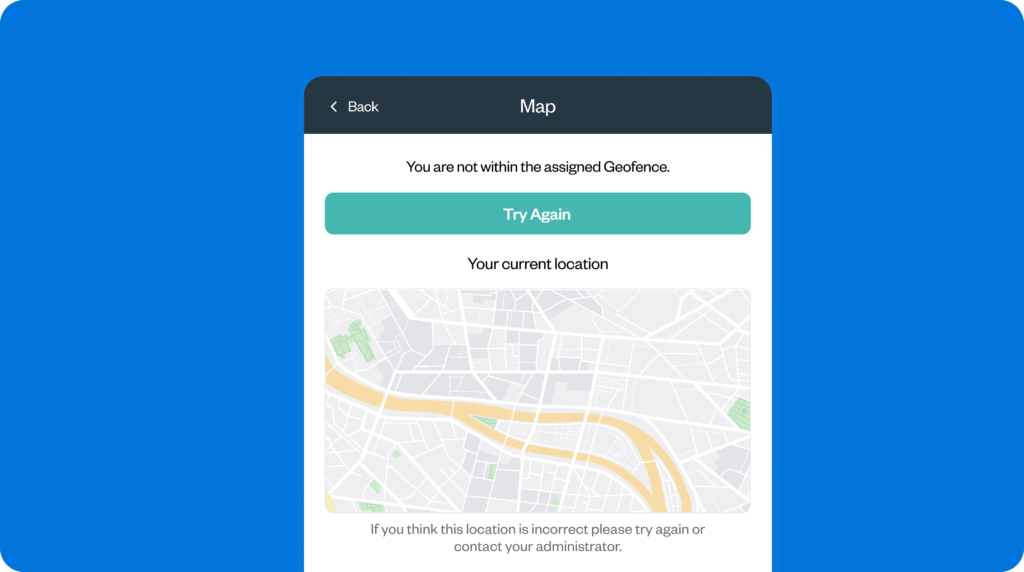
Buddy Punch is a time tracking app that’s designed for hourly employees who work at multiple locations, such as job sites (construction), client homes/businesses (field services), workstations (manufacturing and agriculture), or businesses (healthcare and retail). It’s easy to use and affordable, offers a geofencing feature that prevents offsite punches, and comes with several other time theft prevention features.
Buddy Punch’s geofencing feature lets you create geofences around all of the locations where employees work; there is no limit to the number of geofences you can create. Additionally, geofences in Buddy Punch are highly customizable. You can:
- Create a single geofence and assign all employees to it.
- Create multiple geofences and assign different employees to different geofences.
- Make clocking in and out within the geofence required for all employees.
- Make clocking in and out within the geofence required for only specific employees.
If you make geofencing required, employees can only clock in and out when they’re within the geofence’s boundaries. All offsite punching attempts are recorded in the platform’s error report.
Geofences in Buddy Punch can also simplify job costing. When an employee clocks in while inside of a geofence that’s been assigned a specific job code, the platform will automatically log the employee’s time to the connected project.
Beyond geofencing, Buddy Punch also has a number of other features for preventing time theft and reducing labor costs. You can turn on real-time GPS tracking to see everywhere employees traveled over the course of a workday, enable photos on punch to require employees to take a selfie when clocking in and out, or turn an iPad into an on-site kiosk to validate employees’ identities with FaceID.
Employees clock in and out using their mobile phones, and Buddy Punch automatically transforms that data into timesheets with regular hours, overtime hours, and pay all calculated for you. And when it’s time to run payroll, you can download reports formatted perfectly for your provider, integrate directly with nearly 20 payroll systems, or use Buddy Punch’s built-in payroll to consolidate everything into a single system.
Pricing
Free trial available. View Buddy Punch’s current pricing.
Learn more about Buddy Punch
- Start a free trial — no credit card required
- Watch a video demo
- Take an interactive product tour
- Request a personalized demo
2. QuickBooks Time – Best for reminding employees to switch job codes

QuickBooks Time is a good option for employees who work at multiple job sites over the course of a single day. Its geofencing feature doesn’t block offsite punches like Buddy Punch’s, but it will send employees a notification on their phones when they enter and exit geofences to remind them to switch job codes.
If employees don’t notice the alert, you’ll at least have records showing when they left and arrived at job sites. Missed and dismissed alerts show up in QuickBooks Time’s notifications list, so you and the employee can review their notifications to determine what times to adjust when editing timesheets.
It is worth noting that reminders won’t be sent until after an employee is already clocked in, so they’ll still have to remember to clock in when they arrive at work for the day. Once they’ve clocked in, QuickBooks Time uses real-time GPS tracking to identify when they enter and leave geofences.
To create a geofence in QuickBooks Time, you can enter an address that’s recognized by Google Maps, or for job sites where an address isn’t available, you can use latitude and longitude values. If you have lots of job sites and technical resources, you can also use QuickBooks Time’s API to add geofences in bulk.
Beyond geofencing, QuickBooks Time also offers real-time GPS tracking and mileage tracking. Mileage tracking can be useful if employees drive their own vehicles for work and you need to reimburse them for mileage. It calculates mileage automatically so you will never have to check another odometer again.
One important thing to note about QuickBooks Time is that you can only subscribe to it if you’re a QuickBooks Online customer; you can’t subscribe to QuickBooks Time without first subscribing to QuickBooks Online. So if you’re not already a QuickBooks Online subscriber, QuickBooks Time may not be the right option for your business.
Pricing
Free trial available. View QuickBooks Time’s current pricing.
Learn more about QuickBooks Time
- Read our in-depth QuickBooks Time review
- Compare Buddy Punch vs. QuickBooks Time
- Discover the best QuickBooks Time alternatives
3. Workyard – Best for automatic job costing

Workyard combines real-time GPS tracking with geofencing to fully automate your process of job costing. Employees clock in once at the beginning of the day and once at the end of the day. Everything that happens in between those two punches is logged in Workyard and used to automatically allocate work hours to projects.
Workyard’s real-time GPS tracking tracks employees’ travels throughout the workday, and geofences designate job sites and are attached to specific job codes. Any miles employees travel are automatically logged, and when they enter and exit geofences, the system automatically switches job codes for them.
This makes your job costing incredibly accurate. Workyard captures the exact time employees arrive at and leave sites, so you don’t have to wait for them to notice an alert on their phones or remember on their own to switch projects.
One big highlight of Workyard is that geofences can be created retroactively. If you forget to create a geofence around a job site before employees start working there, you can create it when you do remember, and the system will review previous time cards and employee location data to retroactively assign those hours to the right projects.
Another nice thing about Workyard is that you have more flexibility when creating geofences. While most other tools only let you create geofence boundaries as circles, in Workyard, you can draw custom boundaries directly on a map to match the exact dimensions of job sites. However, you can also simply enter an address to build geofences quickly.
Pricing
Free trial available. Contact Workyard for pricing.
4. Hellotracks – Best for keeping track of deliveries and delays

Hellotracks is a time tracking and dispatching app designed for transportation and logistics companies. Unlike the other apps on this list that are more focused on time theft prevention and accurate job costing, the core of Hellotracks is planning delivery or travel routes and staying updated in the office with what’s happening with your team while they’re on the road.
The first thing you do when setting up Hellotracks is add your customers’ locations. You can create them as geofences. Like Workyard, geofence shapes in Hellotracks are very customizable. Create geofences in any shape you’d like — circles, squares, triangles, and even polygons — so you can be specific about which exact areas employees should be checking in and out of.
Next, you add those customer drop-off points to employees’ daily schedules. Once you’re finished, you can use Hellotracks’ route optimization feature to automatically determine the most efficient routes for employees to take. Route optimization organizes your delivery sequence to reduce mileage and redundancy. Employees can use the app on their phones to get directions while they’re driving.
In the office, Hellotracks’ same-second GPS tracking lets you see where all employees are located at any time, watch their movements, and replay their routes. You’ll get notifications when employees arrive at a customer’s site and when they leave it, so you’ll know if people are running earlier or later than you planned. You can also get a notification if they exit a defined delivery route area.
As far as time tracking, Hellotracks isn’t as robust as some of the other tools on this list. Employees can clock in and out using the mobile app when they start and stop working for the day, and that data is transformed into timesheets. However, there’s no built-in payroll and no payroll integrations, so you’ll have to download your timesheet data in XLSX format and upload it to your payroll provider to use it.
Pricing
Free trial available. View Hellotracks’ current pricing.
5. Timeero – Best for electronic visit verification

Timeero does a lot of the things we’ve covered in other apps on this list. You can create geofences that prevent offsite punches, remind employees to clock in and out when entering/exiting geofences, or automatically switch the job code an employee is billing time to when they enter or exit a geofence. Mileage tracking and real-time GPS tracking are included in all of Timeero’s plans.
And while you can do a lot with Timeero, it’s a more expensive app than the others on this list for the same features. The price is worth it for home healthcare teams, however, because of Timeero’s electronic visit verification (EVV) module. EVV works by integrating with Sandata to document patient visit times, employee locations, and care types provided. The app can also be configured to be HIPAA compliant.
Another unique feature of Timeero is its offline mode, which could be worthwhile if your employees commonly work in areas where there’s no cell phone signal. Offline mode saves the data on their phones and uploads it to the app when they have a signal again, and you can allow employees to override geofence clock-in rules when they don’t have a signal. They can leave a note explaining the override.
Timeero does have a low-cost, $4/user per month plan, but it’s only available for up to 10 employees, and it doesn’t include the platform’s geofencing feature. Its automatic time tracking module, called Segmented Tracking in Timeero, isn’t included on any of its plans. Instead, you have to purchase an add-on, which costs an additional $5/user per month on top of your selected plan’s base fee.
Pricing
Free trial available. View Timeero’s current pricing.
Learn more about Timeero
- Read our in-depth Timeero review
Other geofence time tracking tools to consider
While the list above covers what we feel are the best options for the five specific use cases we listed, they might not be exactly right for your team. Here are some other options to consider, including what you can do with geofences in the platform and why they didn’t make our main list:
6. Hubstaff is primarily an employee computer activity monitoring tool. It does offer geofences as part of its Locations add-on — and those geofences can remind employees to switch job codes or automatically switch job codes for them — but it’s pricier than all of the other apps on this list at $13.33/seat per month.
7. Connecteam lets you create geofences that prevent offsite punches and automatically clock employees out when leaving a geofence, but to be able to create unlimited geofences like the other apps on this list, you have to subscribe to the $99/month Expert plan, which makes it much pricier than some of the other apps on this list for smaller businesses with few employees.
8. Homebase lets you create geofences that prevent offsite punches, but its location-based pricing makes it untenable for businesses like construction, field services, transportation, and home healthcare teams with employees working across dozens of locations. For the types of teams that need geofencing, user-based pricing is generally much more affordable.
9. Jibble bills itself as a free geofence time tracking app. However, the product’s website isn’t transparent about its pricing. To get access to specific features, you have to upgrade to paid plans, and while there used to be a page on the site that showed what features you get on the free plan versus its paid plans (and the cost), Jibble has removed that page from its site.
10. Arcoro Time (formerly ExakTime) is a construction-focused time tracking platform that has a geofencing feature that prevents offsite punches, but it requires a one-year contract to use it (there are no monthly plans), and it’s priced much higher than other options with the same core features.
11. ClockShark, like Arcoro Time, is a construction-focused time tracking platform. Its geofencing feature can be used to remind employees to clock in and out when entering and exiting geofences, but to use the platform, you have to sign a three-year contract. Most other geofence time tracking tools only require a monthly commitment.
Other things to consider when adopting geofence time tracking
Choosing a geofence time tracking app is just the first step in the process. Once you’ve found the right app for you, you’ll need to roll it out to your team. Here are a few things to keep in mind as you get your new time tracking app set up and introduce it to your employees.
Legal and compliance considerations
Some states have specific regulations around GPS tracking, so before you begin this type of tracking, review the GPS tracking laws in the locations where your business operates, or speak to an employment attorney.
Generally speaking, businesses can track employees’ locations during their working hours and when using company-owned (not personal) vehicles. Choosing an app that only tracks employees’ locations while they’re clocked in can ensure you’re compliant.
Additionally, before you begin tracking employees’ locations, you should write a GPS tracking policy describing how employees will be monitored and how this data will be used. It’s always best to get employees’ consent whether your state requires you to do so or not.
Employee privacy considerations
Time tracking apps contain a lot of sensitive, personal information. Employees’ names, pay rates, addresses, and locations may all be stored in the app, so you’ll want to talk to any provider you’re considering to find out how they keep your employee data secure. Ideally, you’ll only input data that is absolutely necessary.
You’ll also want to look for apps that have detailed permission sets to control who has access to private employee data. Enforcing two-factor authentication or other preventative measures for users with access to sensitive data can also be helpful to minimize the chance of a data breach.
Implementation tips
You may be worried that employees will be opposed to you tracking their locations, but this is rarer than you might expect. A QuickBooks Time study found that 70% of employees are fine with their employers knowing their locations, and only 6% said they would quit if they were asked to be tracked.
Interestingly, the thing that employees in the study were most concerned about was the app draining their phone batteries or using all of their data. To prepare for these questions, talk to your app provider to get more information you can share with your team to quell their concerns.
The best way to avoid employee pushback when implementing GPS tracking is to be very transparent with your employees about the fact that they’re being tracked, when they’ll be tracked, why, and who will have access to their location data. That’s why creating and distributing a GPS tracking policy is crucial.
Finally, when it’s time to roll your new system out, hold a meeting where employees can ask questions and share any concerns they have so they don’t feel like they’re being forced to do something they’re uncomfortable with.

