

The 7 Best Time Clock Software for Small Businesses in 2026

Written By: Eric Czerwonka
Last Updated August 5, 2026
If your team still relies on handwritten timesheets and spreadsheets for time tracking, you’re probably losing more time and money than you think. Employees write down that they arrived on time even when they were late, bookkeepers spend hours doing manual calculations at the end of each pay period, and mistakes work their way into payroll, creating rework and degrading morale.
Employee time clock software gives you an accurate, transparent record of hours worked. It automates payroll calculations, lets you track project costs accurately, and gives you lots of features that ensure employees are actually working when they say they are.
In this post, we’re taking a look at the seven best time clock software for small businesses. Below, you’ll find our detailed reviews, explaining which types of businesses and teams each tool is best for, what unique features they offer, and how all of the tools compare on price.
| Platform | Summary | G2 Rating | Free Trial | Starting Price |
|---|---|---|---|---|
| Buddy Punch | Best for deskless teams and businesses with multiple locations, Buddy Punch makes it easy to keep track of your team’s time even when you’re not all working in the same place. | 4.8/5 | 14 days | $4.99/user/month |
| Time Doctor | Best for preventing time theft by knowledge workers, Time Doctor tracks time, monitors employee computer activities, and integrates with popular project management and support tools. | 4.4/5 | 14 days | $6.67/user/month |
| Hubstaff | Best for companies with field- and computer-based employees, Hubstaff offers multiple features for preventing time theft no matter where or how your employees do their work. | 4.4/5 | 14 days | $4.99/seat/month |
| Connecteam | Best for teams with limited budgets, Connecteam’s free plan is a generous option that gives you time tracking, scheduling, messaging, and HR features at no cost for up to 10 users. | 4.6/5 | 14 days | Free for up to 10 users; paid plans start at $29/hub/month |
| Kimai | Best for companies that want to self-host, Kimai is an open-source platform with multiple plugins for extending its functionality and a robust read and write JSON API. | 4.8/5 | 30 days (cloud-hosted version) | Free for self-hosting; from €2.99/user/month for cloud-hosted plans |
| 7shifts | Best for restaurants, 7shifts is a basic time clock that connects with your POS to help you save money on labor costs, enforce breaks, and prevent clopenings when creating schedules. | 4.5/5 | 14 days | $39.99/location/month (there is a free plan, but it doesn’t include time tracking) |
| ClickTime | Best for professional services companies, ClickTime makes it easy to ensure every minute of billable work is accounted for without forcing you to monitor employees’ computer activities. | 4.6/5 | Not offered | $12/user/month |
1. Buddy Punch – Best for deskless teams and businesses with multiple locations

Buddy Punch is an affordable option that combines time and attendance tracking, employee scheduling, PTO management, and payroll into one easy-to-use platform. Employees can clock in and out on the web when working at computers, on a tablet turned into a time clock kiosk, or on their mobile phones when they’re working in the field. You can even have a supervisor clock everyone in and out at the same time.
The big advantage of Buddy Punch is for companies where employees work across multiple locations (construction, healthcare, franchises, manufacturing, transportation, etc.). The platform comes with features that help you ensure employees are where they’re supposed to be when they’re supposed to be there, letting you easily keep track of your team even when you’re not on site working with them.
GPS on punch logs employees’ locations to their timesheets when they clock in and out. Real-time GPS tracking records their movements across the entire workday. Geofences block offsite punches so employees can only clock in and out when they’re at the right location, and photos on punch requires employees to take a selfie when clocking in to prevent time theft tactics like buddy punching.
Alerts let you get real-time notifications when there are issues in the field. You can get an email or in-app notification when employees clock in late, clock out early, or miss a shift entirely. You can also set up notifications when employees are nearing overtime so you can shift schedules around to avoid paying high overtime costs. Plus, reports will alert you to issues like offsite punching attempts.
All clock in and out data is compiled into timesheets in the system with regular hours, overtime hours, and pay calculated for you automatically. When it’s time to run payroll, you can download reports that are pre-formatted for your payroll provider, integrate with one of nearly 20 payroll systems to send your timesheet data to payroll instantly, or use Buddy Punch’s built-in payroll service to pay employees.
Beyond time tracking, Buddy Punch can also be used to create employee schedules, collect employee availability, and inform employees what roles they’ll be working in and what locations they’ll be working at. There’s also a PTO management feature that lets you add lump sums or set up automatic accruals, block time off requests for specific dates, and set rules for PTO expiration or carryovers.
Pricing
Free trial available. View Buddy Punch’s current pricing.
Learn more about Buddy Punch
- Start a free trial — no credit card required
- Watch a video demo
- Take an interactive product tour
- Request a personalized demo
2. Time Doctor – Best for preventing time theft by knowledge workers

Time Doctor is a time tracking and employee monitoring app that’s designed for companies with hourly employees who do most or all of their work on computers. In addition to letting you track the hours employees work and compile that data into timesheets and reports for payroll, you can also see exactly what employees are doing with their time while they’re on the clock.
Time Doctor has features like app and URL monitoring that let you see what websites and applications employees are spending their time on, automatic screenshots so you can see what they were doing on those websites, and idle detection so you can see when they’re logged in but not actually working.
Additionally, it has the ability to do this monitoring silently, meaning employees won’t know you’re monitoring their activities. This makes it a great choice if you believe time theft is a problem and you don’t want people looking for ways to work around your monitoring system. However, Time Doctor also has features built in to prevent common workarounds like mouse jiggling and automated inputs.
Time Doctor’s built-in AI and reports keep you from having to monitor every employee individually. These tools provide you with overarching insights for your team, making it easy to identify employees whose performance has declined and may be burned out. You can also view benchmarks to see how your team’s productivity compares to other companies like yours.
When it comes to integrations, Time Doctor doesn’t offer much in the way of connecting to your payroll system; it only integrates with ADP, Gusto, Payoneer, PayPal Payouts, Deel, Wise, and Xero AU Payroll. However, it does integrate with multiple project management systems like Asana, Basecamp, and ClickUp, making it easy for you to add projects and tasks to the system for employees to bill their time to.
Time Doctor can also be a good choice for call center and IT/customer support teams that want to track time and monitor computer activity. It integrates with several popular support tools like Zendesk, Freshdesk, Freshservice, Intercom, Help Scout, Spiceworks, and Zoho Desk.
Pricing
Free trial available. View Time Doctor’s current pricing.
3. Hubstaff – Best for companies with both computer- and field-based employees
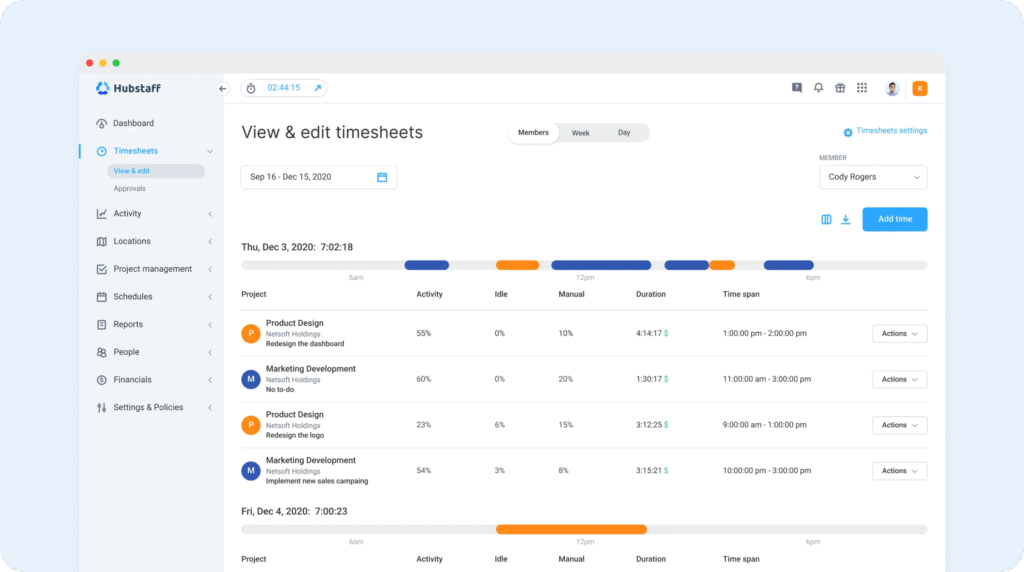
Hubstaff stands out because it helps you prevent all types of time theft. It has features similar to Buddy Punch for preventing time theft by field employees, as well as features similar to Time Doctor for preventing time theft by employees who do their work on computers. This makes it a good option for hybrid teams that want to prevent time theft by employees doing lots of different types of work.
For field employees, you can get real-time GPS tracking and geofencing features if you’re subscribed to the Team plan ($10/seat per month) and add the Locations add-on ($3.33/seat per month). Real-time GPS tracking shows you where all employees are located at any time on a map and provides you with breadcrumb trails of their travels, while geofences can automatically clock them in and out of projects.
All Hubstaff plans include employee computer monitoring (though there are limits on lower-cost plans). You can see which apps employees are using and what URLs they’re visiting while on the clock, and you can grab images of their screens at regular intervals. There’s also idle detection, and you can set the system up to automatically clock employees in and out based on computer usage.
Another highlight of Hubstaff is that the platform offers HIPAA compliance on its Enterprise tier ($25/seat per month), which makes it a good option for healthcare teams. Other security features like role and access permissions, single sign-on, two-factor authentication, and audit logs make it a good fit for small businesses working in regulated industries. The platform is also SOC 2 Type II certified.
When it comes to running payroll, Hubstaff doesn’t have as many integrations as some of the other tools on this list, connecting only with Payoneer, Deel, and Gusto. For the most part, the system is more suited for companies paying contractors than it is for traditional payroll for full-time employees. However, you can download timesheet reports and reformat them to get your time data into your payroll software.
Hubstaff does offer a number of integrations with project management systems, though, if you want to pull in projects and tasks from those systems to track time toward them. Its project management integrations include Asana, Breeze, ClickUp, Jira, Monday, Trello, and Zoho Projects. It also integrates with help desk tools like Time Doctor does, but only Zendesk and Freshdesk.
Pricing
Free trial available. View Hubstaff’s current pricing.
Learn more about Hubstaff
- Read our in-depth Hubstaff review
- Compare Buddy Punch vs. Hubstaff
- Discover the best Hubstaff alternatives
4. Connecteam – Best free option for very small businesses
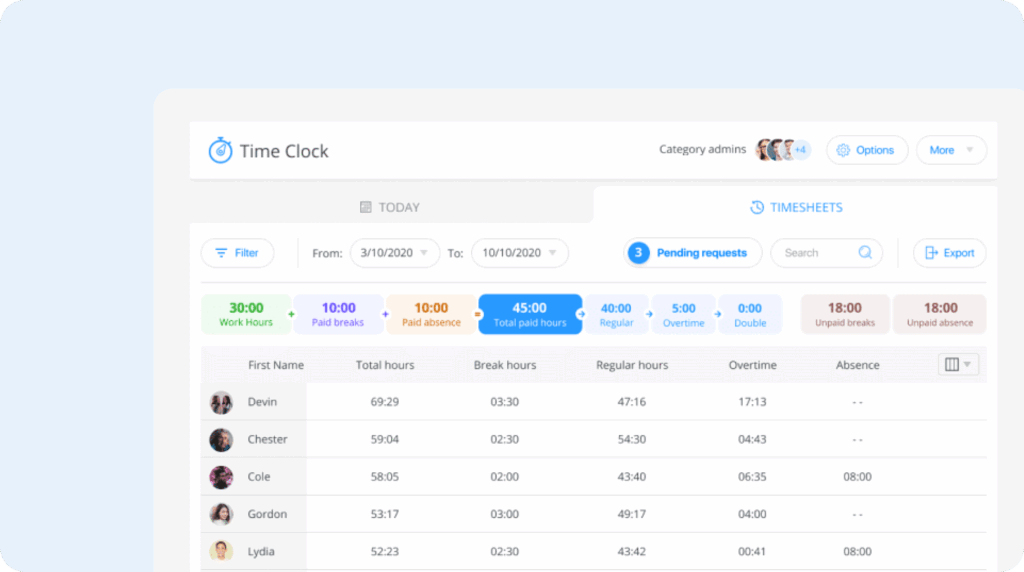
If you haven’t yet switched away from time tracking with paper timesheets and punch cards because you can’t afford the cost of a digital app, Connecteam might be the right choice for your business. Its free plan is one of the most generous free options on the market, giving you access to features from all of its hubs (Operations, Communications, and HR) for up to 10 users.
As far as time and attendance tracking, employees can clock in and out using Connecteam’s web or mobile apps. It creates timesheets for you automatically, and you can set up timesheet approval workflows. On the free plan, you can track time for one location, add unlimited project/job codes, track employees’ locations on clock in/out, and integrate with one of four payroll providers.
Scheduling for one location is also included in the free plan. Employees can view and claim open shifts that you’re having a hard time filling, and you can add tasks to shifts so employees know what they need to do on specific days (though note that you can only add one task per shift on the free plan). For features like auto-scheduling and having employees confirm or decline their shifts, you’ll need to upgrade to paid.
The free plan also gets you access to a number of HR features. Track paid time off, create training courses for your team, and build an employee directory, org chart, and internal knowledge base. You can also use Connecteam as a team messaging app to send company, team, and one-on-one messages, and you can create and send surveys to employees for them to complete to collect feedback from your team.
Overall, Connecteam’s free plan is generous, but it’s best if you’re not really planning to have more than 10 total team members at any time in the near future. Once you grow out of the free plan, Connecteam’s pricing becomes very complex, with features that you had access to in the free plan spread across three different hubs that each have four separate plans (12 options total).
Pricing
Free plan and trial available. View Connecteam’s current pricing.
Learn more about Connecteam
- Read our in-depth Connecteam review
- Compare Buddy Punch vs. Connecteam
- Discover the best Connecteam alternatives
5. Kimai – Best for companies that want to self-host

One way to avoid the subscription cost of paying for time tracking software without sacrificing access to features or running into user limits is to use an open-source option that allows for self-hosting. It requires a lot of technical know-how to set up, but if you have dedicated IT staff to assist with that, Kimai is a good choice.
Kimai is open-source time clock software that can be either self-hosted or cloud-hosted. If you self-host the platform, you can use it for free with no limitations. If you want Kimai to host your instance, you’ll have to pay a monthly per-user fee.
Kimai is designed for knowledge workers and has features for time tracking, project tracking, invoicing, and expense tracking. You can create private client portals — which can be shared via unique URL or password-protected — to share project progress with individual clients. It’s also fully translatable into 30+ languages out of the box.
You can extend the functionality of the platform using plugins — some of which are free and some have a flat-rate cost. And since it’s open source, you can also build anything else you need into the platform. Kimai has an extensive JSON API for reading and writing data, so external apps and custom tools can communicate with Kimai. This makes it infinitely customizable.
Kimai does not offer any pre-built integrations with other payroll providers and does not offer payroll itself. However, you are able to download reports for payroll in CSV and Excel formats, and you can also use its JSON API to build your own integration with your payroll provider.
Pricing
Free trial available for cloud-hosting. View Kimai’s current pricing for its cloud-hosted product. The self-hosted product is completely free.
6. 7shifts – Best for restaurants
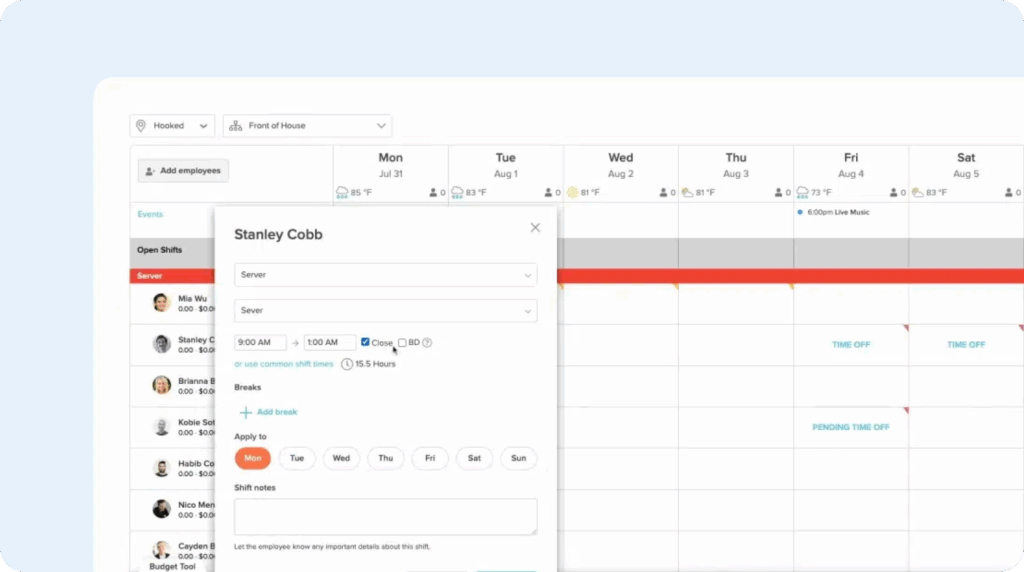
7shifts is built specifically for restaurants. It has pre-built integrations with 36 different point-of-sale (POS) systems, which allows you to aggregate your labor hours and sales data and use that information to create more effective employee schedules. Additionally, it has several features designed to solve restaurant-specific problems like tip distribution and clopening prevention.
When you connect 7shifts with your POS, your employees use the POS to clock in and out of work, and that data is sent to 7shifts where you can access your timesheets. Its time tracking features are much more limited than those of most of the other apps on this list, but basic features are all restaurants usually need. You can use it to track time and breaks, and timesheets can be edited to correct errors.
Where 7shifts really stands out is with its scheduling features. Because of the POS integration, 7shifts has access to your historical sales data, and it can use that information to provide recommendations for how many people in each role you need to have on staff for different days and times of day. It will also warn you about issues in schedules you built, flagging things like clopenings that could cost you money.
Employees can view their schedules at any time in 7shifts’ mobile app, which they can also use to clock in and out if you don’t want them to use your POS or haven’t connected your POS. The app will also send alerts to employees to remind them about upcoming shifts, let them know when it’s time for them to take a required break, or inform them about changes to a previously published schedule.
Finally, 7shifts also has a built-in tip management system. You can require employees to declare their tips when they clock out so you can include that information in payroll and IRS submissions. If you pool tips, 7shifts can automatically distribute credit card tips to employees based on the rules you set. Employees can also view the amount of tips they earned in the system at any time.
When it comes to payroll, 7shifts offers its own built-in payroll service if you want to consolidate time tracking and payroll into one tool. Or if you already have an existing payroll provider, 7shifts offers integrations with 15 different payroll providers like ADP, Paycom, Heartland Payroll, and Paylocity.
Pricing
Free plan (for scheduling only) and trial available. View 7shifts’ current pricing.
7. ClickTime – Best for professional services businesses

While Time Doctor and Hubstaff are great choices for companies that are concerned about time theft, they’re often a poor fit for professional services teams where the goal is tracking the time spent on projects and tasks accurately — not monitoring what employees are doing while they work. After all, computer monitoring often makes employees feel micromanaged and distrusted (as we discovered in our research).
If you want the ability to track project time without monitoring employees’ computer activities, ClickTime is a good choice. It’s a project time tracking and resource planning platform designed for professional services businesses and agencies. In addition to tracking employee time overall and against specific clients’ tasks and projects, you can also improve your forecasting and make sure projects stay on budget.
ClickTime uses AI to log everything employees do while they’re working, but not so leadership can review those activities. Instead, employees use the data to make sure that every minute they spend on client projects is accounted for. The system captures exactly what they were working on — which meetings they were in, what apps they were using, etc. — so they can allocate their time to projects accurately.
Employees can also log their time to billable and non-billable tasks. Admins and managers can review that data to optimize productivity by reducing or eliminating the types of work you can’t bill clients for, such as unnecessary internal meetings.
ClickTime also takes all of your historical data and pairs it with your future plans to help you understand how many employee hours new projects will take to complete, how the hours you’ve worked compare to the hours you estimated you’d need, and how much work each member of your team is assigned. The data is displayed in detailed burndown reports that help you catch issues before they eat into your profits.
Since ClickTime is designed more for salaried workers than hourly ones, its payroll integrations are minimal; it only integrates with ADP and Rippling. However, it does integrate with the tools your team uses to do their work, such as Asana, Slack, GitHub, Zoom, Salesforce, and more so that ClickTime can pull activities in from those systems for employees to categorize into time entries.
Pricing
No free trial offered. View ClickTime’s current pricing.
How to choose the best employee time clock for your small business
The first thing you’ll want to do when shopping for time clock software is put together a shortlist. Hopefully, the list of options above helped with that. Just start by writing down the names of any options you find interesting. You’ll narrow down the list in the next steps.
Next, you’ll want to compile a list of features you’d like to have. At this stage, just write down anything you think would be helpful. When you’re finished, decide which features on your list are must-haves, and which are nice-to-haves:
- Must-haves are table stakes, business-critical features that you can’t operate without.
- Nice-to-haves are things that you’d like but don’t absolutely need to operate effectively.
With this list of must-haves and nice-to-haves compiled, you can start narrowing down the options on your shortlist. Look at the features of each tool, and remove any that don’t include your must-haves.
Next is pricing and budget. Determine which of the tools on your list are priced within your budget. Remove any that cost more than what you can afford to spend.
A note on pricing: Make sure to spend extra time validating that the features you need are available at the price you can afford. Pricing for software tends to be incredibly vague, with many apps putting their most desirable features in higher-cost plans. Spend extra time at this stage looking closely at the plan comparison charts on each tool’s pricing page to see how much you’ll pay for the features you need.
After that, you can start to consider your nice-to-have features. Narrow your list down to three or so tools that offer the highest number of features you want at the most reasonable price.
From there, start a free trial and test the apps. You’ll want to make sure that the features work the way you expect them to and that everything you need is available. You might also want to try reaching out to the provider’s support team to make sure they’re responsive when you run into issues and need help.
Following this process, you should be able to find the perfect time clock software for your team.

