
The 8 Best Construction Payroll Software in 2026

Written By: Mark Fairlie
Last Updated August 28, 2026
In other industries, employees often work at the same location, keep regular hours, and earn the same rate consistently. Construction is more complex. You have employees working across multiple sites. Their pay may vary if you’re taking on prevailing wage jobs or have employees working non-traditional hours. And you need to track labor hours not only for payroll but also for job costing.
Construction payroll software makes juggling all of these complexities much simpler, saving you time and reducing the likelihood of payroll errors. To help you find the right fit for your team, I’ve put together this list of the eight best construction payroll software. Below, you’ll find my detailed reviews covering what each tool is best for, what unique features each option offers, and how they all compare on price.
| Platform | Summary | G2 Rating | Base Fee | Starting Price |
|---|---|---|---|---|
| Buddy Punch | Best for connecting payroll to scheduling and timekeeping, Buddy Punch gives advanced time tracking tools that ensure your payroll is accurate. | 4.8/5 | $68/month | $12.99/user/month for payroll and time tracking |
| Miter | Best for companies that work on a lot of public works projects, Miter includes features for prevailing wages, certified payroll reports, and union reports. | Not rated | Contact for pricing | Contact for pricing |
| Payroll4Construction | Best for companies that want to outsource payroll, Payroll4Construction handles calculations, taxes, and payments for you and provides detailed reports. | Not rated | Contact for pricing | Contact for pricing |
| JOBPOWER | Best for companies that need accounting and payroll software, JOBPOWER lets you manage all of your project costs and payments in a single, central system. | 3.5/5 | Contact for pricing | Contact for pricing |
| Justworks | Best for rapidly growing construction companies, Justworks lets you offer competitive benefits, outsource payroll and HR tasks, and track hours. | 4.6/5 | $50/month | $8/employee/month for payroll only; $16/employee/month for payroll and advanced time tracking |
| Everee | Best for payroll during tight cash flow cycles, Everee lets you apply for temporary financing to cover the costs of a payroll run you don’t currently have funds for. | 4.6/5 | Contact for pricing | Contact for pricing |
| CheckMark Online Payroll | Best for outsourcing the time-consuming aspects of payroll, CheckMark Online Payroll calculates pay and deductions for you while you continue making payments. | 4.4/5 | $20/month | $5/employee/month |
| Roll by ADP | Best for getting AI assistance with payroll, Roll by ADP’s built-in AI can answer payroll questions and give you instructions on how to perform tasks. | 4.6/5 | $39/month | $5/employee/month |
1. Buddy Punch – Best for connecting payroll to scheduling and timekeeping
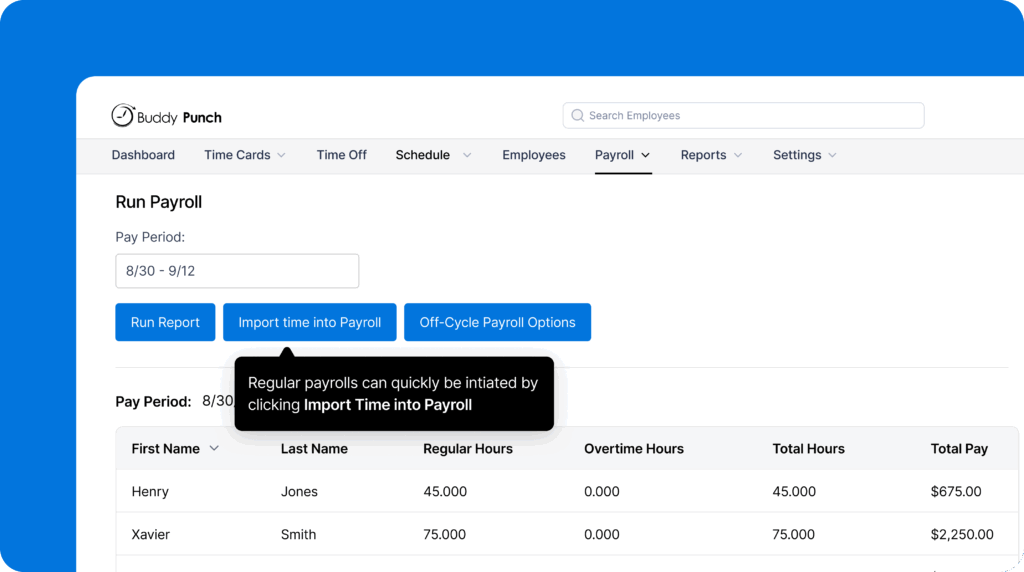
Buddy Punch is a great option for construction companies that are looking for a complete workforce management platform. In addition to using it to run payroll, it also includes features for time tracking, employee scheduling, break tracking, PTO management, and time theft prevention. Having all of your data in a single system saves time and is usually also less expensive than buying multiple tools.
Employees can clock in and out from wherever they work using Buddy Punch’s mobile apps, which are available in English and Spanish. Create job codes to track labor hours toward projects, prevent offsite punching and buddy punching with features like geofences and Photos on Punch, add different wages for different jobs, and pay your employees via paper checks or direct deposit — all from the same system.
Key features
- Timesheets are created automatically when employees clock in and out. The system calculates regular hours, overtime hours, employee pay, and payroll deductions for you.
- Use GPS tracking or geofences to ensure employees were at the job site when billing time.
- Create job codes to track labor hours toward specific projects.
- Build schedules in the system and send notifications to employees when schedules are published.
- Let employees enter their availability, trade shifts with each other (with manager approval), fill out their payroll forms electronically, and request paid time off for approval.
- Send your time data to payroll in two clicks to run payroll faster — no manual data entry or spreadsheet formatting required.
Pros
- Easy to use even for employees who aren’t tech savvy
- Great, U.S.-based customer support by payroll experts
- Manage your entire workforce from a single application
Cons
- A time tracking plan is required to use Buddy Punch’s payroll service
- Payroll is only available for U.S.-based employees and companies
Who should choose Buddy Punch?
Buddy Punch is a great option for construction businesses with fewer than 100 employees, particularly those that are concerned that time theft is eating into their profits. Having multiple tools in the same system will save you time and lower your software costs, and the platform’s location and attendance tracking features give you confidence that you’re only paying employees for actual work hours.
Pricing
It’s not possible to use Buddy Punch’s payroll service without also subscribing to a time tracking plan. Time tracking plans start at $4.99/user per month plus a $19/month base fee that covers the cost of all of the admin users you add to the platform. The payroll add-on costs an additional $8/user per month plus a $49/month base fee, bringing the total starting price to $12.99/user per month plus a $68/month base fee.
Learn more about Buddy Punch
- Start a free trial — no credit card required
- Watch a video demo
- Take an interactive product tour
- Request a personalized demo
2. Miter – Best for companies that work on a lot of public works projects

If your company regularly wins public works projects, Miter is a good payroll solution to consider. It handles prevailing wage requirements really well. When a new job comes in, you add the relevant wage determination and classifications. Your crew selects the appropriate job when clocking in, and the system automatically applies the required fringe benefit or increased wage to those hours.
Once you’ve run payroll, the app creates the federal WH-347 or a supported state-certified payroll report, populating it with each employee’s classifications, hours, rates, deductions, and payment details. You can submit these reports directly to state and compliance portals. And if Miter doesn’t offer a direct submission route for the system you need, you can export the report and upload it manually.
Key features
- Employees can track their time using their mobile phones or an on-site kiosk.
- Hours are tied to projects for accurate job costing and prevailing wage determinations.
- Timesheets can require multiple levels of approval before payroll is run.
- Run work authorizations and background checks when hiring new employees.
- Generate certified payroll reports for federal- or state-funded public projects.
- Configure Workers’ Comp rates for employees who are out due to a workplace injury.
Pros
- Designed specifically for construction company payroll
- Includes features for unionized construction companies
Cons
- Miter’s pricing isn’t published on its website, making it hard to compare to other tools
- Payroll is only available for U.S.-based employees and companies
Who should choose Miter?
Larger construction companies that either have unions or work on a lot of public works projects will benefit from the automation features in Miter for Davis-Bacon compliance, certified payroll reporting, managing complex union overtime rules, and union reciprocity reporting. However, if you don’t regularly need those features, a simpler payroll solution is likely to be more affordable for your business.
Pricing
Miter doesn’t publish its pricing. To get a quote, you’ll have to request a demo through its website.
3. Payroll4Construction – Best for teams that want to outsource payroll

Payroll4Construction is designed for construction companies that no longer want to manage payroll in-house. You’re still responsible for gathering each employee’s details, job allocations, rates, deductions, and approved hours for the pay period. However, once you’ve uploaded your data, Payroll4Construction takes things from there.
When you submit the payroll information, you see a proofing report in Payroll4Construction and can correct any errors before the app calculates pay. Once you approve the proofing report, Payroll4Construction handles your entire payroll process, including gross and net calculations, payments, tax filings, union deductions, prevailing wages, certified payroll, and multi-jurisdictional payroll.
Key features
- Get access to more than 40 detailed reports after payroll is run, including certified payroll, Workers’ Comp, and union reporting.
- There’s an online portal for employees to access their paystubs and tax forms.
- Get unlimited support from Payroll4Construction’s in-house payroll specialists.
Pros
- Save time by outsourcing your payroll to be run and managed by experts
- Get access to industry-specific features like Workers’ Comp, fringe deductions, and union reporting
Cons
- You’re still responsible for organizing your employee time, project, and wage data
- If you want to use the platform for time tracking, you have to subscribe to a separate tool
Who should choose Payroll4Construction?
Growing construction companies that have a good handle on time tracking already and simply want to outsource payroll will benefit from Payroll4Construction. However, keep in mind that you’ll still be responsible for gathering all of the data needed for payroll. If you don’t have that process working efficiently, one of the combined time tracking and payroll tools might work better for you.
Pricing
Payroll4Construction doesn’t publish its pricing. To learn more about its pricing, you’ll have to request a quote through its website.
4. JOBPOWER – Best combined payroll and accounting software

JOBPOWER is part of the JDM Technology Group, which provides construction industry software solutions for a number of workforce management tasks. JOBPOWER is its combined accounting and payroll software, and having those two tools bundled together lets you set budgets for projects, see how many labor hours have been billed to them, and catch overruns before they affect project profitability.
Start by giving each project its own job code. Workers enter their hours through JPMobile — the platform’s time tracking app. All this data feeds back into JOBPOWER, with the project, type of work, pay type, and hours attached to each entry. When you’re ready to run payroll, the app calculates each worker’s gross and net pay and deductions including payroll taxes, Workers’ Comp, insurance, and benefits.
Key features
- Use the same platform for time tracking, payroll, and accounting.
- Feed data into your accounting system to track project costs and profitability.
- Generate subcontractor agreements and change orders.
- Track time using the platform’s time tracking module or import time from another system.
- Withhold union fees from payroll, even if you have multiple unions.
- Track subcontractor payments alongside W-2 employee payroll.
Pros
- Link each individual’s wages and hours to specific jobs and specific tasks within jobs
- Run built-in reports to see how close the expected pay on a job is to the initial budget and profitability
Cons
- JOBPOWER doesn’t e-file W-2s and 1099s, so you have to do them yourself
- There’s no portal for employees to use to access their paystubs and tax forms
Who should choose JOBPOWER?
Large construction companies with multi-person accounting teams that are in charge of payroll will appreciate having all of their data in a single tool instead of having to integrate multiple different systems together. The platform also works on desktop devices, so you don’t have to have an internet connection to do work in the system.
Pricing
JOBPOWER doesn’t publish its pricing. To get a quote, you’ll have to request a demo through its website.
5. Justworks – Best for rapidly growing construction companies

Justworks is a good choice for rapidly growing construction companies because it lets you start simple with payroll only and then expand as needed to add benefits management, advanced time tracking, payments to contractors, international employee payroll, and more. You can even upgrade to one of the platform’s PEO plans to outsource your HR and payroll processes to the Justworks team entirely.
With Justworks’ basic payroll plan, you can pay U.S.-based employees. However, you can also purchase add-ons that allow you to pay domestic and international contractors or become an employer of record for hiring full-time international employees. Additionally, you can offer benefits through the platform, such as insurance, 401k plans, and HSA/FSA accounts, with premiums automatically deducted from paychecks.
Key features
- Use the platform to pay U.S. and international employees and contractors.
- Run payroll yourself or outsource it by purchasing a PEO-eligible plan.
- Offer and administer benefits like medical insurance, 401ks, and HSAs/FSAs.
- Get basic time tracking on every plan or upgrade for advanced time tracking.
- Purchase insurance for unemployment or employment practices liability.
- Manage Workers’ Comp.
Pros
- Get started with payroll only and then add on more features as your company grows
- Get access to benefits that are normally only available to much larger companies
Cons
- Only basic time tracking is included in the payroll-only plan
- Many features are sold as add-ons, which can increase your costs significantly
Who should choose Justworks?
Justworks is a great option for construction companies that plan to grow rapidly. It lets you offer your crew members more enticing benefits packages so you can hire and retain the best workers, and you have the option to outsource some of your admin work if you can’t grow your full-time HR team fast enough. However, if you don’t need those options, its costs are higher than other tools offering the same features.
Pricing
Justworks’ payroll plan starts at $8/employee per month plus a $50/month base fee and includes its payroll product as well as basic time tracking. Many features are sold as add-ons, including advanced time tracking ($8/employee per month), health insurance ($8/employee per month), and contractor payments ($39/employee per month). PEO plans start at $79/employee per month with no base fee.
6. Everee – Best for payroll during tight cash flow cycles

Cash flow gets tight in many construction firms while they wait for progress payments, retainage, or approved change orders to reach their bank account. This often forces companies to access their savings or working capital to pay employees and payroll taxes. Everee’s Flex Credit service is especially useful in these situations. It covers any shortfall in funding from the same system you use to run payroll.
Approval usually takes a few days when you apply for Flex Credit. You’ll hear from their underwriters the maximum amount of cash they’ll advance you plus the finance rate and repayment schedule. Then, when you need funding, prepare the pay run in the normal way on the Everee app. Everee pays employees straight away and handles the tax filings. You only pay interest on the credit you draw on.
Key features
- Pay employees via pay cards in addition to direct deposit.
- Get temporary financing for payroll when cash flow is tight.
- Run payroll on a schedule (as often as daily) or as ad-hoc runs.
- Let employees access their pay before payday.
- Pay U.S.-based employees and contractors.
Pros
- Get temporary financing when you need extra funds to complete payroll
- Let employees pull funds from their checks before payday
Cons
- There’s no option for time tracking, so you’ll have to import your time data into the system
- You have to pass a credit check to use the platform’s daily payroll run feature
Who should choose Everee?
Everee is a good option to consider if you’re trying to build your construction business but don’t yet have a reserve of money to pull from if customers don’t pay their invoices on time. Its payroll financing option has a cost, but it’s a good solution for ensuring employees are always paid on time and in full. It can also be helpful if you have a lot of employees regularly requesting advances on their pay.
Pricing
Everee doesn’t publish its pricing. To get a quote, you’ll have to request a demo through its website.
7. CheckMark Online Payroll – Best for outsourcing the time-consuming aspects of running payroll

If you don’t need the benefits (and costs) of an end-to-end payroll service right now but want software to handle the time-consuming tasks of performing calculations and creating paperwork for you, CheckMark is a good option to consider. It does this work for you at a much lower rate than full-service payroll providers, preparing the paperwork you need while you remain responsible for making all payments.
To get started, open their app and add each employee’s pay rate, tax details, deductions, and how you pay their wages. When it’s time to run payroll, enter the crew’s regular, overtime, sick, and vacation hours as you normally would. When you select the pay period and payday, CheckMark calculates each person’s gross pay, taxes, deductions, and take-home amount.
After you’ve approved the figures, CheckMark creates an ACH file that you can upload to your bank or ACH provider for staff you pay by direct deposit. For staff who don’t want to be paid electronically, you can issue or print checks.
The app can also work out what federal, state, and local payroll taxes you’re liable to pay. To access this feature, you need to set up the IRS, state agencies, and other organizations as employer payees. The system then creates the relevant payment checks or ACH payments. The app prepares federal tax reports and W-2 and W-3 files too.
Key features
- Use software to calculate pay and deductions while continuing to make those payments yourself.
- Get tax reports and end-of-year employee tax documentation created for you.
Pros
- Run payroll for the whole company at once or for one employee at a time
- Outsource the time-consuming work while still keeping payments in house
Cons
- To pay 1099 contractors, you need separate CheckMark software
- You’re still responsible for organizing your employee time, project, and wage data and making payments, tax deposits, and payroll returns on time
Who should choose CheckMark?
If you mostly want to run and manage payroll yourself but want to speed up the process by having software that does the calculations and paperwork for you, CheckMark is a good and affordable choice. However, it’s best if you have a bookkeeper or accountant on your team who’s in charge of running payroll because you’ll still need payroll expertise on your team to succeed with the platform.
Pricing
CheckMark Online Payroll costs $5/active employee per month plus a $20/month base fee. The base package doesn’t include 1099 filing, so you need separate CheckMark 1099 software, starting at $239 for print-only filing or $319 for e-filing.
8. Roll by ADP – Best for getting AI assistance with payroll

Roll is ADP’s payroll software for small businesses. It comes with an AI assistant that you can get answers and help from. It uses a ChatGPT-like interface and responds to natural-language prompts. For example, tell it you want to add a worker, change someone’s pay, add a bonus, or start payroll. It may ask a few questions to understand what you need done, then walk you through how to do it.
Admins can also use the chatbot to pull up a worker’s previous pay, a quarterly payroll report, or your year-to-date figures instead of trying to remember which report to open. Roll also sends payroll reminders and flags anything unusual, like one employee being paid much more than normal, so you can double-check the figures before processing the run.
Key features
- Automatically calculate, file, and pay federal, state, and local payroll taxes in all 50 states.
- Pay both W-2 employees and 1099 contractors with unlimited payroll runs.
- Send wages via direct deposit (including same-day and next-day options) or pay by check.
- Give employees a self-service app to view their pay, download pay stubs, and access tax forms.
Pros
- The chatbot-style interface is intuitive and makes the app easy to learn and use
- Built-in AI helps users by, for example, providing warnings on potential payroll errors
Cons
- You can’t add or change a wage garnishment yourself, so you have to reach out to Roll by ADP’s team for help
- Users need to log into the app on their phone before they’re able to log into Roll by ADP on a desktop or a laptop
Who should choose Roll by ADP?
Roll by ADP is best suited to small construction businesses that have fairly straightforward payroll needs. It’s easy to learn and fast to use. Keep in mind, though, that it isn’t built specifically for construction, so it doesn’t handle job costing, prevailing wages, certified payroll reports, or union deductions. If you regularly take on public works projects, one of the construction-specific tools on this list will be a better fit.
Pricing
Roll by ADP costs a base fee of $39 plus $5 per worker per month. The company offers a three-month free trial and doesn’t require an annual contract.
How I chose the tools on this list
I began with over 30 payroll software platforms, looking for a mix of specialist tools and general providers suitable for different types of contractors. Many industry-specific apps cover a wide range of tasks, but smaller firms may find them too expensive and more complex than they need.
I narrowed the list to eight, split evenly between construction specialists and general payroll providers. I assessed each on the following criteria:
- Whether the tool runs payroll itself or sends approved hours and other records to another payroll provider
- How well it handles the construction payroll job it’s designed for, such as public works, fringe benefits, job costs, payroll funding, employee benefits, or workers’ compensation
- How much manual data work it removes for workers, forepersons, payroll staff, and administrators
- Whether the setup, integrations, deadlines, and limitations suit the size and type of contractor it’s meant for
I made sure not to include vendors whose software had hard-to-use controls. In my 10 years of experience reviewing software, I’ve seen that tools that staff members struggle with are less likely to be adopted, undermining the time savings and reduction in errors the software was meant to deliver.

