
The 8 Best Time Tracking Apps with QuickBooks Integrations

Written By: Brooke Flemming
Last Updated July 13, 2026
If you use QuickBooks, finding time tracking software that integrates with it will save you a lot of time. You’ll no longer have to bother with downloading spreadsheets, making sure they’re formatted correctly, and uploading them to your accounting or payroll software. Instead, you just set up the integration and let it do the work for you.
Below, you’ll find the eight best time tracking software with pre-built integrations for QuickBooks Online, QuickBooks Desktop, or both, along with detailed reviews of each option, details on which types of businesses they’re best for, and breakdowns on how much each app costs for plans that include the QuickBooks integration.
| Platform | Summary | G2 rating | Free trial | Starting price for plans that include QuickBooks integration |
|---|---|---|---|---|
| QuickBooks Time | Best for large companies using QuickBooks Payroll, QuickBooks Time is Intuit’s time tracking software that syncs data with QuickBooks Online and Payroll automatically. | 4.5/5 | 30 days | $10/user/month |
| Buddy Punch | Best for small businesses with hourly employees, Buddy Punch has lots of features to prevent time theft, minimize unexpected labor costs, and ensure employees are taking state-required breaks. | 4.8/5 | 14 days | $4.99/user/month |
| Hubstaff | Best for preventing time theft among knowledge workers, Hubstaff is a time tracking and computer activity monitoring tool with features that let you see what employees spent their time doing. | 4.4/5 | 14 days | $7.50/seat/month |
| Harvest | Best for freelancers and consultants, Harvest lets you track time by client and project, create detailed invoices, log expenses, and copy your Harvest invoices to QuickBooks Online. | 4.3/5 | 30 days | $9/seat/month |
| BigTime | Best for agencies, BigTime expands on simple time tracking and invoicing with proposal and quote generation, resource management, and portfolio management to help your business stay profitable. | 4.5/5 | Not offered | $20/user/month |
| Deputy | Best for restaurants and retail businesses, Deputy integrates with your POS system to turn it into a time clock kiosk and let you build employee schedules automatically using historical sales data. | 4.6/5 | 30 days | $5/user/month |
| Hour Timesheet | Best for government contractors, Hour Timesheet is designed for FAR and DCAA compliance with detailed audit logs, charge code limitations, timesheet signatures, and automated reminders. | 4.7/5 | 30 days | $8/user/month |
| LawBillity | Best for legal services businesses, LawBillity goes beyond simple time tracking, offering a conflict checker, LEDES and LSS invoice formats, and UTBMS/ABA billing codes. | Not reviewed | 14 days | $30/user/month |
1. QuickBooks Time – Best for large companies using QuickBooks Payroll

For the most straightforward way to connect your employee timesheet data to QuickBooks, look no further than Intuit’s own time clock software: QuickBooks Time. The great thing about QuickBooks Time is that no integration is needed to pass data from it to QuickBooks Online and Payroll. Since the platforms are all part of Intuit’s software ecosystem, data flows between each of the apps automatically.
If you’re already subscribed to QuickBooks Online or Payroll when you sign up for QuickBooks Time, it’s very easy to set the system up. It will pull employee data from those other systems and set up employee and customer profiles in QuickBooks Time automatically. You can also perform certain actions in multiple systems; for example, you can approve timesheets in QuickBooks Time, Online, or Payroll.
As far as time tracking features, QuickBooks Time lets employees clock in and out on their computers, mobile phones, or a tablet you use as a time clock kiosk. You can add job codes to track time toward projects, use its real-time GPS feature to track employee mileage automatically, and create geofences that automatically assign employee hours to the projects being worked on at specific locations.
QuickBooks Time also includes features for employee scheduling and PTO tracking. Employee schedules can be color-coded by job, and you can add as many custom fields to schedules as you need, letting you add things like location, role, customer, and more. Its PTO tracking feature supports accruals by year, pay period, or hours worked, and employees can request time off in the QuickBooks Workforce mobile app.
The downsides of QuickBooks Time: You have to be a QuickBooks Online subscriber to use QuickBooks Time, so if you’re using QuickBooks Desktop, you’ll have to upgrade to the subscription accounting platform. Additionally, QuickBooks Time is one of the pricier tools on this list, so it’s not as good of a fit for small businesses. It’s best for larger companies that are already deeply integrated in Intuit’s ecosystem.
Pricing
Free trial available. View QuickBooks Time’s current pricing.
Learn more about QuickBooks Time
- Read our in-depth QuickBooks Time review
- Compare Buddy Punch vs. QuickBooks Time
- Discover the best QuickBooks Time alternatives
2. Buddy Punch – Best for small businesses with hourly employees

Buddy Punch is an affordable option for small businesses with hourly workers, particularly those with deskless employees working in the field (construction and trades), at multiple locations (healthcare and retail), or at large job sites with multiple stations (manufacturing and agriculture). It gives you the tools you need to keep an eye on employees even when you’re not all working in the same place.
Employees clock in and out using Buddy Punch’s apps for iOS and Android phones. To ensure they were at work when logging time, you can use three features. GPS on punch collects their locations when they clock in and out and adds it to their timesheets. Real-time GPS records everywhere they travel while they’re on the clock. And geofences can be used to block offsite punches entirely.
There are also features to help you prevent other time theft acts like buddy punching. With photos on punch, you can require employees to take a selfie when they clock in and out; those photos display on their timesheets for managers and admins to review. And if you’re using Buddy Punch on an iPad as a time clock kiosk, you can set up facial recognition using Face ID to prevent buddy punching entirely.
Break tracking in Buddy Punch keeps you compliant with state break laws. You can set up rules for when employees need to take breaks and how long those breaks need to last. Then, the system will send employees an alert when it’s time to take a break, as well as prevent them from clocking back in before the required break duration has passed.
Buddy Punch also has a scheduling feature that makes time tracking even more powerful. When you use Buddy Punch for scheduling, you can prevent employees from clocking in early, automatically clock them out when their shift ends, and track attendance. Set up notifications to get an alert when an employee clocks in late, clocks out early, or misses a shift, and view all attendance issues in detailed reports.
There’s also PTO tracking with accruals by year, pay period, or hours worked. Employees can see their balances in the app at any time and request time off for approval. Managers can be added to review and approve timesheets before payroll is run. And when it’s time to run payroll, you can integrate with QuickBooks Online, QuickBooks Desktop, QuickBooks Payroll, and several other payroll systems.
Pricing
Free trial available. View Buddy Punch’s current pricing.
Learn more about Buddy Punch
- Start a free trial — no credit card required
- Watch a video demo
- Take an interactive product tour
- Request a personalized demo
3. Hubstaff – Best for preventing knowledge worker time theft
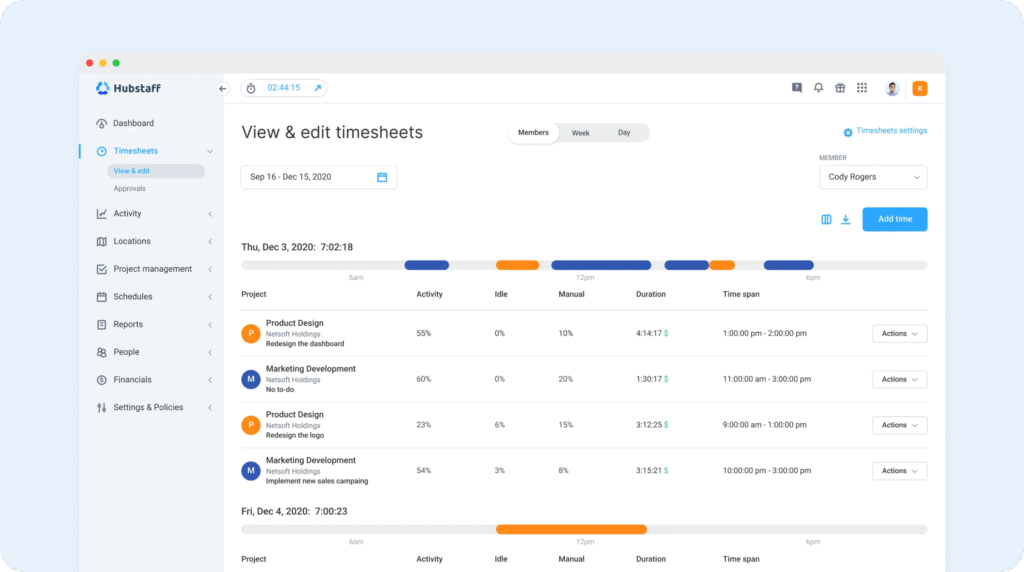
Hubstaff is time tracking and employee monitoring software that’s designed to prevent time theft by knowledge workers who do their work on computers. While employees can clock in and out using Hubstaff’s web and mobile apps, you’ll need them to download one of its desktop applications — available for Mac, Windows, and Linux — to use its employee monitoring features.
Once employees have the desktop apps installed, there are many features that let you monitor what they’re doing on their computers while they’re clocked in:
- App and website tracking monitors how much time employees spend in specific desktop applications or on specific URLs. You can access reports to view this data so that if someone spent half the day watching shows on Netflix, you’ll know it.
- Automatic screenshots capture snapshots of employees’ computer screens at regular intervals (e.g., every 10 minutes) throughout the day. This lets you identify if your marketers were on social media because they were working or because they were stealing time.
- Keyboard and mouse activity monitors keystrokes and mouse movements to gauge activity levels, letting you identify people who are just pretending to work but are actually doing chores.
- Idle time detection pairs with keyboard and mouse activity to identify when employees aren’t working at all. It will prompt employees to confirm if they’re still working so you can tell if someone was just idle because they were in a meeting or if they’d left their desk completely.
Hubstaff also offers automatic time tracking to help prevent forgotten punches. It starts and stops tracking time based on computer activity, so if an employee logs off of their computer, the system automatically clocks them out. And if employees travel for work, you can also opt to purchase the Locations add-on to track where they travel in real time while they’re working.
When it’s time to run payroll, Hubstaff integrates with QuickBooks Online and Desktop, and the integration automatically pushes your time data to QuickBooks once every hour. And while Hubstaff has a large selection of integrations with project management tools, its non-QuickBooks payroll integration selection is very limited, so it’s best if you’re planning to connect it to QuickBooks to run payroll.
Pricing
Free trial available. View Hubstaff’s current pricing.
Learn more about Hubstaff
- Read our in-depth Hubstaff review
- Compare Buddy Punch vs. Hubstaff
- Discover the best Hubstaff alternatives
4. Harvest – Best for freelancers and consultants
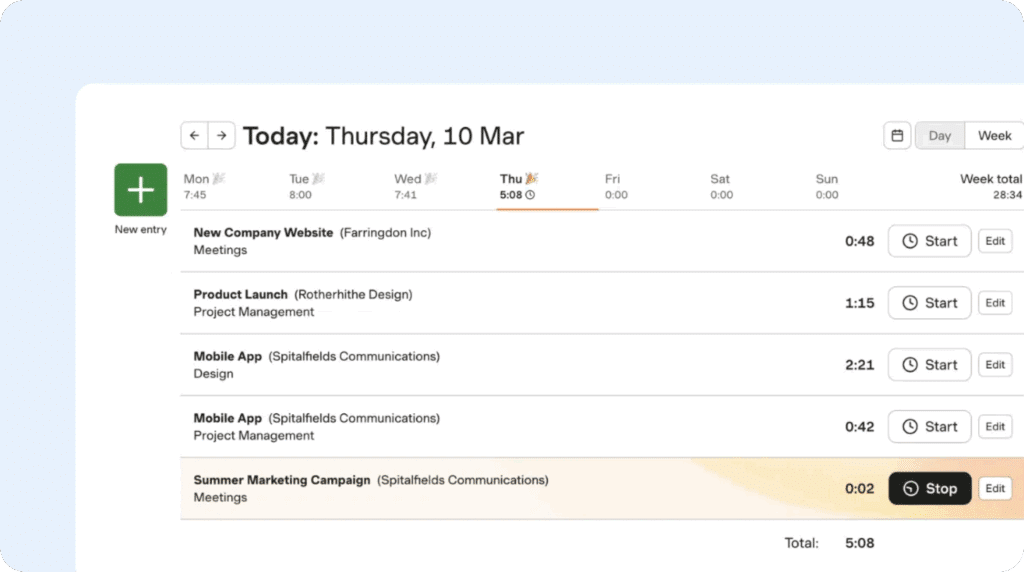
If you’re a freelancer or consultant who needs to track the time you spend on client projects, Harvest is a good option. It includes time tracking and invoicing, and you can sync the payments you receive to QuickBooks, which makes it easy to aggregate your income and expense data so you can hand it off to your accountant when it’s time to file taxes — or sync it directly to TurboTax if you do your taxes yourself.
For individuals who only work with a couple of clients at a time, Harvest has a free plan you can use to track time, log expenses, and send invoices. However, the QuickBooks integration isn’t included in the free plan, and you’ll only be able to track time toward two projects. To add more projects or integrate with QuickBooks Online (QuickBooks Desktop isn’t supported), you’ll have to upgrade to a paid plan.
Harvest is designed for project-based work, and its integrations make it easy to track time toward specific tasks, projects, and clients. It integrates with project management tools like Asana and Basecamp, calendar apps like Outlook and Google Calendar, and messaging tools like Slack. You can start and stop Harvest timers in any of those systems or pull data from those systems directly into Harvest.
When it’s time to invoice your clients, you can do that in Harvest too if you’d like. It will automatically generate invoices for you showing a full breakdown of the time you spent per client, project, and task. You can integrate with PayPal or Stripe to accept payments directly from your Harvest invoices, and you can also add expenses to your invoices along with copies of your receipts.
If you prefer to invoice clients through QuickBooks Online, you can use Harvest’s integration to pass your time data to QuickBooks instantly. Simply build your invoice in Harvest, and it will be automatically copied to QuickBooks Online. All you need to do is log in to QuickBooks Online and send the invoice.
Pricing
Free plan and trial available. View Harvest’s current pricing.
5. BigTime – Best for agencies

In addition to freelancers and consultants, Harvest can also work for small agencies. However, its features really start and stop with time tracking and invoicing. If you’re running a large agency or have more complex operations, BigTime may be the better choice for you. It has time tracking, expense tracking, and invoicing like Harvest, but it also offers tools for scoping, quoting, and resource and portfolio management.
BigTime uses all of your historical project data to inform new quotes and proposals. You can build quotes, statements of work, and proposals quickly in the system, and it will look at how long similar projects took in the past to determine how much you need new clients to pay for their projects. Build the documents in BigTime, set up approval workflows for review, and then send them off to prospects.
Once the proposal has been approved, you can use BigTime’s resource management feature to plan the work. Create schedules in a drag-and-drop calendar view, view heatmaps showing team member availability, or use AI to quickly build schedules based on workloads and availability. It’s also useful before you even send a proposal to a prospect because you can see if you’ll need to hire to complete the project.
When it comes to time tracking, BigTime offers duration entry, timers, and mobile apps. With duration entry, employees manually fill out their timesheets row by row, entering times and selecting the projects or tasks they were working on. With timers, employees can initiate a stopwatch-like function that ticks up as they work on specific tasks or projects. However, there are no integrations with project management tools.
Finally, BigTime’s portfolio management feature lets you track estimates vs. actuals, forecast profitability, and run what-if scenarios to identify situations where you might end up losing money on projects. It integrates with both QuickBooks Online and Desktop to sync client, staff, project, and payments data between both systems — or to push timesheets, expenses, and invoices from BigTime to QuickBooks.
Pricing
No free trial offered. View BigTime’s current pricing.
6. Deputy – Best for restaurants and retail shops

Deputy is a great tool for restaurants and retail businesses for two key reasons. First, it integrates with several point-of-sale (POS) systems, which lets you turn your POS into a time clock kiosk that all employees can use to clock in and out of work. Second, its AI-generated scheduling tool lets you build schedules quickly based on historical sales, employee profile data, and employee availability.
Deputy’s integrations with Clover, Square, Epos Now, Revel, and Lightspeed power both of these features. When employees arrive for or leave work, they can clock in and out using the POS, which creates timesheets that can be reviewed and approved in Deputy. All of your sales data, customer traffic, and labor patterns from the POS also sync to Deputy so it can be used to help you build schedules.
To use the automatic scheduling function, you set up rules in Deputy for things like minimum coverage per role and ratio of staff to sales volumes. Then, you create employee profiles, defining the maximum number of days/hours they can work per week, minimum rest times between shifts, roles they can work, etc.
With all of that in place, you can click a button in the scheduling tool to have Deputy’s AI create your schedule for you automatically. It will consider all of the data you entered above — as well as things like employee availability and approved time off — to create a draft schedule. You can review the schedule before publishing it, and if the system has any concerns about the schedule, it will flag them for you.
If you don’t want to use your POS as a time clock, employees can also clock in and out (and view their schedules) using Deputy’s mobile apps. There’s a geofencing feature that prevents them from clocking in or out when offsite. Finally, Deputy integrates with QuickBooks Online (but not QuickBooks Desktop), allowing you to export your timesheets from Deputy to QuickBooks for your records or running payroll.
Pricing
Free trial available. View Deputy’s current pricing.
If you’re running a restaurant and Deputy doesn’t offer an integration with the POS system you use, another option to consider is 7shifts. It integrates with 36 different POS systems and has many features designed specifically for restaurants, but its automated scheduling tools aren’t quite as robust as Deputy’s.
7. Hour Timesheet – Best for government contractors

When you work on government projects, time tracking isn’t as simple as logging hours so you know what to pay your employees. Contracts that are governed by FAR and audited by the DCAA come with strict rules about how time is recorded, who can edit it, and how you prove it all after the fact. Get it wrong, and you can put a contract — or your eligibility for future ones — at risk.
Hour Timesheet is built specifically for that world. If your company works on government or defense contracts and needs FAR- or DCAA-compliant time tracking, it handles the recordkeeping requirements that general-purpose time clocks don’t:
- It provides a detailed audit trail of all timesheet entries, including usernames, IP addresses, and date and time stamps.
- Automated timesheet reminders make sure everyone remembers to record their time daily, which is a core DCAA expectation.
- Users can track time to both billable and non-billable tasks, so you can capture direct and indirect labor.
- Employees and managers can both sign submitted timesheets.
- Charge codes can be limited to only the employees approved to work on them.
- Supervisors and admins receive alerts when timesheets are edited, and the person making the edit must provide a reason for the change.
Beyond compliance, Hour Timesheet covers the day-to-day basics you’d expect. Employees can clock in and out on the web or through its mobile apps, and they can log their time to specific charge codes and projects.
As far as its QuickBooks integrations, Hour Timesheet will sync data to and from QuickBooks Online and QuickBooks Desktop in one click. Approved hours flow into QuickBooks for job costing and payroll, and because the sync runs in both directions, changes you make in one place show up in the other. If you run payroll outside of QuickBooks, it also integrates with providers like ADP and Paychex.
Pricing
Free trial available. View Hour Timesheet’s current pricing.
8. LawBillity – Best for legal services businesses
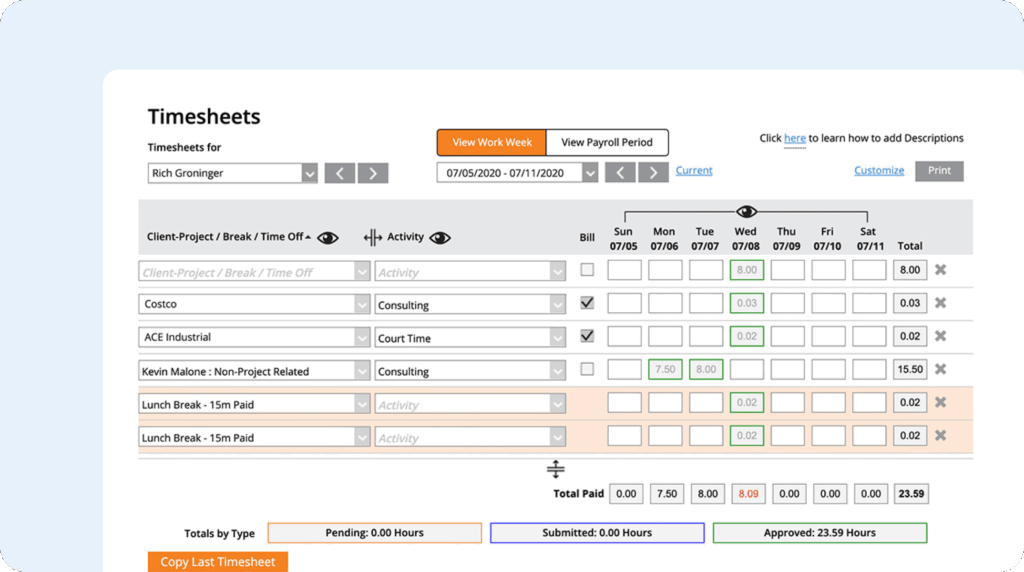
Legal services is another area where tracking your time is more complex than simply knowing what to pay employees. You need accurate data both for billing clients and for satisfying bar rules. LawBillity, a legal-specific time tracking app created by eBillity, is built for that specific purpose.
On the time tracking side, lawyers can clock in and out of specific matters on any device: your computer, a tablet, or a mobile app on your phone. If you don’t have a cell signal or internet connection, LawBillity will store your clock in and out data locally and sync it later when a signal or connection becomes available.
The value in LawBillity is what it does with your time once it’s tracked. LawBillity supports LEDES and LSS invoice formats along with UTBMS/ABA billing codes. You can also run realization reports to see how much of your billed time you’re actually collecting, manage client trust accounts and apply payments to invoices directly from them, and track expenses and attach them to the right client invoice.
There’s also a conflict checker to help you screen new clients and matters against existing ones before you take them on. And when it comes to accounting, LawBillity syncs with both QuickBooks Online and QuickBooks Desktop. The connection runs in both directions, so records you create in one system show up in the other.
If you just need to track hours, LawBillity is more tool — and more cost — than most businesses require. But if you run a law firm and need billing that speaks your industry’s language, those capabilities are hard to find in a general time tracker, and that’s what makes LawBillity worth the price for legal teams.
Pricing
Free trial available. View LawBillity’s current pricing.
Choosing the right time tracking software for your team
The first thing you’ll want to do when shopping for time tracking software is put together a shortlist. Hopefully, the list of options above helped with that. Start by writing down the names of any options you find interesting.
Next, you’ll want to compile a list of features you’d like to have. At this stage, write down everything you think would be helpful. When you’re finished, decide which features on your list are must-haves and which are nice-to-haves. Must-haves are table stakes, business-critical features that you can’t operate without. Nice-to-haves are things that you’d like but don’t absolutely need to operate effectively.
With this list of must-haves and nice-to-haves compiled, you can start narrowing down the options on your shortlist. Look at the features of each tool, and remove any that don’t include your must-haves.
Next is pricing and budget. Determine which of the tools on your list are priced within your budget. Remove any that cost more than what you can afford to spend.
After that, you can start to consider your nice-to-have features. Use this to narrow your list down to three or so platforms that offer the highest number of features you want at the most reasonable price.
From there, start a free trial and test the apps. You’ll want to make sure that the features work the way you expect them to — particularly the QuickBooks integration — and that everything you need is available. You might also want to try reaching out to the provider’s support team to make sure they’re responsive when you run into issues.
Following this process, you should be able to find the perfect option for your team.

