
The 7 Best Construction Workforce Management Software

Written By: Nick Murphy
Last Updated August 24, 2026
Workforce management software is a broad category of tools that help businesses manage their staff more efficiently. In construction, workforce management software often includes features for time tracking, PTO management, job costing, scheduling, and forecasting. Some tools are easy to use and built for smaller construction businesses, and some are incredibly robust and built for large, complex operations.
In this post, we’re taking a look at the seven best construction workforce management tools. Below, you’ll find our detailed reviews that cover which types of construction businesses each option is best for, what unique features they offer, and how they all compare on price.
| Platform | Summary | G2 Rating | Free Trial | Starting Price |
|---|---|---|---|---|
| Buddy Punch | Best for small construction businesses, Buddy Punch is an easy-to-use and affordable solution with features for time tracking, scheduling, PTO management, and payroll. | 4.8/5 | 14 days | $4.99/user/month |
| Workyard | Best for automated job costing, Workyard uses real-time GPS tracking and geofences to automatically switch job codes for employees as they travel to different worksites over the day. | 4.8/5 | 14 days | $6/user/month |
| Buildbite | Best for general contractors, Buildbite gives you tools for planning your projects, tracking time toward tasks, collecting updates from subcontractors, and creating invoices for clients. | Not rated | 14 days | €8/user/month |
| Arcoro | Best for large construction companies needing a full HR suite, Arcoro has features for time tracking, payroll, hiring, scheduling, and benefits and performance management. | 4.0/5 | 14 days | $9/user/month |
| Procore | Best for companies looking for project management capabilities, Procore offers time tracking and scheduling as part of its larger construction project and resource planning system. | 4.6/5 | Not available | Contact for pricing |
| Raken | Best for advanced time tracking and project management, Raken has features for preventing time theft and scheduling employees alongside RFI, submittal, and document handling. | 4.6/5 | Not available | Contact for pricing |
| Jibble | Best for companies with limited budgets, Jibble offers a free-forever plan for unlimited users that lets you track employees’ hours and record their locations on clock in/out. | 4.7/5 | Via free plan | Free plan available; contact Jibble for paid plan pricing |
1. Buddy Punch – Best for small construction businesses
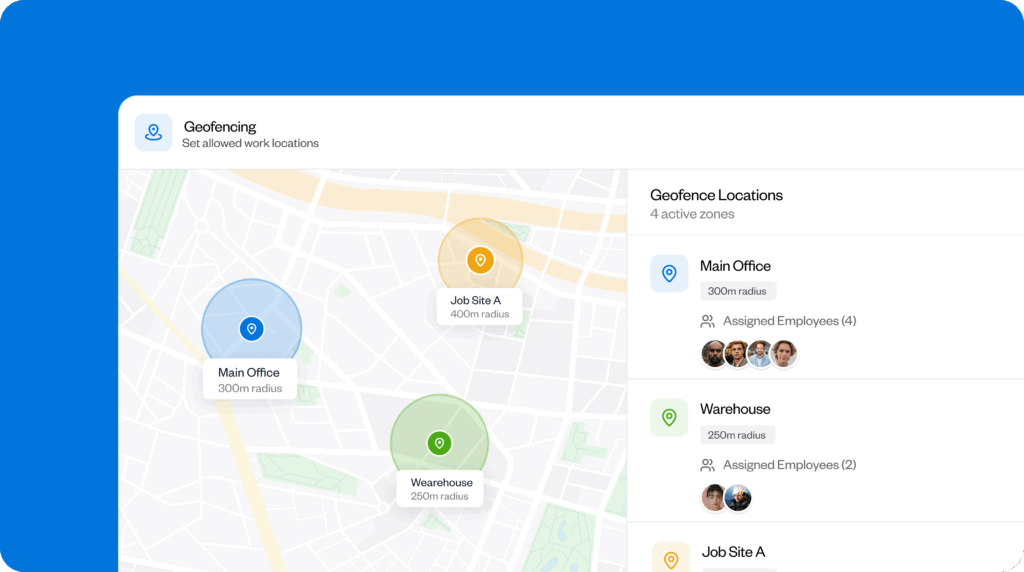
Buddy Punch’s workforce management software is built for small businesses with hourly employees. It includes features for time tracking, scheduling, PTO management, and payroll. And it’s designed for field teams, so there are lots of features that help supervisors, foremen, general contractors, and owners keep track of what’s happening with their crews even when they’re not all working at the same location.
There are multiple ways for crew members to clock in and out using Buddy Punch. Set up a kiosk on a tablet that everyone can use if employees come to the office before heading out into the field, or let employees clock in/out on their mobile phones if they start their day on the job site. You can also have a foreman clock everyone on site in and out at the same time if everyone’s working the same shift.
If employees are using their mobile phones to clock in and out (Buddy Punch’s mobile apps are available in both English and Spanish), there are lots of features you can turn on to ensure they were where they were supposed to be when they were supposed to be there:
- GPS on Punch logs employees’ locations to their timesheets when they clock in and out.
- Geofences prevent employees from punching in/out when they’re not at the designated worksite.
- Real-time GPS records everyone’s movements throughout the day and displays them on a map.
- Photos on Punch requires employees to take selfies when clocking in/out to prevent buddy punching.
These features are all completely customizable. You can make them required for everyone, make them optional, or turn them on only for specific employees.
Job costing in Buddy Punch can be used to tie the hours employees work to the specific projects they were working on, and clock in and out data is transformed into timesheets and reports with regular hours, overtime hours, project hours, and pay all calculated for you automatically. You can even set up different wages for different projects — helpful if employees are working on prevailing wage jobs.
You can also create work schedules easily in Buddy Punch. Create single or recurring shifts, assign employees to work in specific roles or at specific locations, and see employee availability and time off directly in the schedule-creation interface. Employees can update their availability in the app, request time off, or organize their own shift trades and covers that managers can review and approve.
Finally, Buddy Punch can also be used to run payroll if you want to consolidate all of your workforce management processes into a single tool. However, if you have an existing payroll provider you want to stick with, you can use one of Buddy Punch’s payroll integrations or download reports pre-formatted for your existing provider to get accurate time data over to payroll quickly and easily.
Pricing
Free trial available. View Buddy Punch’s current pricing.
Learn more about Buddy Punch
- Start a free trial — no credit card required
- Watch a video demo
- Take an interactive product tour
- Request a personalized demo
2. Workyard – Best for automated job costing

In terms of features, Workyard is very similar to Buddy Punch. It comes with tools for tracking time, creating schedules, and managing PTO. However, while it offers a handful of payroll integrations, there is no built-in payroll option in Workyard.
Where Workyard stands out is with its automated project tracking feature. Using real-time GPS tracking and geofences you create for your different job sites, Workyard will automatically switch job codes for employees when they arrive at and leave job sites. This can be a useful feature if you’re finding that employees are forgetting to change job codes when switching jobs and throwing off your project tracking.
Since the app only tracks employees’ locations while they’re on the clock (which is required by law in several states), employees will still need to remember to clock in at the beginning of the day. However, after that first punch, all of their time is allocated to projects automatically. You can even create a geofence after employees have logged time in an area and have it apply those hours to projects retroactively.
In addition to tracking employees’ hours and the time they spend on projects, Workyard also tracks the miles they drive. This is useful if employees travel between job sites during the day using their own vehicles. You can see how much mileage to reimburse them for without having to check odometers.
As for scheduling, Workyard can be used to create schedules both in advance and off-the-cuff. If you know ahead of time what employees need to work on, you can schedule them for specific shifts, jobs, and locations. If you get calls throughout the day for new jobs you need someone to pick up immediately, you can use the scheduling feature to dispatch employees, notifying them where to go and what to do.
Finally, you can use Workyard’s Smart Forms feature to collect updates from the field. There’s a library of pre-built templates you can use to create forms for things like equipment updates, project updates, safety checks, incident reports, and more. You can have the forms available in the app for employees to fill out when they need them, or you can require forms to be submitted when employees clock out for the day.
Pricing
Free trial available. View Workyard’s current pricing.
3. Buildbite – Best for general contractors

Buddy Punch and Workyard are built primarily for businesses employing their own hourly workers. However, if you’re a general contractor working solely with subcontractors or independent contractors, Buildbite might be the better solution. While it has time tracking, the feature is more focused on project costing and invoicing than payroll. You can add admins, workers, and clients as users in the system.
When a new job comes in, you start by creating the project in Buildbite. You can add different project phases, break each phase down into the specific tasks that need to be completed, and then assign people to work on those tasks. The contractors you work with can track their time to your project by opening the task in Buildbite and starting/stopping the timer.
While they’re working on tasks, contractors can add text, image, and video updates to let you know what’s going on, what’s finished, and what issues have come up. You can also message workers and clients through the app in real-time when you need to have more in-depth conversations or want to provide updates. All text in the platform can also be translated into other languages using its built-in AI.
The time tracked toward projects can be transformed into invoices for your clients. Clients can review those invoices in your system, but keep in mind that the system does not offer payment processing for collecting payments from clients. There’s also not a way to pay subcontractors or employees, so you’ll still need other tools for collecting and making any payments for your business.
Buildbite’s pricing is interesting. While most construction workforce management tools charge you more for access to more advanced features, all Buildbite plans include all of the platform’s features. The price you’ll pay per user depends not on what features you need but on how many users you add. If you have fewer than 10 users, for example, you’ll pay more than a company with 25-50 users.
Pricing
Free trial available. View Buildbite’s current pricing.
4. Arcoro – Best for large construction companies needing a full HR suite

Arcoro is a full HR suite of tools designed for large construction companies that need more than just time tracking and scheduling. Arcoro does offer tools for time tracking, scheduling, PTO management, and payroll — with many of the same features as other tools we’ve looked at — but it also has features for applicant tracking, benefits management, performance management, and learning management.
Like Buddy Punch and Workyard, Arcoro’s time tracking product, Arcoro Time, has features that let employees clock in and out on their mobile phones, lets you track their locations while they’re on the clock, and lets owners and admins create schedules for their teams. There are a handful of payroll integrations available, or you can purchase Arcoro’s payroll product to track time and run payroll in the same system.
Arcoro’s hiring tools deliver a lot of value to large construction companies that are doing a lot of hiring. You can post your jobs to construction-focused job boards, manage applicants using an applicant tracking system, run background checks, and have hired candidates fill out all of their paperwork electronically. For federal contractors, there are also tracking and reporting tools for VEVRAA/OFCCP requirements.
If you offer benefits to your team, Arcoro makes it easy to manage those benefits. You can connect the system to your benefit providers, let employees enroll in benefits electronically, and track enrollment periods automatically. If you’re using Arcoro for both benefits management and payroll, the system automatically calculates benefits deductions, removes them from paychecks, and pays the premiums.
Finally, Arcoro’s Grow tools let you manage your workforce better. It has tools for tracking certifications, safety incidents, and compliance requirements; building performance improvement plans and career roadmaps for your team; and creating training courses. Analytics help you identify training gaps and performance trends and stay up-to-date on crew member certifications that are nearing expiration.
Pricing
Free trial available. View Arcoro’s current pricing.
5. Procore – Best for companies looking for project management capabilities

Procore is primarily a construction project management tool. However, since time tracking and scheduling are core components of project management, Procore offers those features as well. If you’re just looking for a system to help you track time for payroll and create schedules, Procore is going to be too complex for your needs, but if you need project management in addition to those things, it might be the best option.
Procore’s time tracking features are relatively basic. Employees can clock in and out using their mobile phones, and that data is compiled into timesheets in the system with hours connected to your projects. There are no features for preventing time theft like what you’ll find in Buddy Punch, Workyard, and Arcoro, and there’s no built-in payroll. Instead, you can download time reports to forward to your payroll provider.
However, the nice thing about having your time data in the same system you use for project management is that it can help you plan and manage projects better. All of your project costs — materials, labor, subcontractors, etc. — live in Procore, so you can see how costs are trending alongside accepted bids. Additionally, you’ll be able to use historical costs to create more accurate bids for future projects.
Because Procore’s scheduling feature is connected to your project plans, you can create schedules that are much more granular than what you’ll find in more traditional workforce management systems. You create employee profiles that include job titles, skills, and certifications to use in scheduling, and schedules not only show hours and locations but also task details so employees know what to work on.
Finally, Procore’s built-in AI assistant can also make project planning and workforce management easier. Because it’s connected to all of your project and cost data, it can help you identify risks you hadn’t considered, draft documentation like RFIs, create project updates in seconds, and more.
Pricing
No free trial offered. Contact Procore for pricing.
6. Raken – Best for advanced time tracking and project management

Procore is an incredibly sophisticated construction project management system, but its time tracking features leave a lot to be desired. If you want both advanced time tracking features and some project management capabilities, Raken is the better choice.
When it comes to time tracking, employees can clock in and out on their mobile phones or using an on-site tablet as a time clock kiosk. They select the project they’re working on when clocking in for accurate job costing, and you can require them to take a photo — that’s validated by the platform’s built-in AI — to ensure they weren’t buddy punching.
When employees are clocking in and out using their phones, you can create geofences to make sure they can only punch in when they’re at their designated job sites. There’s also real-time GPS tracking available, which lets you know if employees left the job site while they were on the clock.
Surveys in the platform require employees to fill out a questionnaire before they can clock in and out, which is helpful for collecting project updates and information about illnesses or injuries. And when it’s time for employees to submit their time cards for a pay period, you can have them sign them digitally.
While Raken’s time tracking features are more advanced than Procore’s, Raken’s project management features aren’t as advanced as Procore’s. It lets you build RFIs, track submittals, and store project documents, but you can’t assign specific tasks to specific team members, it doesn’t offer drawing and document collaboration, and it doesn’t forecast costs and risks automatically.
So which option is right for you? If you’re a larger operation running several complex projects and needing deep customization, forecasting, and analytics, Procore is probably the right choice. If you’re a smaller team that wants to prevent time theft and mainly needs clean field-to-office communication, daily reporting, and basic RFI/submittal/document handling, Raken covers the essentials with less cost and complexity.
Pricing
No free trial offered. Contact Raken for pricing.
7. Jibble – Best free construction workforce management software

If you need to migrate to a more modern and automatic workforce management system but can’t afford one, Jibble is a good option to consider. Jibble offers a free-forever plan that includes features for time tracking and PTO management, and you can add an unlimited number of users to it at no cost.
One thing to keep in mind, however, is that while Jibble’s website makes it look like all of its features are included in the free plan — and that there are no paid plans at all — that’s not really accurate. The free plan is generous, but there are paid plans too; they’re just not advertised on the product’s website. And there’s no way to tell if what you need is a free or paid feature without signing up for the tool.
With that said, there are some workforce management features that are definitely free. An unlimited number of employees can clock in and out using Jibble’s mobile apps, and that data is transformed into timesheets in the system. You can log employees’ locations to their timesheets when they clock in and out, and you may also be able to create a limited number of geofences on the free plan.
For unlimited geofences, real-time GPS tracking, and attendance reports, you’ll likely need to upgrade to a paid plan. There are also features like facial recognition, NFC/RFID punching, and break tracking, but it’s unclear if those are free or paid features. Still, if your needs are very basic, you may be able to get away with using the platform to digitize your time tracking process without having to pay for a tool.
Jibble does not currently offer employee scheduling, but as of the time of writing this post, its website says the feature is coming soon. It does have PTO management, though. You can automate PTO accruals, let employees see their PTO balances in the app and request time off, and set up multi-level workflows for approving requested time off. It’s unclear if these features are free or paid.
When it comes to payroll, Jibble’s options are fairly limited. You can use an integration to send your timesheet data to three systems only — QuickBooks, Xero, and Deel — or you can download reports in XLS and CSV formats. There is no built-in payroll option.
Pricing
Free plan available. Contact Jibble for pricing.
Choosing the best construction workforce management software for your needs
Choosing the right workforce management tool for your construction company comes down to understanding what you need most:
- If you’re a smaller operation looking for something that will help you track time and project costs accurately, tools like Buddy Punch, Workyard, and Jibble deliver those essentials without unnecessary costs or complexity.
- If you’re managing large, multi-stakeholder projects and need workforce planning tightly connected to the rest of your project lifecycle, platforms like Buildbite (for general contractors), Procore (for large construction businesses), and Raken (for lightweight project management) offer that broader integration.
- If you want HR tools built into your workforce management system, Arcoro is the right choice.
- If you need something that’s affordable with transparent pricing, Buddy Punch and Buildbite are the only two options where you’ll know exactly what you’ll pay before you have to sign up for the product or speak to a sales rep.
Keep in mind that no single tool does everything perfectly. If you need all of the different features of the different tools in this list — time tracking, scheduling, project management, hiring, performance management, etc. — you may end up needing to subscribe to multiple specialized platforms to get exactly what you need. If possible, look for tools that integrate with each other for the best experience.
Get started by identifying what your budget is and what your biggest pain points are right now, then pick a few tools that do what you need them to do at the price you can afford to pay. After that, start trials of the tools on your list if possible; request demos if not. Ideally, you’ll want to try the tool out with your team for a time to make sure it does what you need it to do both in theory and in practice.

