

The 7 Best Homebase Alternatives: Detailed Comparisons

Written By: Eric Czerwonka
Last Updated June 17, 2026
Homebase is a great workforce management app for small teams that work together at the same location. It has a generous free plan, integrates with your point-of-sale (POS) system for simple time tracking and labor cost management, and offers some basic HR features for hiring and onboarding new employees.
However, it’s not the right app for every team. Its location-based pricing can get costly quickly when you have employees working at multiple locations, its HR features are very limited, and it’s missing some of the more advanced industry-specific features that many teams need to streamline their workflows.
If you’re a current Homebase customer looking for a replacement for time tracking, scheduling, PTO management, and more, this list of the seven best Homebase alternatives will help you create a shortlist of options to consider quickly. We’ve reviewed each option in depth, listed what types of teams they’re best for, and explained how each option is similar to and different from Homebase.
| Platform | Summary | G2 Rating | Free Plan | Starting Price |
|---|---|---|---|---|
| Buddy Punch | Best for field services teams, Buddy Punch offers features like job costing, GPS tracking, and geofencing in addition to time tracking, scheduling, PTO tracking, and payroll. | 4.8/5 | Not offered | $4.99/user/month |
| 7shifts | Best for restaurants, 7shifts offers integrations with 36 different POS systems, time management, sales-based employee scheduling, and real-time team messaging. | 4.5/5 | Free for one location and up to 15 employees | $39.99/location/month |
| Deputy | Best for automated scheduling, Deputy builds entire schedules in a single click based on needs, predicted sales, and employee availability. | 4.6/5 | Not offered | $5/user/month |
| Square | The best POS with built-in time tracking, Square’s all-in-one app gives you payment processing alongside basic time tracking, scheduling, and payroll. | 4.6/5 | Free for payment processing only | $49/location/month |
| Jibble | The best free Homebase alternative, Jibble’s free plan lets you add unlimited users and up to two locations and includes several features for preventing time theft. | 4.8/5 | Free for unlimited users and two locations | $4.49/user/month |
| Workable | Best for upgrading your hiring tools, Workable offers basic time tracking and scheduling alongside sophisticated hiring tools for growing teams or teams with high turnover. | 4.4/5 | Not offered | $299/month |
| Connecteam | Best for team communication, Connecteam is essentially a one-to-one replacement for Homebase with a similar feature set and comparable pricing. | 4.6/5 | Free for up to 10 employees | $29/hub/month |
1. Buddy Punch – Best for field services teams

Homebase’s location-based pricing makes it incredibly affordable if you have lots of employees but only one or two locations. However, if your employees work across a lot of locations, it gets pricey quickly.
An affordable alternative is Buddy Punch, which offers many of the same features as Homebase but charges by employee rather than by location — you can add as many locations as you need at no additional cost. It’s perfect for field services teams with hourly employees working at multiple locations.
Your crew members can clock in and out from any location using their mobile phones. Like Homebase, Buddy Punch offers location logging on punch and geofencing, but Buddy Punch also has a real-time GPS tracking feature. With real-time GPS, you can track employees’ movements across the workday, see everyone’s locations on a map, and view breadcrumb trails of their travels.
Another feature you’ll find in Buddy Punch but not Homebase — and one that’s crucial for field services teams — is job costing. You can create job codes in Buddy Punch and assign them to the employees working on those jobs. When employees clock in, they select the appropriate job code if more than one is assigned. If only one is assigned, their time is tied to that project automatically.
Job codes can also be tied to geofences for even simpler job costing. If an employee is located within a geofence that’s tied to a job code when they clock in, the system will automatically assign the time they spend in that geofence to the job code. Geofences can also be used to prevent offsite punches or remind employees to clock in and out, and you can view all offsite punching attempts in an error report.
As far as similarities, both Buddy Punch and Homebase offer time tracking, scheduling, attendance tracking, PTO management, break tracking, overtime management, payroll integrations, and built-in payroll. Employees can self-service many things in the Buddy Punch app: they can add their availability, view their PTO, request time off, update their direct deposit information, and fill out their tax forms.
Pros
- Buddy Punch’s job costing and real-time GPS features cater more to the needs of field services teams than Homebase.
- Buddy Punch’s pricing is based on number of employees rather than number of locations, making it more affordable for teams that work across multiple locations.
Cons
- No HR-focused features
- No POS system integrations
Pricing
Free trial available. View Buddy Punch’s current pricing.
Learn more about Buddy Punch
- Start a free trial — no credit card required
- Watch a video demo
- Take an interactive product tour
- Request a personalized demo
2. 7shifts – Best for restaurants
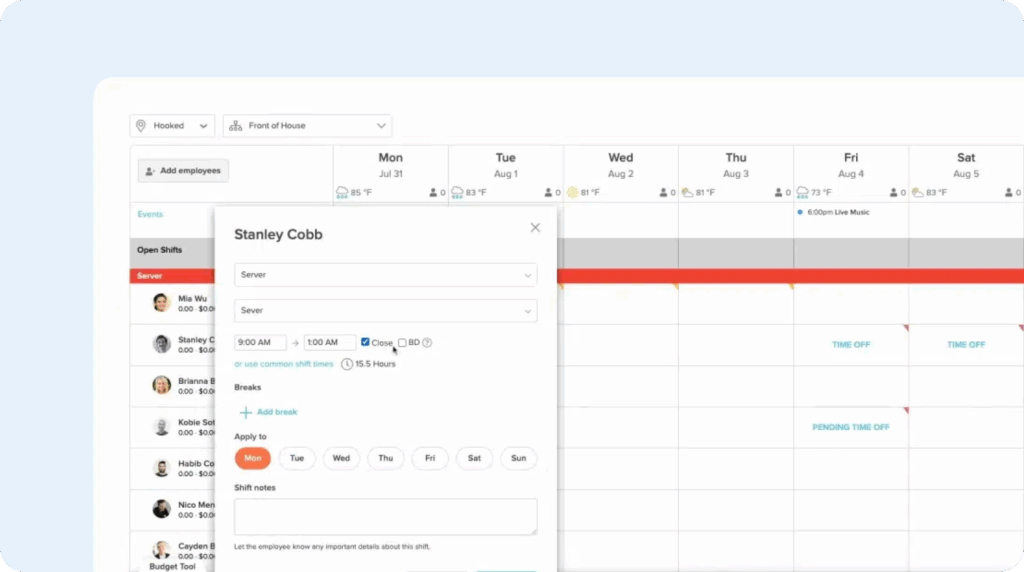
Restaurants are just one of several types of businesses that Homebase caters to. That means that often, there are features in the platform that are designed more for other industries than your own. If you want something that’s custom-built for foodservice businesses, 7shifts is a great alternative to consider.
Like Homebase, 7shifts integrates with your POS to turn it into a time clock and let you consider historical sales and labor costs when creating employee schedules. However, 7shifts integrates with a lot more POS systems than Homebase does. Homebase offers seven total POS integrations; 7shifts has 36. If you couldn’t integrate with your POS because Homebase didn’t offer an integration, 7shifts likely has it.
When it comes to payroll, 7shifts — like Homebase — offers both built-in payroll and payroll integrations. Tips can be easily added to payroll in 7shifts. Any tips recorded from your POS are automatically added to paystubs and included in employees’ checks and direct deposits, and you can also ask employees to record any cash tips they received during their shifts so taxes can be withheld for those tips as well.
If you pool tips, 7shifts can use your employee schedule and time clock data to split tips by percentage, weighted points, or equally. There’s also a manager log book that lets you document notes about shifts.
As far as other features go, Homebase and 7shifts are very similar. Both include tools for time tracking, employee scheduling, and PTO management, both offer real-time team communication systems, and both have HR and hiring tools. One key difference where Homebase has an advantage, however, is with job postings. Its job boost feature that adds your post to multiple job boards isn’t something 7shifts offers.
Pros
- Integrates with 36 different POS systems
- Restaurant focus means all features of the app are designed specifically for foodservice businesses
Cons
- While 7shifts’ free plan lets you add more users, its paid plans are more expensive than Homebase’s
- There’s no built-in ability to publish your job postings in 7shifts to other platforms like Indeed
Pricing
Free plan and trial available. View 7shifts’ current pricing.
3. Deputy – Best for automatic scheduling

If creating employee schedules feels like it takes up way too much of your time, Deputy is a good Homebase alternative to consider. Like Homebase, it integrates with your POS system to pull in historical sales data. However, instead of just providing you with guidance on what your estimated labor costs will be for specific shifts, Deputy uses that data to automatically create a draft of a schedule for you.
To use auto-scheduling, you first integrate Deputy with your POS, which pulls in past sales volumes, customer traffic, and labor patterns. Next, you set up rules like minimum coverage per role and ratio of staff to sales volumes. After that, you create employee profiles, defining the maximum number of days/hours they can work per week, minimum rest times between shifts, roles they can work, etc.
With all of that in place, you can click a button in the scheduling tool to have Deputy’s AI create your schedule for you automatically. It will consider all of the data you entered above — as well as things like employee availability and approved time off — to create a draft schedule. You can review the schedule before publishing it, and if the system has any concerns about the schedule, it will flag them for you.
Beyond auto-scheduling, Deputy also has a number of features that cater to the ways restaurants and retail shops function. The system can automatically flag clopening shifts in your schedule, you can require employees to confirm their shifts so there are no more “I didn’t know I was scheduled” excuses, and you can log when employees must be given predictability pay for schedule changes.
Other features you’ll find in Deputy are similar to what’s offered in Homebase. You can connect with your POS to turn it into a time clock kiosk, use a tablet as a time clock kiosk with facial recognition, or have employees clock in and out on their phones. Built-in geofencing prevents offsite punches. You also get access to team messaging, hiring and onboarding features, and built-in payroll via a third-party service.
Pros
- Auto scheduling lets you create complex team schedules faster than ever
- Several features to keep teams compliant with Fair Workweek laws
Cons
- Built-in payroll is provided by a third-party service and more expensive than tools like Buddy Punch, Homebase, and 7shifts
- There are fewer POS integrations available than in Homebase and 7shifts
Pricing
Free trial available. View Deputy’s current pricing.
4. Square – Best combined time tracking and POS software

It’s great to have options like Homebase, 7shifts, and Deputy that integrate with your existing POS system, but if you don’t want to have to subscribe to and pay for multiple tools, switching everything over to Square might be your best option. Square’s POS lets you ring customers up and accept payments, track your employees’ time, create work schedules, and run payroll — all in the same system.
Square’s simplicity makes it great for small retail and foodservice businesses that aren’t worried about things like time theft, Fair Workweek laws, or break compliance. When you only have a handful of employees working at the same location, these issues aren’t as much of a concern. You just need an easy way to track time, distribute tips, create schedules, and pay your employees.
But Square’s simplicity makes it less of an ideal fit for larger companies and more complex workflows. There are no tools for preventing time theft (like photo clock-ins, geofences, or facial recognition), no alerts when you’ve scheduled employees for clopening shifts or checkboxes to remind you that you owe predictability pay, and no built-in features to flag when employees didn’t take breaks required by state law.
You get basic clocking in and out via your Square POS or its mobile app, automatically generated timecards that managers can edit if needed, and downloadable reports that you can send to your payroll provider. Conversely, to consolidate even more tools, you can use Square’s built-in payroll system, which lets you pay employees their wages, tips, and commissions.
Since Square is a POS system and not just a workforce management app, it also has a lot of features you wouldn’t have had access to in Homebase, such as item and menu management, reservation management, payment processing, marketing messaging via SMS and email, and much more. It does also have a team communication feature like Homebase for real-time announcements and discussions.
Pros
- Use your POS as a time clock kiosk without having to set up an integration
- Get payment processing, time tracking, scheduling, and payroll in a single tool
Cons
- Square’s time tracking and scheduling features are very basic
- There are no features for preventing time theft or staying compliant with employment laws
Pricing
Free plan and trial available. View Square’s current pricing.
5. Jibble – Best free Homebase alternative

If you’ve surpassed the 10 user count limit on Homebase’s free plan but can’t afford to pay for a subscription for time tracking software, Jibble is a good alternative to consider. It offers a free-forever plan that includes unlimited users, two locations, and a number of similar features as Homebase.
With Jibble, employees can clock in and out using a computer, mobile phone, or a tablet turned into a kiosk (the free plan is limited to a single kiosk). When using the platform as a kiosk, employees can clock in using NFC and RFID cards, PINs, or facial recognition. When punching from a mobile phone, you can require employees to take selfies that you can review to make sure no one was buddy punching.
Other time theft prevention features include geofencing (you can create two geofences on the free plan), automatic screenshots (take screenshots of employees’ computer screens while they’re working), and GPS on punch (log employees’ locations when they clock in and out). Geofences can also be used to automatically clock employees in and out when entering and exiting geofences.
Jibble also has scheduling, but its features are really basic. Plus, you can only create a single schedule on the free plan. It might be enough if you have a small team and a single location, but anything more complex will likely require you to upgrade to a paid plan. PTO tracking is also included in the free plan, but PTO accruals require a paid upgrade.
Jibble doesn’t offer any of the team communication or HR features Homebase offers; however, if you were on Homebase’s free plan, you wouldn’t have had access to those features anyway, so it’s not really a loss. If you eventually need to upgrade from Jibble’s free plan to one of its paid ones, whether it’s less or more expensive than Homebase will depend on how many employees and locations you have and what features you need.
Pros
- Jibble’s free plan lets you track time for unlimited users
- Offering the ability to clock in via NFC/RFID cards is rare among time tracking apps
Cons
- Jibble does not have built-in payroll or offer any payroll integrations, so you’ll have to download reports to send to your payroll provider
- The free plan is limited to a single kiosk, two geofences, and one schedule, which means the unlimited users perk loses value fast if you have any operational complexity
Pricing
Free plan and trial available. View Jibble’s current pricing.
6. Workable – Best for upgraded hiring tools

If you do a lot of hiring and are frustrated with Homebase’s very basic applicant tracking system (ATS), Workable is a good option to consider. Its hiring tools are significantly more sophisticated than Homebase’s, though the tradeoff is that you’ll have to give up some of the depth in your workforce management features. Time tracking and scheduling are included in Workable, but they’re basic.
When it comes to hiring, Workable beats every other tool on this list — no contest. It has an AI recruiting agent that searches candidate profiles, screens them against your job criteria, builds a shortlist for you, and sends personalized outreach to candidates you’re interested in. This lets you find promising candidates more proactively rather than just waiting for the right person to notice your opening and apply.
Beyond the AI agent, you get one-click posting to 200+ job boards, a no-code branded careers page builder, LinkedIn Preferred Partner and Indeed Platinum Partner status (meaning better visibility on those platforms), one-way video interviews, science-backed cognitive and personality assessments, candidate self-scheduling, offer letters with e-signatures, and an employee referral program with gamified rewards.
As far as workforce management, Workable tracks attendance, hours, and overtime and generates reports for payroll processing. You can create custom work schedules, manage time off policies with accrual cycles, and handle time-off requests with manager approval workflows.
With that said, you won’t get some of the features that are highlights of Homebase and some of the other options on this list. There are no location-tracking or other time theft prevention features, no auto-scheduling, no shift swapping features, and no real-time team chat. However, if hiring is your biggest pain point and your team management needs are simple, it’s a good choice.
Pros
- Offers much more sophisticated hiring tools than Homebase
- Makes it easy to source candidates and publish open roles to multiple job boards
Cons
- Time tracking and scheduling features are very basic
- No built-in payroll and only five payroll integrations
Pricing
Free trial available. View Workable’s current pricing.
7. Connecteam – Best for team communication
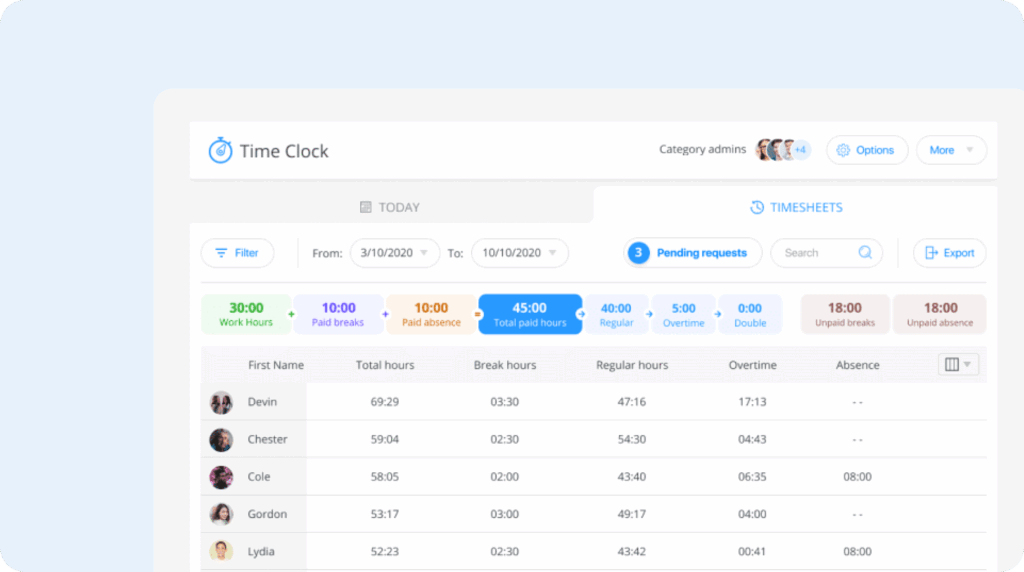
Connecteam is probably the best one-to-one replacement for Homebase of the options on this list. In addition to time tracking, you also get access to team communication and hiring tools. Managers can use the communication platform to message employees individually or as a group, and you’ll get a basic applicant tracking system for publishing job listings and moving candidates through the hiring funnel.
Connecteam’s time tracking features are part of its Operations hub. Your employees can use it to clock in and out, and you can track their time by location, project, or customer. For in person teams, you can set up a time clock kiosk, and for field services teams, employees can clock in and out on their mobile devices. Geolocation stamps will show you where employees were located when they punched.
Connecteam’s team communication features are part of its Communications hub, which lets you send messages to groups of employees, build an internal knowledge base, create an internal help desk, and create events. You can also access reports showing data on who viewed and engaged with your posts.
Connecteam’s HR tools are part of its HR & Skills hub. It lets you build an org chart, track PTO, create courses and quizzes for your team, store company documents, award employees with recognition badges, and send auto-generated celebration messages for team member birthdays and anniversaries.
If you have fewer than 10 employees, Connecteam’s free plan is a great option. It’s a generous plan that gives you access to some of the features of all of its hubs at no monthly cost.
However, once you outgrow the free plan, its pricing gets incredibly complex. Time tracking is in one hub, team communication is in another, and its HR features are in a third. Each hub has separate pricing, and the features in each individual hub are spread across four different plans per hub, so you have to figure out which features you need across 12 total plans and add up the cost to know what your cost will be.
Pros
- The all-in-one app offers features for time tracking, scheduling, PTO management, team communications, and HR management
- Connecteam’s free plan is generous for small businesses with 10 or fewer employees
Cons
- Once you outgrow the free plan, the pricing becomes more complex than all of the other workforce management apps on the market
- There’s no built-in payroll option, so you’ll have to pay for a separate payroll system
Pricing
Free plan and trial available. View Connecteam’s current pricing.
Learn more about Connecteam
- Read our in-depth Connecteam review
- Compare Buddy Punch vs. Connecteam
- Discover the best Connecteam alternatives
Choosing the best Homebase alternative for your company
If learning more about the unique features of and ideal use cases for the Homebase alternatives on this list didn’t help you narrow your options down to a clear winner, here are some additional tips for finding the right choice for your company:
- Take advantage of free trials: Get into the system, add some employees, and try setting up things like your PTO policies and geofences. Have one or two employees use the system for a few days for clocking in and out. Try creating a schedule. Actually using the tool to do the work you need it to do will be way more illustrative than reading about it.
- Send a support request: Issues with your time tracking software will prevent you from running payroll on time. Issues with your scheduling software might lead to violations of predictive scheduling laws when you can’t get your schedule completed on time. Make sure the provider you choose will be helpful and quick to get back to you when you need them.
- Read reviews from other customers: Seeing what a company’s existing customers are saying about them will give you a sense of what it’s like being a customer yourself. We linked to the G2 reviews for all of the platforms in this list in the table at the top of the post. Follow the links, read some 5-star, 3-star, and 1-star reviews to get a sense of what to expect and watch out for.
- Become a pricing expert: Dig deep into the feature comparison tables — not just summaries — to make sure you’re getting the features you expect in the plan you’re budgeting for. Compare pricing between the apps to make sure you’re not overpaying for a tool when there’s a more affordable option that offers the same features.
Spending a little time upfront to make sure you’re picking the right option ensures that the tool you select is one you’ll be able to rely on for years to come.

