

The 7 Best ClockShark Alternatives for Field Teams in 2026

Written By: Nick Murphy
Last Updated June 25, 2026
ClockShark is a construction time tracking app with a particular focus on field team management features like GPS tracking, geofencing, and job costing. The app is available in both English and Spanish, it integrates with construction-specific applications like Sage and Simpro, and you can collect end-of-day updates from employees in the field. These things all make it appealing for construction and field services.
However, there are many reasons why ClockShark isn’t a good fit for all teams. Its plans are pricier than many alternatives with comparable features, you have to sign a three-year contract to use the software, and a lot of its features — such as real-time GPS tracking that isn’t truly real-time — don’t hold up for keeping field teams truly accountable while they’re on the clock.
If you’re a current ClockShark customer looking for a replacement after your current contract ends, we’ve put together this list of the seven best ClockShark alternatives to help you find the right fit. Below, you’ll find our detailed reviews of each option, including what types of teams they’re best for, what unique features they offer, and how each compares on price.
| Platform | Summary | G2 Rating | Free Trial | Starting Price |
|---|---|---|---|---|
| Buddy Punch | Best for cost savings and simplified payroll, Buddy Punch nearly halves the monthly cost of your time tracking software and offers more payroll integrations. | 4.8/5 | 14 days | $4.99/user/month + $19/month base fee |
| Workyard | Best for automated project time tracking, Workyard uses real-time GPS and geofences to attach employee labor hours to projects automatically. | 4.8/5 | 14 days | $6/user/month + $50/month base fee |
| BusyBusy | Best for small businesses with basic time tracking and time theft prevention needs, BusyBusy’s free plan lets you track time for unlimited users at no cost whatsoever. | 4.8/5 | 14 days | Free plan available; paid plans start at $9.99/user/month + $40/month base fee |
| QuickBooks Time | Best for large teams that have outgrown ClockShark, QuickBooks Time offers multi-level approvals, a robust API, and syncing between Intuit products. | 4.5/5 | 30 days | $8/user/month + $20/month base fee |
| Arcoro Time | Best for tracking time without mobile apps, Arcoro Time’s portable time clocks can be mounted at any job site, work on battery power, and are weather resistant. | 4.0/5 | 14 days | $9/employee/month + $50/month base fee |
| FieldServicely | Best for dispatching technicians to job sites, FieldServicely lets you notify crews when emergency calls come in and send them optimized travel routes. | Not rated | 10 days | Free plan available; paid plans start at $9/user/month |
| Timeero | Best for teams working in rural locations, Timeero’s offline tracking lets you collect punch times even when crews are working in areas with no cell service. | 4.8/5 | 14 days | $5/user/month (max 10 users) |
1. Buddy Punch – Best for cost savings and simplified payroll
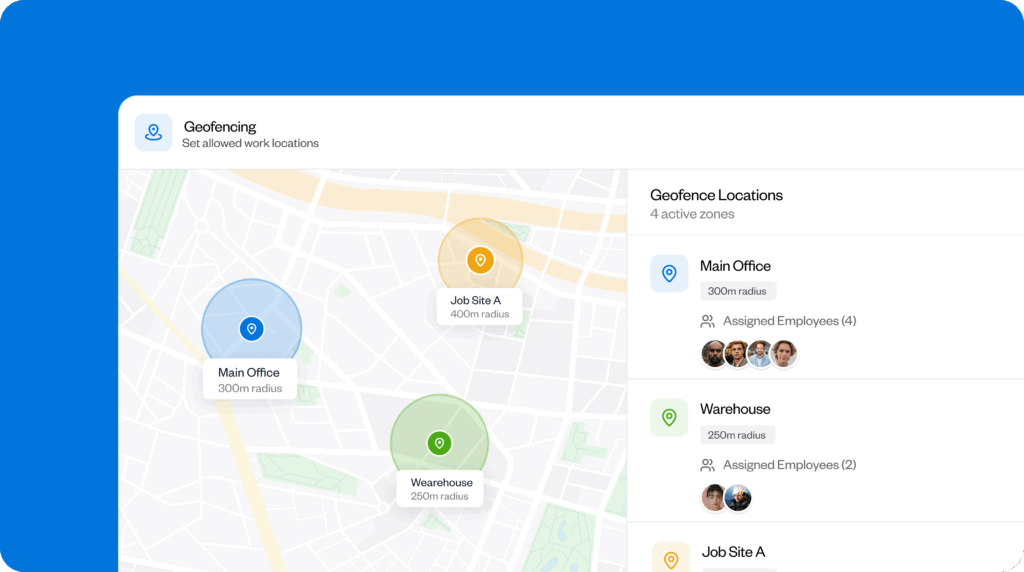
Buddy Punch offers the same features you’ll find in ClockShark — and even adds on additional features ClockShark doesn’t have — for nearly half the price. ClockShark’s lowest-cost plan is $9/user per month plus a $40/month base fee. Buddy Punch’s lowest-cost plan is $4.99/user per month with a $19/month base fee; it’s one of the most affordable options on this list, particularly given its broad feature set.
Buddy Punch’s Starter plan ($4.49/user/month) gets you time tracking, job costing, break tracking, manager roles, location logging on clock in/out, PTO tracking, punch limiting, facial recognition, nearly 20 integrations with popular payroll providers, and detailed, downloadable reports. Plus, its $19 base fee covers the cost of all admin users; you don’t have to pay individual per-user costs for admins.
To add in scheduling, geofences, photos on punch, and QR code scanning or PIN punching, you can upgrade to the Pro plan for $6.99/user per month. Adding scheduling also gives you access to more advanced features: you can track employee attendance; get alerts for late arrivals, early departures, and no shows; prevent early clock-ins; and automatically punch employees out at the end of their shifts.
Buddy Punch’s real-time GPS tracking — which is truly real-time and not captured in 15-20 minute increments like ClockShark — can be added to any plan for an additional $2/user per month. Its time tracking apps are available in English and Spanish, employees can add notes to their timesheets so you can get updates from the field, and you can pay for the app month-to-month — no contract is required.
Beyond price, Buddy Punch also makes payroll a lot simpler. You can download reports that are formatted perfectly for your existing payroll provider, set up an integration with nearly 20 providers to send your time data to payroll instantly, or use Buddy Punch’s built-in payroll service to consolidate multiple tools. Buddy Punch Payroll lets you pay U.S.-based employees and contractors via check or direct deposit.
In essence, Buddy Punch offers everything you need to manage employees who work in the field without breaking the bank. You can make sure employees are at the right locations where they’re charging for their time, prevent offsite punches and buddy punching, get alerts when employees have attendance issues or are nearing overtime, and set up managers in the system for timesheet reviews and approvals.
Pros
- Get the same features as ClockShark for nearly half the cost
- Simplify payroll with several third-party integrations or use Buddy Punch’s built-in payroll
Cons
- Mileage tracking is not available
- A phone signal or internet connection is required to use the software
Pricing
Free trial available. View Buddy Punch’s current pricing.
Learn more about Buddy Punch
- Start a free trial — no credit card required
- Watch a video demo
- Take an interactive product tour
- Request a personalized demo
2. Workyard – Best for automated job costing
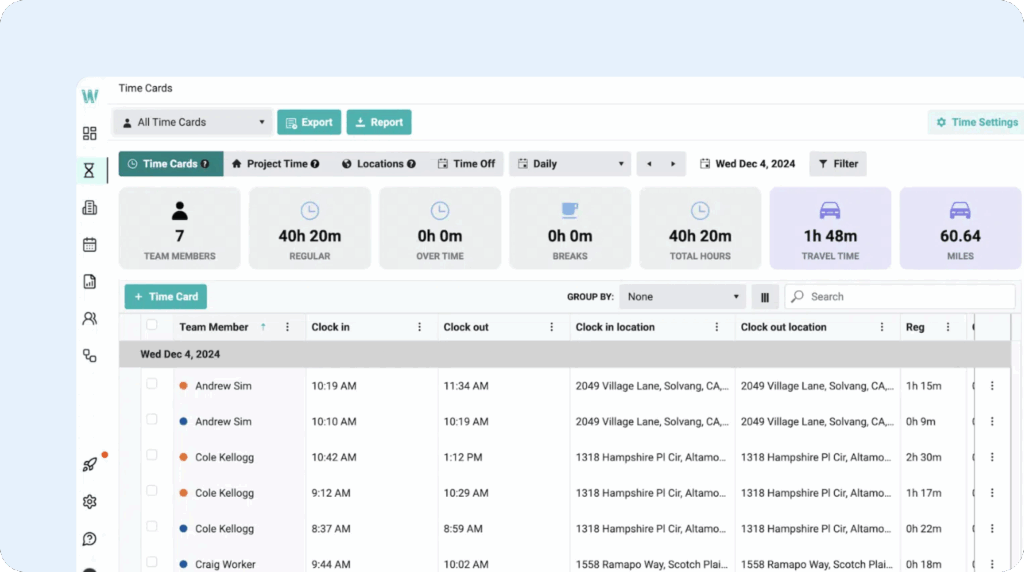
While ClockShark does offer job costing, it requires employees to select the right job code when clocking in and remember to switch job codes throughout the day when starting work on new projects. Workyard’s automated project time tracking feature does the job costing for you automatically without employees having to remember to do anything, letting you get much more accurate data on your project labor hours.
Workyard’s automatic project time tracking works by using same-second GPS tracking and geofences. First, you set up geofences for all of your job sites and attach those geofences to the appropriate job codes. When employees clock in, the system turns on real-time GPS tracking to monitor their locations. Any time they spend in a geofenced area is then automatically attached to the respective job code.
Additionally, Workyard’s real-time GPS feature also tracks employee mileage and adds it to their timesheets. This can be helpful if you reimburse employees for miles traveled in their personal vehicles, as well as if you’re tracking mileage on company vehicles to know when it’s time to have them serviced.
Like ClockShark, Workyard also has features for keeping track of what’s going on in the field. Build questionnaires using Smart Forms that can be used for conducting site inspections, reporting safety issues or accidents at the end of a shift, or tracking usage of heavy equipment. There are more than 200 pre-built form templates available in Workyard that you can use or repurpose for your needs.
When it comes to integrations, Workyard connects to more construction-specific tools than ClockShark, offering integrations with several Sage products, Foundation Software, and Deltek ComputerEase. There are also integrations with a handful of payroll providers like ADP, QuickBooks, Gusto, Paylocity, and Paycor, but Workyard does not offer an option for built-in payroll.
Pros
- Automatic project time tracking ensures you’re capturing all project labor hours accurately
- Smart Forms make it easy to collect updates from the field electronically
Cons
- Automatic project time tracking is only available on Workyard’s highest-cost plan
- Smart Forms are only available as an add-on with an additional cost
Pricing
Free trial available. View Workyard’s current pricing.
3. BusyBusy – Best free option for small teams with basic needs

BusyBusy offers a free plan that makes it a good choice for small construction and field services teams that have only basic time tracking needs. On the free plan, employees can clock in and out on their mobile phones, GPS location details are added to their timecards when they punch in/out, you can see the locations of your heavy equipment on a map, and you can add unlimited users at no additional cost.
If you’re a small company that plans to stay small, it’s a great, no-cost way to track employee time. However, if you think your company will grow or your needs will change over time, it might not be the best option. BusyBusy’s paid plans are among the pricier options on this list — higher than ClockShark’s plans — and it can be difficult to switch to a different app when employees are used to the one they’re using.
If you’re not looking for a free tool and are willing to pay for BusyBusy, the app offers a few unique features that are worth considering. You get reports showing estimated labor hours versus your current labor costs; photos, receipts, and documents can be attached to projects by employees, managers, or admins; and equipment tracking gives you details on machine hours and operator efficiency.
Clock-in and clock-out questionnaires ensure your crew members document important details about jobs at the beginning and end of the day, and you can collect employee signatures on their time cards when it’s time to submit timesheets for payroll. BusyBusy also integrates with several construction-specific apps, including Sage, Procore, ProContractor, ComputerEase, JobView, Foundation Software, and more.
BusyBusy also offers a built-in payroll feature that’s powered by Gusto. When it’s time for you to run payroll, you review your employee timesheet data, fix any errors or issues, then submit it for processing. It sends your data to Gusto, and employees are paid from that system. You can also submit payroll adjustments at any time if needed to retroactively make changes to what employees were paid.
Pros
- Small teams get basic time tracking for unlimited employees for free
- Integrations with several construction-focused apps let you connect data across systems
Cons
- Paid plans are on the pricier side, which can make it expensive if you need to upgrade from free
- The features available in the free plan are very limited and only useful for basic needs
Pricing
Free plan and trial available. View BusyBusy’s current pricing.
Learn more about BusyBusy
- Read our in-depth BusyBusy review
4. QuickBooks Time – Best for large teams that outgrew ClockShark

If you started out on ClockShark as a small business, grew over time into a larger one, and are finding your time tracking is not as sophisticated as it needs to be, QuickBooks Time might be worth considering. It comes with the field-specific features you’re used to in ClockShark — like GPS tracking, geofencing, and job costing — as well as the more advanced options you need for managing a larger business.
First, QuickBooks Time syncs automatically with QuickBooks Online and QuickBooks Payroll, so you can manage your business’s accounting, team, and payroll in the same ecosystem. This lets you pass expenses you reimbursed employees for via payroll to your accounting system, sync your timesheets to payroll automatically, and track project budgets in detail, including labor costs and material expenses.
QuickBooks Time’s API is also more mature and feature-rich than ClockShark’s. It supports creating or updating up to 200 records in a single request, so you can add, update, or remove employees, job codes, and locations quickly. The API also supports OAuth 2.0, letting you connect QuickBooks Time to any other tool you need to connect it to whether there’s a pre-built integration or not.
There are also multi-level timesheet approvals that let you require multiple people to review and approve timesheets before you run payroll, robust alerts that let you know when employees are nearing overtime so you can avoid unexpected labor costs, and advanced permissions and user roles that ensure everyone who has access to your system can only see the data they’re approved to have access to.
QuickBooks Time’s real-time GPS tracking and geofences can also work similarly to Workyard’s automatic project time tracking. You can create geofences and attach them to job codes, then use real-time GPS to determine where employees are over the course of the day. When they enter geofences, you can either switch job codes automatically or remind them to switch job codes, as well as track mileage between sites.
Pros
- The connection between QuickBooks Time, Payroll, and Online enables more granular reporting
- More sophisticated features for larger teams with more complex workflows
Cons
- You have to be a QuickBooks Online customer to use QuickBooks Time
- QuickBooks Time works best with QuickBooks payroll — not as well with other payroll software
Pricing
Free trial available. View QuickBooks Time’s current pricing.
Learn more about QuickBooks Time
- Read our in-depth QuickBooks Time review
- Compare Buddy Punch vs. QuickBooks Time
- Discover the best QuickBooks Time alternatives
5. Arcoro Time – Best for portable time clocks

With ClockShark, employees can clock in and out on their mobile phones or by using a tablet that has the ClockShark app downloaded onto it to be used as a time clock kiosk. However, if you’ve been having issues with tablets getting lost or broken — or employees not having cell service to allow them to clock in — Arcoro Time (formerly ExakTime) offers portable, durable time clocks that solve those problems.
Arcoro’s portable time clocks can be temporarily mounted at any job site. They’re battery powered and only need to be charged once every 21 days. They’re weather proof, withstanding temperatures as low as -10 degrees and as high as 170 degrees Fahrenheit. And it automatically syncs your clock in and out data with Arcoro’s overall platform once every hour, so you get near real-time updates in your system.
Employees clock in and out using key tabs that you’ve assigned to them. A green key tab clocks them in, and a red key tab clocks them out. Unfortunately, if employees lose their key tabs, you’ll have to replace them before they can clock in and out again, and you’ll have to pay additional costs on top of your monthly subscription for the portable time clocks and key tabs that you need for time tracking.
If you don’t need portable time clocks, Arcoro also offers clocking in and out via mobile apps. The mobile app supports GPS tracking, can remind employees when it’s time to take breaks, and lets you build forms for employees to complete while on job sites. Scheduling and PTO tracking features are also available, and like ClockShark, Arcoro also requires you to sign a contract to use the tool.
As far as integrations, Arcoro integrates with a handful of providers like ADP, QuickBooks, and ConstructionPayroll.com, or you can use Arcoro payroll to get everything in a single tool. Much more impressive is Arcoro’s list of integrations with construction software. It offers more than 80 integrations with the apps construction companies use — significantly more than any other option on this list.
Pros
- Offers portable time clocks that are durable and designed for construction sites
- Has more than 80 different integrations with construction-focused software
Cons
- A contract of at least one year is required when signing up for the tool
- Few integrations are available for connecting to third-party payroll providers
Pricing
Free trial available. View Arcoro Time’s current pricing.
6. FieldServicely – Best for dispatching technicians to job sites

ClockShark and most of the other tools on this list are designed for crews that have their schedules set before the day begins, but that doesn’t really work for trades businesses where emergency calls may come in over the course of the day and require technicians to be dispatched to customers’ homes or businesses to handle urgent issues. For that use case, FieldServicely is unique.
When an emergency call comes in, an office administrator or supervisor can see exactly where all of your technicians are located on a map alongside their current schedules. They can use that information to determine who’s the best person to send on the emergency call based on who can get there the fastest. The employee being dispatched gets a notification on their phone along with directions to the location.
Another unique feature of FieldServicely for trades businesses is route optimization. It can be used to automatically optimize the route your employees travel between jobs, reducing the time it takes and the mileage required to get to new locations. Managers can automatically optimize routes after finalizing schedules or dispatching technicians, and employees get the optimized routes on their phones.
Outside of dispatching, FieldServicely also offers real-time GPS tracking for your crews, geofencing to prevent offsite punching, and required selfies on clock in. When creating work schedules, you can list the locations employees will be working at, and crew members can leave notes on their timecards when clocking out to provide updates on jobs from the field.
Like BusyBusy, FieldServicely also offers a free plan, though it’s not as generous as BusyBusy’s. And like BusyBusy, the cost can be high if you outgrow the free plan and need to upgrade to paid. Its per-user pricing is similar to ClockShark’s ($9/user per month for the Standard plan and $12/user per month for Elite), though FieldServicely does not charge a base fee and doesn’t require a contract to use it.
Pros
- Route optimization feature directs technicians to take the most efficient path between jobs
- Dispatching available for trade businesses sending technicians on emergency calls
Cons
- If you don’t need route optimization or dispatching, the cost is high for the features you get
- No mileage tracking
Pricing
Free plan and trial available. View FieldServicely’s current pricing.
7. Timeero – Best for crews working in rural areas

Timeero has an offline tracking feature that makes it a good choice for teams that work in rural areas without phone service or internet access. With offline tracking, clock in and out data is saved locally on employees’ phones while they’re offline and then uploaded to the cloud when they’re back in an area with service. This lets you track time no matter where your teams are working.
Beyond offline tracking, Timeero has many of the same features you’ll find in the other options on this list. You can track employees’ locations in real time, capture their mileage automatically, and create geofences that prevent offsite punches. However, if you know that phone signals are bad in areas where crews work, you can also let crew members bypass the geofence requirement so you can still get their time data.
Like Workyard and QuickBooks Time, Timeero also offers an automated project time tracking feature called segmented tracking. It uses real-time GPS tracking and geofences that have been connected to project codes to automatically switch job codes for employees as they enter and leave geofences. However, the feature is sold as a separate add-on ($5/user per month) and not available in any plan.
For small businesses, Timeero’s Basic plan is affordable ($5/user per month), but it has a hard user limit — you can’t add more than 10 users on that plan. If you need to add an eleventh, you’ll have to upgrade to the Pro plan. But for teams with fewer than 10 users who plan to stay small, it’s the most affordable way to get features like real-time GPS and mileage tracking (geofencing is only available on the Pro plan).
Beyond time tracking, Timeero has a built-in employee scheduling feature, and two-way messaging is available as an add-on to its Pro and Premium plans for an additional $2/user per month. There’s no built-in payroll option, but it does offer pre-built integrations with a handful of payroll solutions like QuickBooks, Gusto, ADP, Paycor, Paychex, Paylocity, and Rippling.
Pros
- Offline tracking lets crews working in remote areas track their time using Timeero’s app
- Mileage tracking is affordable for teams with 10 or fewer employees
Cons
- Add-ons with additional per-user costs can quickly make the app less affordable than alternatives
- No built-in payroll, and payroll integrations are somewhat limited
Pricing
Free trial available. View Timeero’s current pricing.
Learn more about Timeero
- Read our in-depth Timeero review
Choosing the right ClockShark alternative for your business
Each of these seven ClockShark alternatives has its own strengths. If it’s not obvious which one is the best for your team based on what you read here, there are a few additional questions you can ask yourself during a free trial to narrow down your list and make a final decision:
- Do you need all of the tool’s features? More features often means higher prices, and having too many options can make the software more difficult to use. Before you start shopping, compile a list of your must-have features and determine what’s nice-to-have and what’s unnecessary.
- How easy is the tool for your average team member to use? Can your least-tech savvy employee use the app to track their time without a lot of instructions? This is especially important on remote job sites. Consider bringing a team member or two in to test the software with you during your trial so you can determine if your crews are going to struggle to use it.
- Does the tool fit your budget? Software pricing isn’t always transparent. Look critically at side-by-side plan comparisons on vendors’ pricing pages to understand what features are included in which plans. Something that seems affordable at a glance may actually cost a lot more than you expected once you factor in all of the features you need.
- How responsive is the vendor’s customer support? Every tool has the occasional bug or a bit of downtime. Customer support should be ready to answer any question or concern you have ASAP. Test a prospective tool’s customer support by asking a question and noting how quickly and comprehensively they answer.
No matter which option you’re leaning toward, the most important thing is finding a tool that actually fits how your team works. The right choice will feel intuitive for your team, fit within your budget, and give you the visibility you need to keep field operations running smoothly.

