
What to Say to an Employee Who Falsifies Their Time Card

Written By: Kenzi Wood
Last Updated October 12, 2026
Timecard falsification puts managers in a tough position. You need to understand why timesheet discrepancies happened, but you can’t assume that an incorrect record automatically implies deliberate fraud.
Unfortunately, timesheet falsification can cost businesses heavily. According to the U.S. Bureau of Labor Statistics, private non-farm workers earned an average of $37.75 per hour as of August 2026. So if even 10 of your workers record 10 minutes more than what they’ve actually worked each day, that could cost you more than $16,000 a year in wages.
But how do you manage a worker you suspect has been falsifying timecard data? What do you say to them without hurting trust and morale? Having this conversation can be a challenge.
In this article, we explain how timecard fraud happens, provide helpful scripts you can use in real employee conversations, and share expert tips on how you can prevent future timecard fraud.
What is timecard fraud?
Timecard fraud happens when an employee deliberately falsifies their work hours to receive pay they didn’t earn. Employees may do this for a number of reasons, such as hiding the fact that they took a too-long break, trying to increase their overtime pay, or hiding excessive absenteeism.
However, incorrect timesheet entries aren’t always intentional. They can also happen because of a missed punch or a simple misunderstanding.
As a manager, it’s your job to investigate these discrepancies and establish the facts.
The 3 most common types of timecard fraud
Before you can spot timecard fraud, you need to know what it can look like in practice. Here are three of the most common ways that employees commit it.
Inflation of work hours
This happens when an employee deliberately changes their start or end times to make it look like they worked more than they really did. This is especially costly when the inflated hours make your employee eligible for overtime pay.
Companies using manual timekeeping methods like paper timesheets are particularly susceptible to work hour inflation, because employees can claim whatever start and end times they want.
Inaccurate break times
Another common type of timecard fraud is intentionally logging inaccurate break times. Many employers offer their workers two 15-minute paid breaks over an eight-hour shift and one unpaid 30-minute break. However, some employees may take more than two paid breaks during a shift — or take a lunch longer than 30 minutes — without subtracting those hours from their timecards.
If you’re using a time tracking app like Buddy Punch for break tracking, the system can automatically convert any time that exceeds the allotment for a paid break into unpaid break time when an employee stays on break too long.
Intentionally logging inaccurate break times is different from employees taking extended breaks. According to the Department of Labor (DOL), short rests of 5 to 20 minutes are usually compensable. The DOL also says that unpaid meal periods require employees to step away from their duties, so if they’re required to work while eating, the meal period generally counts as work time.
In these cases, it’s an opportunity to coach employees on appropriate break times, but it might not rise to the level of fraud.
Buddy punching
Buddy punching happens when one employee punches in for another who’s actually absent or arriving late. This costs you more than wages. It can hurt morale among employees who show up on time, especially if management doesn’t notice the fraud.
How to deal with timecard fraud in your business
Spotting timecard fraud can be challenging, so approach this conversation with care. Follow these scripts to have a straightforward, professional conversation with your employee.
Open the conversation
Discretion is always vital in the workplace, but especially so when it comes to issues like employee time theft. Notify your worker via email or another discreet method that you’d like to speak with them privately in your office. Never announce it loudly in front of a group of coworkers or discuss details with anyone it doesn’t concern.
Once you and the employee are sitting together, take a minute to lead into the issue. You want to have an honest and open conversation, but if they’re nervous, it could make it harder for you to understand the facts. Ask neutral, open-ended questions about their typical daily routine to provide context for the issue, making it easier to transition to the discussion at hand.
You can start the conversation by saying:
Present the evidence
Next, present the timecard issues you’ve seen. Pull up the employee’s timecard on your computer, provide screenshots, or play video evidence if you have it so they can see the issue.
Ask about the employee’s schedule, where they were on the day in question, and how many hours they worked. If their claims conflict with the time recorded, ask them to explain the discrepancy.
This script can help you present evidence in an honest but non-confrontational way:
Devin Hornick, Co-Founder and Partner at KORE1, urges managers to give employees the benefit of the doubt:
“When it comes to timesheet discrepancies, I believe the better approach is to assume positive intent until proven otherwise. Establishing the facts first is critical. Is there clock-in data that doesn’t match the timesheet? Manager records? Schedules that conflict with the submitted hours? Given the opportunity, the employee may provide an explanation that satisfies your questions.”
Clarify the policy
Having a written timekeeping policy in place is important for moments like this. Before you get into the specifics, confirm that your employee understands the policy.
Use this script to remind them of your timekeeping rules:
Consider their explanation
A schedule or location record alone isn’t conclusive proof that no work occurred. Ask the employee to explain their side of the story, and keep an open mind. This is especially true for employees who have a great track record or have been with you for a long time without incident. Maybe a lunch break ran long or a personal issue derailed their productivity.
According to Laura Gauley, HR Lead at Business Sherpa Group:
“A recurring discrepancy that consistently benefits the employee is different from an isolated missed punch or confusion about how time should be recorded.”
Give the employee the floor and ask them:
Explain what happens next
After gathering the facts, thank the employee and let them know you’ll follow up later. Tell them:
- What the team will review
- Who will follow up
- When they can expect an update
Put together, this can will sound like:
Take disciplinary action
At this point, there are three potential outcomes:
- It’s an honest error: Maybe the employee unknowingly logged time incorrectly, or there was a genuine issue with time tracking. Depending on the problem, you may need to retrain the employee, address technical issues with your tracking system, or overhaul inefficient processes.
- There’s an unresolved discrepancy that needs more investigation: Some situations will still be unclear after speaking with the employee. You may need to bring in their manager, IT, or other parties to figure out what happened.
- There’s substantiated misconduct: If the evidence shows an obvious trend that proves timecard fraud or the employee admits to it, you need to take some kind of disciplinary action.
Ideally, your employee handbook should outline what actions will be taken in case of timecard fraud. This should set the standard for all employees.
It’s important to ensure that the disciplinary action you take is commensurate with the problem. Whether you give the employee a warning or dismiss them will depend on your findings, policies, and legal requirements.
What to document before, during, and after the conversation
Documentation is essential for justifying any claims of timecard fraud. According to Thomas Ricotta, Litigation Attorney and Partner at Ricotta & Marks, P.C., employers need to “get the facts straight” before taking action against an employee for suspected fraud.
And according to the Fair Labor Standards Act (FLSA), employers must maintain accurate time records for employees covered by minimum wage and overtime laws — which means it’s your responsibility to ensure your employees’ time cards are correct. Ricotta says:
“You need documented proof to show the hours claimed weren’t actually worked, such as access logs, badge swipes, GPS data, and witness statements.”
Here’s what you should record at every stage of your investigation.
| Stage | What the manager should record |
|---|---|
| Before the conversation | – Timecard discrepancies – Data from time tracking systems, cameras, and other sources |
| During the conversation | – Written notes of what was said during the meeting – The employee’s explanation – Agreed follow-up steps and timing |
| After the conversation | – Talks with other authorized parties if needed, such as finance, management, or legal – Steps taken to remedy the situation |
Follow these dos and don’ts while documenting your investigation.
Do:
- Keep all documents confidential and restrict access to impacted parties only.
- Preserve original records. If you need to make changes, document what you changed instead of overwriting evidence.
Don’t:
- Assume guilt. Even if you have a hunch that an employee is falsifying records, assumptions aren’t evidence.
- Make personal judgments. Instead, focus on the facts.
Can timecard fraud lead to criminal charges?
Deliberately falsifying a timecard could support a theft or fraud charge. However, there’s a big difference between an employee violating your internal policies and committing a crime.
There’s no single federal offense or nationwide dollar threshold for timecard fraud. That doesn’t mean that any theft below the felony threshold in your state is automatically lawful, either.
In most cases, state law will determine whether timecard fraud is a criminal matter. For example, New York Penal Law makes it a Class E felony to knowingly make a false entry in a business record. A lot of factors determine whether a falsified timesheet would fall into that category.
Can an employer deduct pay for falsified hours?
If you’ve proved an employee committed timecard fraud, the next step is to understand if you can legally update any payments already approved for hours not actually worked — or recover any payment you’ve made. Thomas Ricotta advises that employers need to tread carefully if they want to deduct fraudulent wages from an employee’s paycheck:
“If you dock someone’s pay on your own and get it wrong, you could be on the hook legally. Managers should investigate first, then talk to a lawyer to find out if they’re even allowed to deduct pay or demand repayment before they do anything.”
An employment lawyer will be the best person to guide you based on your specific circumstances, but in general, you have three courses of action.
Correcting unpaid time records
If you caught timecard fraud before paying the employee, verify their actual hours worked and document the correction. Never remove recorded hours just because they exceeded the limit or an employee didn’t have advance approval to work overtime. According to the DOL, work that’s not requested but performed is generally compensable, even if the employee didn’t receive advance approval to do it.
There are federal protections for minimum and overtime wages that shield workers from some deductions. State-specific guidelines also matter here. For example, California has stringent requirements for what constitutes a pay deduction, and accusations of timecard fraud may not be enough to warrant one.
Recovering an amount already paid
Can you ask an employee to repay funds if you can prove fraud and have already paid them? It depends on a lot of factors. Work with an employment attorney to understand your local laws, employee classification, and authorization requirements before taking action.
According to Seann Malloy, Founder and Managing Partner at Malloy Law Offices:
“Every detail throughout the entire handling process must be documented. Employers must never immediately deduct a disputed amount directly from an employee’s next paycheck. Wage deduction laws vary by state, and arbitrary deductions can easily lead to violations of the law.”
Withholding wages earned
You can’t legally withhold wages to “punish” employees. Pay all wages when required under federal, state, or local law and treat recovery as a separate issue. Withholding pay could put you at risk of additional liability.
Prevent timecard fraud with Buddy Punch
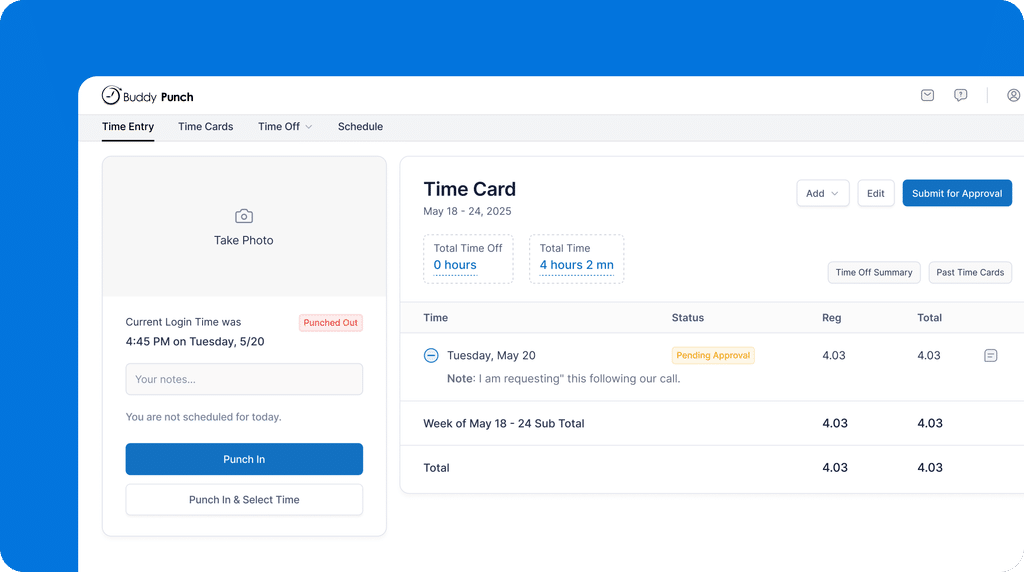
With the right time tracking solutions in place, you can maintain the records required under the FLSA while keeping timecard fraud in check. Buddy Punch’s time tracking software helps deter time theft and makes it easier for you to identify discrepancies faster. It offers advanced features for:
- Verifying employee location: With the GPS feature, you can log employees’ locations when they punch in and out and/or track their locations in real time to see if they’re running errands while they’re on the clock.
- Prevent offsite punches: With geofencing, you can block employees from clocking in or out while offsite and see which employees tried to punch while offsite.
- Verifying identity: Photos on Punch requires employees to take pictures of themselves when clocking in and out. You can review those photos on their timesheets to identify buddy punching.
Contributors
- Devin Hornick, Co-Founder and Partner, KORE1
- Laura Gauley, HR Lead, Business Sherpa Group
- Thomas Ricotta, Litigation Attorney and Partner, Ricotta & Marks, P.C.
- Seann Malloy, Founder and Managing Partner, Malloy Law Offices

