
15 Best Timesheet Apps for Multiple Employees in 2026

Written By: Eric Czerwonka
Last Updated September 1, 2026
Tracking employee time using paper timesheets and spreadsheets becomes very time-consuming once your team hits a certain size. The more employees you track time for, the bigger the headache: employees are not honest about when they clock in/out, and calculating hours and running payroll becomes increasingly complex.
We learned that lesson ourselves when struggling to run payroll for a team of over twenty employees across three different business locations. Time theft was hard to detect. Payroll took a full day to complete. Often, we had to re-run payroll because of mistakes made when calculating hours or entering data.
Employee timesheet apps are designed to solve all of these problems. They calculate work hours for you automatically, send your time data to payroll in seconds, and even have features to help you reduce labor costs and prevent time theft.
If your company is growing and looking for a better way to track your team’s time, one of the 15 timesheet apps below — all designed specifically for growing businesses with multiple employees — should solve the issues you’re running into.
| Platform | Summary | G2 Rating | Free Trial | Starting Price |
|---|---|---|---|---|
| Buddy Punch | Best for multi-location companies, Buddy Punch lets you track employee time, attendance, breaks, and locations so you can keep track of your distributed team. | 4.8/5 | 14 days | $4.99/user/month |
| QuickBooks Time | Best for connecting time tracking to accounting and payroll, QuickBooks Time automatically syncs your data across all of the different Intuit products you use. | 4.5/5 | 30 days | $10/user/month |
| Timely | Best for tracking time toward projects automatically, Timely records everything employees do on their computers and uses AI to log that time to the right projects. | 4.8/5 | 14 days | $9/user/month |
| ADP Workforce Now | Best for biometric identity verification, ADP’s physical time clock devices can include facial recognition, fingerprint scanning, and voice recognition capabilities. | 4.2/5 | Not offered | Contact for pricing |
| Hubstaff | Best for employee computer monitoring, Hubstaff tracks the websites employees visit and the apps they use and can clock employees out automatically when they’re idle. | 4.4/5 | 14 days | $4.99/seat per month |
| actiTIME | Best for time tracking and project management, actiTIME lets you create projects and tasks, estimate time required, and compare estimates to actuals. | 4.6/5 | 30 days | Free plan available for up to three users; paid plans start at $5/user/month |
| Everhour | Best for preventing budget overruns, Everhour notifies you when you’re running out of budget and prevents employees from billing time to projects that are maxed out. | 4.7/5 | 14 days | Free plan available for up to five users; paid plans start at $8.50/seat/month |
1. Buddy Punch – Best for companies with hourly employees working across multiple locations
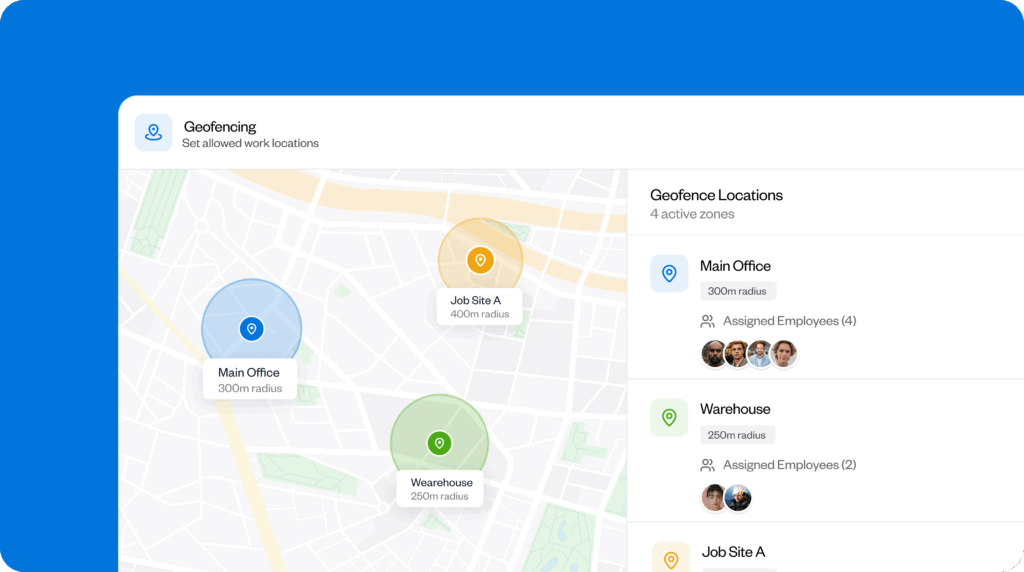
Buddy Punch is built for distributed workforces in industries like construction, field services, manufacturing, transportation, retail, and healthcare. It gives you the tools you need to stay on top of what’s happening with your team even when you’re all working at different locations.
Employees can clock in and out using their phones. Location tracking lets you see where all of your employees are located while they’re on the clock, and geofences prevent employees from clocking in or out while offsite. Attendance alerts notify you when employees clock in late, clock out early, or miss a shift, and overtime alerts give you a heads-up when employees are nearing overtime.
There are also features for preventing buddy punching, like Photos on Punch (require employees to take a selfie when clocking in/out) and facial recognition (on Apple devices only). And Buddy Punch also makes it easier to track breaks and ensure breaks are taken to stay compliant with state meal and rest break laws.
Key features
- GPS on Punch lets you validate that employees were on site when clocking in and out.
- Geofencing and IP address locks prevent employees from clocking in/out when not on site.
- Real-time GPS lets you see where everyone is located on a map and where they traveled.
- Job costing lets you track time toward specific clients, projects, and/or tasks.
- Attendance alerts notify you when an employee clocks in late, clocks out early, or misses a shift.
- Overtime alerts give you a heads-up when employees are getting close to going into overtime.
- Break tracking reminds employees when it’s time to take a break and documents all breaks.
- Photos on Punch and facial recognition prevent buddy punching.
- Multiple options are available for payroll: use Buddy Punch as your payroll provider, integrate with 20 popular payroll providers, or download reports pre-formatted for your existing payroll software.
Pros
- One of the highest-rated timesheet apps on G2 and Capterra (4.8/5), with customers praising its ease of use and great customer support.
- Simplifies payroll by offering multiple options for getting your time data to payroll easily.
- Buddy Punch often costs nearly half as much as other timesheet apps with the same features.
Cons
- Buddy Punch offers a free trial, but it doesn’t have a free plan for very small businesses.
- You can track time toward jobs and projects using the system, but there’s no invoicing feature.
Pricing
Buddy Punch’s plans start at $4.99/user per month. All plans have a $19/month base fee that covers the cost of all admin users you add to the system. The lowest-cost plan includes time tracking, GPS on Punch, PTO tracking, alerts and reminders, payroll integrations, reports, and job costing.
For scheduling, geofencing, and photo clock-ins, you’ll need to upgrade to the Pro plan, which starts at $6.99/user per month. Real-time GPS is available in the Enterprise plan ($10.99/user per month) or can be purchased as an add-on to any other plan for $2/user per month.
To use Buddy Punch’s built-in payroll, you’ll need to purchase the payroll add-on, which is $8/user per month plus a $49/month base fee. However, if you have an existing payroll provider that you like, you can integrate with it or download reports for it on all Buddy Punch plans.
Learn more about Buddy Punch
- Start a free trial — no credit card required
- Watch a video demo
- Take an interactive product tour
- Request a personalized demo
2. QuickBooks Time – Best for connecting time tracking to accounting and payroll

If you’re already using QuickBooks Online for accounting or QuickBooks Payroll for payroll, QuickBooks Time is worth considering. It integrates automatically with those two systems so your time data flows from your time tracking tool into payroll and then into your accounting software without you having to do any manual data moving or integration setup.
It’s also a good option if you don’t already have tools for time tracking, accounting, and payroll, or if you want to move from having multiple systems from different companies to one central system that’s tied together out of the box. Just keep in mind that while all three systems work together, you’ll have to subscribe to them separately, and you have to subscribe to QuickBooks Online to use QuickBooks Time.
QuickBooks Time is designed for larger businesses with hourly employees. It has several of the same features as Buddy Punch, including real-time GPS tracking, geofencing, and scheduling. However, QuickBooks Time also offers mileage tracking, and while its geofences won’t block offsite punches, they can automatically switch job codes for employees as they enter and leave job sites you’ve geofenced.
Key features
- Track employees’ locations with real-time GPS tracking and log how many miles they drove.
- Automatically sync data across QuickBooks Time, Online, and Payroll.
- Use the platform’s REST API to connect time tracking to other systems you use or to add data (e.g., employees, job codes, locations, geofences) in bulk.
- Use geofences to either remind employees to switch job codes when entering or exiting geofences or automatically switch job codes for them.
- Create invoices in QuickBooks Time then sync them with QuickBooks Online to send them to clients and collect payments.
Pros
- Syncs out of the box with QuickBooks Online and Payroll — no integrations are needed.
- Offers mileage tracking for quick and easy reimbursements with no odometer checking.
Cons
- Almost twice the cost of similar tools that offer the same features.
- Cannot be used as standalone time tracking software; you must also subscribe to QuickBooks Online.
Pricing
You must have a QuickBooks Online subscription to subscribe to QuickBooks Time. QuickBooks Online starts at $38/month for one user.
Plans for QuickBooks Time start at $10/user per month plus a $20/month base fee that covers the cost of one admin user. The base plan includes time tracking and PTO management. For mileage tracking, geofencing, and job costing, you’ll need to be on the $12/user per month Time Elite plan.
To purchase QuickBooks Payroll as a standalone product, prices start at $7/employee per month plus an $88/month base fee. You can also subscribe to the Workforce Premium + Plus plan for $13/employee per month plus a $228/month base fee to get Payroll and Time in one package. It is unclear if you need to also subscribe to QuickBooks Online if you’re paying for the Workforce Premium + Plus plan.
New customers get a discount on the base fee — but not the per-user cost — for the first three months of their subscriptions to any of Intuit’s products.
Learn more about QuickBooks Time
- Read our in-depth QuickBooks Time review
- Compare Buddy Punch vs. QuickBooks Time
- Discover the best QuickBooks Time alternatives
3. Timely – Best for tracking time toward projects automatically

If your employees work on tasks and projects for clients and you need to track the time spent on those projects for invoicing or budgeting, Timely might be the right option for you. Its memory tracker captures everything your employees do on their computers over the course of the day, making it easy to go back at the end of the day and make sure all of the work you did was attributed to the right projects.
And while you can sort the time you spent on tasks into projects manually, Timely also has an AI feature that will sort them for you automatically. It learns how you categorize your time when you do it manually and uses that data to sort your time into projects for you. All you need to do is review its suggestions and accept or decline them, and any declined suggestions help it learn how to sort better in the future.
The highlight of Timely is that the computer monitoring that the software does is solely to help employees ensure they’re allocating time to the right projects. It’s not shared with managers like some of the productivity monitoring tools we’ll look at later. This makes it a good option for professional services companies that want to track project time accurately but aren’t concerned about employee time theft.
Key features
- The platform integrates with tools like Asana, Linear, Basecamp, ClickUp, Monday, Trello, and more so you can automatically pull projects and tasks from those platforms into Timely.
- Everything employees do on their computers shows up in a memory tracker so they can allocate their labor hours to the right tasks and projects.
- Timely’s AI learns which types of time entries belong to which clients, projects, and tasks and can sort time into buckets for you automatically.
- A project dashboard shows you how your projects are progressing based on how many labor hours you budgeted for and how many you’ve used.
- Create invoices for clients in Timely, then integrate with QuickBooks Online to recreate your invoices there automatically, send invoices to clients, and accept payments for them.
Pros
- Timely’s memory tracker ensures no billable time goes unbilled.
- Integrations with project management systems sync projects and tasks to Timely automatically.
Cons
- Timely’s two lowest-cost plans both have limits on how many users you can add.
- There are no payroll integrations, so if you have hourly employees, you’ll have to download your time reports and upload them to your payroll provider.
Pricing
All of Timely’s plans include its automatic time tracking feature. Its base plan starts at $9/user per month, but it’s limited to five users and 20 projects. For 5-50 users and unlimited projects, you’ll have to upgrade to the Premium plan, which starts at $16/user per month and includes the platform’s project management integrations. Teams with 50+ users will need to be on the Unlimited plan, starting at $22/user per month.
4. ADP Workforce Now – Best for biometric identity verification

ADP Workforce Now is built more for large and enterprise businesses than small and midsized ones, but it can be a good fit for any company that wants to verify that their employees are who they say they are when clocking in and out. The company sells physical time clock devices that can be used for multiple types of biometric identification, including facial recognition, fingerprint scanning, and voice recognition.
Another benefit of ADP Workforce Now is that the platform can grow alongside your business. You can start by paying only for time tracking and payroll, then add on modules for benefits management, hiring, and scheduling when you need them. ADP also has an AI assistant embedded into its products that can answer both general HR questions and questions about your own data in the platform.
Key features
- Time tracking data syncs with payroll continuously so payroll is always up to date.
- Purchase physical time clock kiosks that can include biometric identification features.
- Use an AI assistant to get answers to general HR and company-specific questions.
- Add on additional HR features over time to get scheduling, benefits management, payroll, and talent management features in one platform.
- Use AI to detect possible issues with payroll and alert you to them for review.
- Use AI to write job descriptions and review applications to surface the most qualified candidates.
Pros
- You can purchase physical kiosks with multiple options for biometric identification.
- Use one tool no matter how large your business grows, adding on features as you need them.
Cons
- ADP doesn’t publish its pricing, so you have to request a demo to get a quote.
- Built more for large and enterprise companies than small and midsized ones.
Pricing
ADP Workforce Now does not publish its pricing publicly. Request a quote through its website.
5. Hubstaff – Best for employee computer monitoring
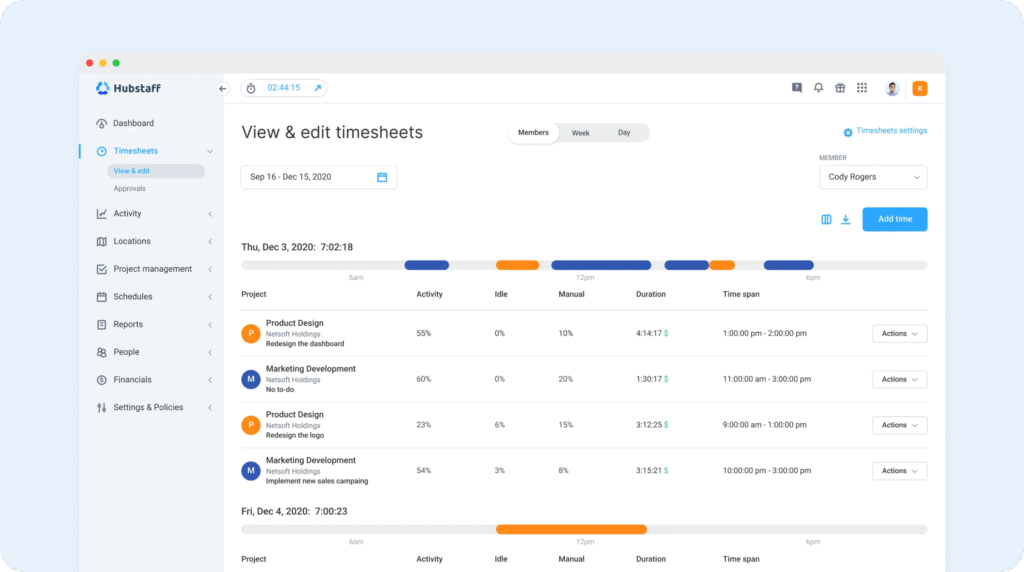
If your employees do all of their work on computers and you’re concerned about time theft, Hubstaff is a good option to consider. It tracks everything employees do while they’re clocked in and provides managers with insight into those activities. Managers can see what URLs employees are visiting, view screenshots showing what employees were doing, and detect when employees are billing time but actually idle.
If you want to prevent employees from billing time when they’re not working, you can set the system up to only log time for them when they’re using their computers. Then, if employees are idle for a certain amount of time, you can clock them out automatically and get a notification. Finally, if you have employees who travel for work, you can purchase an add-on to get real-time GPS tracking and geofencing on the platform.
Key features
- Track the apps employees use and the websites they visit while they’re on the clock.
- Automatically grab images of employees’ computer screens at regular intervals throughout the day.
- Tie time tracking to computer usage to prevent employees from billing time when not working.
- Get a notification or clock employees out when they’ve been idle for a specified period of time.
- Generate invoices and integrate with payment processors to accept payments for those invoices.
- Integrate with several project management tools, CRMs, and help desk tools to track time in the systems your team already has open all day.
- Download apps for Windows, Mac, Linux, Android, iOS, and Chrome.
Pros
- Computer monitoring features make it easy to detect time theft among knowledge workers.
- There are features to prevent time theft for both computer-based and traveling employees.
Cons
- Hubstaff only integrates with three payroll providers and doesn’t offer built-in payroll.
- Most of the platform’s best features are in its Team plan, which costs more than many competitive products with similar features.
Pricing
Hubstaff has two low-cost plans, Starter ($4.99/seat per month) and Grow ($7.50/seat per month). Both of those plans include time tracking, idle time detection, and limited access to screenshots and app/URL tracking.
However, if you’re using the platform to track hours for payroll, you’re almost certainly going to need to be on the Team plan, which starts at $10/seat per month. Must-have features like timesheet approvals, attendance tracking, and overtime tracking are only available on the Team plan or higher.
Companies that want to use Hubstaff for location tracking and geofencing have to be on the Team plan ($10/seat per month) and purchase the separate Locations add-on ($3.33/seat per month), making the total starting cost $13.33/seat per month.
Hubstaff can also be configured to be HIPAA compliant for healthcare companies. Plans that include HIPAA compliance start at $25/seat per month.
Learn more about Hubstaff
- Read our in-depth Hubstaff review
- Compare Buddy Punch vs. Hubstaff
- Discover the best Hubstaff alternatives
6. actiTIME – Best for combining time tracking and project management

While tools like Timely and Hubstaff can integrate with project management tools to bring projects and tasks from a third-party system into your timesheet app, actiTIME can actually be used for both time tracking and project management. You can create customers, projects, and tasks, assign them to employees, and then have employees track their time toward those categories in the system.
When creating projects and tasks, you can add estimates for how long you expect them to take. Data-based estimation creates estimates for you automatically based on how long similar tasks took in the past. There’s also an estimated vs. actual time report you can review to see how your projects are progressing against your original estimates.
For time tracking, employees don’t clock in and out like they do using the other apps on this list. Instead, they enter their hours manually, connecting each segment of time to its respective project. However, there is a timer feature that employees can use to track their time more accurately. They simply select the task they’re working on and start the timer. When they stop the timer, the time entry is added to their timesheet.
Key features
- Consolidate time tracking and project management into a single system.
- Estimate the time required to complete tasks automatically based on historical data.
- View reports showing estimated vs. actual time and actual costs vs. project budgets.
- Create budgets at the project level and the task level.
- Generate PDF invoices that include detailed time breakdowns by task and project.
- The platform can be self-hosted if you need more control over your data.
Pros
- Consolidates time tracking and project management so you don’t have to pay for two separate systems.
- Makes it easy to track project costs in hours and dollars in real-time as employees fill out their timesheets.
Cons
- Invoices can only be created as PDFs, and there’s no option for collecting payments.
- Integrations are only available for Zapier, QuickBooks Time, and other acti products.
Pricing
actiTIME offers a free plan for up to three users. It includes a lot of the platform’s core features but does not include task estimates, budgets, or timesheet approvals.
All of actiTIME’s paid plans include all of the platform’s features. You pay more or less depending on how many users you add. For 1-40 users, plans start at $6/user per month. For 41-200 users, plans start at $5/user per month. For more than 200 users, flat-rate pricing is available. You can get a quote for more than 200 users by contacting the platform’s sales team.
7. Everhour – Best for preventing budget overruns

Everhour is another great option for agencies and other professional services businesses. Like Timely and Hubstaff, it integrates with your existing project management tool, letting you track time toward projects in Everhour itself or your project management system. However, what makes Everhour stand out are its tools for preventing you from going over budget on tasks and projects.
When creating projects in Everhour, you can set budgets for them. Managers get notifications when projects hit 75%, 90%, and 100% of their allocated budgets, giving them a heads-up to check in and see how things are going. When a project hits 100%, all employee timers that are set to that project are stopped so clients aren’t billed for more than they agreed to pay for projects.
If you don’t already have a project management tool, you can create your projects and tasks in Everhour like you can in actiTIME. But in addition to time tracking, you can also track expenses for client projects in Everhour, and you can create invoices in Everhour and sync them with several accounting systems — QuickBooks, FreshBooks, Deel, and Xero — to send them to clients and accept payments.
Key features
- Get notifications when projects are getting close to hitting their budgets.
- Stop all time from being tracked to client projects when budgets are exhausted.
- Track time and create project plans in the same system, or integrate with a third-party project management system.
- Create detailed invoices and send them to popular accounting tools for payment processing.
- Track expenses for client projects and include them in invoices.
- Use a resource planning calendar to see who’s available and when you’ll be able to take on new projects.
Pros
- Everhour gives you the flexibility to manage projects in its system or integrate with a third-party project management system.
- Track time and expenses in one system and generate invoices that include both costs.
Cons
- Everhour’s free plan is very limited, and you have to pay for five users to subscribe to its Team plan even if you don’t need to add five people.
- There are no automatic time tracking or productivity monitoring features you’ll find in some other tools designed for professional services teams.
Pricing
Everhour has a free plan for up to five users. However, its features are really limited, so it is only useful for basic time tracking and project management. Expense tracking, budgeting, invoicing, and integrations are all excluded from the free plan.
To get access to those features, you’ll need to be on the Team plan, which starts at $8.50/seat per month and includes all of the platform’s features. However, the Team plan has a five-seat minimum, so small teams with fewer than five users who want the features of the Team plan will have to pay for five users even if fewer seats are needed.
Other timesheet apps to consider
While these tools didn’t make it into our top seven, they might be the right choice if you’re shopping for a timesheet app for a more niche use case that the tools above didn’t cover:
8. Lawbillity: Designed specifically for lawyers and legal services businesses, Lawbillity lets you track the time you spend on tasks for specific clients and includes features like a conflict checker, LEDES invoice formats, and UTBMS patent billing codes. Its plans start at $33.60/user per month.
9. Insightful: Insightful is a good alternative to Hubstaff for teams that want time tracking and computer monitoring. Its base plan is similar to Hubstaff’s Team plan but costs $2 less per user per month. However, it has fewer overall integrations than Hubstaff and doesn’t integrate with any payroll providers.
10. Hour Timesheet: Designed for government contractors, Hour Timesheet has all of the features you need for DCAA-compliant time tracking, including audit trails of timesheet entries, automated timesheet reminders, timesheet signatures, user-limited charge codes, and more. It costs $8/user per month.
11. Memtime: Memtime is another automatic time tracking tool that works like Timely to capture everything you did over the course of the day. In addition to integrating with project management tools, it has built-in project tracking. Its pricing starts at €10/user per month with a two-year commitment.
12. Time Doctor: Another employee monitoring tool like Hubstaff and Insightful, Time Doctor is a good choice if you don’t need employees to track time. Its Automatic App can track employee productivity without employees having to interact with the platform at all. Prices start at $6.67/user per month.
13. Paymo: Another timesheet and project management app like actiTIME, Everhour, and Memtime, Paymo stands out because it lets you create estimates, set up recurring invoices, and connect to a variety of payment processors to accept payments. A free plan is available for a single client and two projects, and paid plans start at $9.90/user per month. A discount is applied for the first three months.
14. Jibble: Jibble offers a free plan that you can use to track time for unlimited employees. It has features for location tracking, employee monitoring, and time theft prevention. However, there are paid plans in addition to the free plan, what’s included in free vs. paid isn’t specified on Jibble’s website, and there’s no way to see the cost of its paid plans to compare its pricing to other tools without signing up for the free plan.
15. Deputy: Deputy is primarily an employee scheduling tool with time tracking built in. Its time tracking features are pretty basic, but its scheduling features are ideal for teams with high turnover. You can generate schedules automatically, predict how many employees you’ll need based on historical sales data, and get alerts for clopenings. Prices start at $5/user per month for basic time tracking and scheduling.
How to choose the right timesheet app for your company
The key to choosing the right timesheet app is finding an option that has the features you need at a price you can afford. However, that’s often easier said than done. Here are some tips on how to make the right choice:
- Separate features into a list of must-haves and nice-to-haves. In general, the more features you want, the more you’ll pay. Understanding what you absolutely need and what you’d like to have but can live without is a good way to shop on a budget and keep costs low.
- Make sure you fully understand what you’ll have to pay for the features you need. Pricing pages can be deceptive, and apps sometimes drop users into the most feature-rich plan for their free trials. It’s important to take extra time to validate that you will get the features you need at the price you’re expecting to pay.
- Take free trials of the apps you’re considering. Consider bringing in an employee or two to help you test the app as well. There’s no better way to determine if the app you’re considering will work for you than to actually try to make it work for you.
- Request a demo even if you don’t think you need one. Salespeople often know their apps better than anyone else at the company and will be able to help you answer any questions that you couldn’t find the answers to on your own.
- Test their support. You’ll want to make sure that someone will be there to help you if you run into issues. Send the provider’s support team a request to see how long it takes them to get back to you and if the answer is helpful. You don’t want to be on a payroll deadline waiting for a support team that takes ages to respond.
Finally, it can be helpful to read customer reviews of the apps you’re considering or ask people in your network if they have any experience with them. This may help you uncover issues you wouldn’t otherwise consider during an evaluation period.

