
The 9 Best PTO Tracking Software in 2026

Written By: Eric Czerwonka
Last Updated October 16, 2026
Spreadsheets weren’t built for PTO tracking. They struggle to calculate PTO accruals. They don’t notify you when time off overlaps in a way that leaves you understaffed. They force you to toggle back-and-forth between tabs when trying to create schedules for future weeks.
PTO tracking software fixes all of these issues. It calculates accruals and updates employees’ PTO balances automatically. It shows you upcoming time off on your schedule-building interface. It lets employees submit time off requests that are sent to their managers for approval.
We tested dozens of tools to find the nine best PTO tracking software on the market today. Below, you’ll find our detailed reviews of the apps we selected, explaining what unique features each offers, which use cases each tool is best suited for, and how they compare on pricing.
| Platform | Summary | G2 Rating | Free Trial | Starting Price |
|---|---|---|---|---|
| Buddy Punch | Best for businesses with hourly employees, Buddy Punch lets companies track time, create schedules, and manage PTO, and it lets you set up accrual policies by hours worked. | 4.8/5 (408 reviews) | 14 days | $4.99/user/month |
| Vacation Tracker | Best for teams that live in Slack or Microsoft Teams, Vacation Tracker lets employees request time off and managers review those requests without leaving your preferred messaging app. | 4.4/5 (46 reviews) | 14 days | $2/user/month (25 user minimum) |
| Day Off | Best for integrating your time off calendar into shared Outlook calendars, Day Off is a good alternative to Vacation Tracker for teams that live in Microsoft’s ecosystem of apps. | 4.7/5 (59 reviews) | 14 days | Free for up to 10 employees; paid plans start at $2/seat/month (10 seat minimum) |
| BambooHR | Best for large organizations needing a complete HRIS, BambooHR includes PTO tracking alongside tools for hiring, performance management, and time tracking. | 4.4/5 (7,705 reviews) | Not offered | $10/employee/month |
| Jibble | The best free option for teams of any size, Jibble combines leave policies, accruals, and multi-level approvals with time and attendance tracking, and its free plan doesn’t have any user or seat limits. | 4.7/5 (689 reviews) | Via the free forever plan | Free plan available; contact Jibble for paid plan pricing |
| Timetastic | Best for teams that offer unlimited PTO, Timetastic lets you create policies for how often employees should take off and identify low-usage offenders in a burnout report. | 4.6/5 (34 reviews) | 30 days | $1.50/user/month |
| Gusto | Best for teams already using it for payroll, Gusto’s base plan includes basic PTO tracking and can be a good option for teams that don’t want to have to subscribe to another tool. | 4.6/5 (13,523 reviews) | Free to use until your first payroll run | $6/person/month |
| Calamari | Best for growing companies, Calamari has different modules for PTO tracking, time tracking, HR, and performance management so the system scales alongside your business. | 4.6/5 (27 reviews) | 14 days | $2/employee/month (minimum 10 employees) |
| actiPLANS | Best for fully remote and hybrid teams, actiPLANS’ shared calendar shows employee locations, tasks, and time off in a consolidated view. | 5/5 (2 reviews) | 30 days | $1.50/user/month |
1. Buddy Punch – Best for businesses with hourly employees
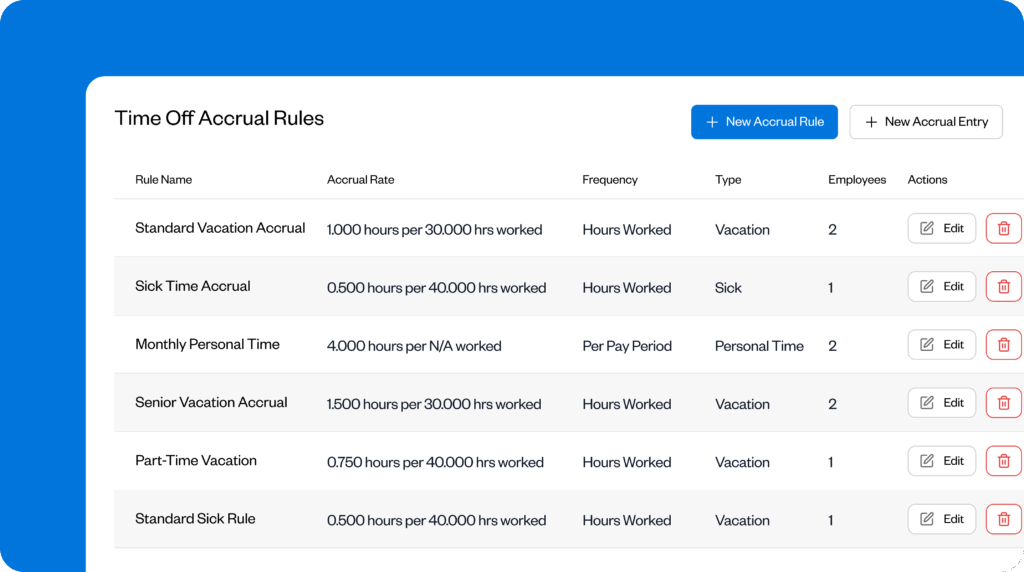
Buddy Punch is a workforce management system for small businesses with hourly employees that gives you access to all of the tools you need to run your business in a single system. With it, you can track employees’ time, create work schedules, monitor attendance, run payroll, and manage time off. It has the highest G2 rating of any app on this list and is praised for its ease of use and great customer support.
PTO tracking in Buddy Punch starts with setting up your leave policies. You can create a single bucket for all time off or create separate policies for vacation, personal time, sick leave, holidays, parental leave, etc. There’s no limit to the number of policies you can create. When you add a new leave policy, you can set it as paid or unpaid, and you can assign the policy to everyone at your company or only specific employees.
Next, you decide how to distribute PTO to employees. You can add PTO in lump sums, or you can set up automatic accruals. PTO can accrue by pay period, number of hours worked, or annually either on the first of the year or a specific date you set. Different employees can have different accrual rules if needed, and accrued time off is automatically added to employees’ PTO balances, which they can see in the app.
Other features for managing PTO in Buddy Punch include blackout dates (block PTO requests during times when you need all hands on deck) and rollover rules (which let you specify whether or not unused balances carry over into the next year).
Employees can submit PTO requests in the app, and those requests are sent to their managers for approval. Managers can approve or deny requests in the app, too. All approved requests for time off display on a PTO calendar, which is useful for managers when reviewing time off requests to make sure that approving the request won’t leave you short-staffed.
The connection with time tracking, payroll, and scheduling makes PTO tracking in Buddy Punch even more efficient. All approved time off is automatically removed from PTO balances, added to timesheets, and included in payroll. Additionally, time off displays automatically on the calendar when creating employee schedules so you never schedule an employee to work a shift when they’re scheduled to be off.
Pros
- Combines time tracking, scheduling, and PTO tracking so everything works together efficiently
- Customizable for businesses that need to create different policies for different employees
- PTO can be set to accrue by number of hours worked, by pay period, or annually
Cons
- Priced higher than tools that only have PTO tracking
- Catered more to businesses with hourly employees than salaried ones
Pricing
Free trial available. View Buddy Punch’s current pricing.
Learn more about Buddy Punch
- Start a free trial — no credit card required
- Watch a video demo
- Take an interactive product tour
- Request a personalized demo
2. Vacation Tracker – Best for managing PTO in Slack or Microsoft Teams

Vacation Tracker is a good fit for salaried knowledge workers who already spend most of their day in Slack or Microsoft Teams. It doesn’t offer time or attendance tracking like Buddy Punch, but those options aren’t needed for salaried employees. It gives you a simple solution for managing time off balances, policies, and accruals without employees having to learn an entirely new system.
With Vacation Tracker, employees can request time off directly in Slack or Microsoft Teams. In Slack, for example, employees simply type the command /vacation. Vacation Tracker opens its request form directly in Slack where employees can select the policy they’re using and enter their dates and a reason if needed. Approvers get a notification to review the request, and the employee gets a notification of the decision.
Vacation Tracker can also integrate with Google Calendar to show all employee vacations and PTO on the same calendar you all use to work, making it easy for everyone to see who’s working and who’s out of the office. And when employees start their PTO requests in the Vacation Tracker web app, they’ll be able to see if any other teammates in their department are off at the same time.
If you have multiple offices that each have their own PTO policies, you can set up different locations in Vacation Tracker. The platform also supports multiple languages: English, French, Spanish, Portuguese, Swedish, Italian, Polish, and Turkish. Employees can select their default language in the app so everyone sees all of the text in the platform in a language they understand.
You can also allow employees to opt into time off in lieu instead of getting paid for overtime, you can set up multi-level approvals for more complex team compositions, and PTO can be set up to accrue at whatever interval your pay periods run on: monthly, semi-monthly, biweekly, or weekly. However, there is no option for accruing PTO based on hours worked.
Pros
- Simple, PTO-only tracking system
- Slack, Teams, and Google Workspace integration
Cons
- No support for accruing PTO by hours worked
- There’s a 25 user minimum on all plans
Pricing
Free trial available. View Vacation Tracker’s current pricing.
3. Day Off – Best for integrating time off into Outlook’s shared calendar

Like Vacation Tracker, Day Off is another simple PTO tracking system that is solely for leave management. However, in addition to integrating with Slack, Microsoft Teams, and Google Calendar, Day Off also integrates with Outlook, allowing teams to view time off on the company Outlook calendar as well.
In terms of features, Vacation Tracker and Day Off are nearly identical. Day Off offers:
- Single or multi-level approval workflows
- Automatic PTO accruals and carryover rules
- Integrations with Slack, Teams, Google Calendar, and Outlook calendar
- Location- and team-specific leave policies and holidays
However, Day Off does not support as many languages as Vacation Tracker; it only has built-in language support for English, French, German, and Spanish. However, Day Off is more affordably priced than Vacation Tracker. There’s a free plan for up to 10 employees, and its user minimum is lower (Day Off requires a minimum of 10 users, while Vacation Tracker requires a minimum of 25).
Admins get access to several reports in Day Off’s web app. You can pull a report showing everyone’s PTO balances, all time off requests by employee (including type, start and end dates, and reasons), and balance carryover details (including how much time has been carried over, when accrued time off expires, and how much time off was removed due to expiration).
Another unique feature in Day Off is announcements. You can send messages to everyone at the company, to employees belonging to a specific team, or to employees working at a specific location. This is great for notifying employees of new time off policies or changes to existing policies that apply to them.
Pros
- There’s a free plan for small teams with basic needs
- Pricing for paid plans is affordable
Cons
- Integrations are only supported on paid plans
- No support for accruing PTO by hours worked
Pricing
Free plan and trial available. View Day Off’s current pricing.
4. BambooHR – Best complete HRIS platform with time-off tracking

On the opposite end of the spectrum from simple PTO tracking tools like Vacation Tracker and Day Off is BambooHR, a complete human resources information system (HRIS). HR teams can use BambooHR for everything they need to manage, from payroll and benefits administration to hiring and improving the employee experience — and, of course, tracking time off.
If you’re just looking for basic PTO tracking software, BambooHR’s feature set (and pricing) will be overkill. But if what you really need is a central platform that helps you manage everything a large human resources team needs to oversee and coordinate, it’s a great choice.
In terms of PTO tracking, you can set up multiple policies for unlimited PTO, accruals, or leave requests; visualize who’s off with a full-company PTO calendar; run reports to track trends in time-off requests; and set up detailed PTO approval workflows. PTO policies in BambooHR are also very customizable. You can customize them by specific locations or departments or create unique policies for specific employees.
You can also use BambooHR for time tracking if you have employees who are paid hourly — or if you need to track hours for salaried employees. Employees can clock in and out for the day or for breaks using the platform’s web app or mobile apps for Android and iPhone devices. There’s also an option to purchase time clock kiosk devices that include badge scanning or facial/fingerprint recognition.
Beyond basic workforce management, BambooHR’s suite includes an applicant tracking system, onboarding and offboarding systems with templates and checklists, and employee engagement and performance monitoring tools. There’s also compensation management, which lets you develop salaries based on aggregated salary data, and global employment, which is helpful for multinational organizations.
Pros
- Complete suite of tools for HR teams at large companies
- A time tracking and employee scheduling add-on is available
Cons
- Priced much higher than other PTO tools
- Time and attendance tracking is sold separately as an add-on
Pricing
No free trial offered. View BambooHR’s current pricing.
5. Jibble – Best for free PTO tracking for teams of any size

Jibble is a time and attendance platform with built-in leave management. It works for small businesses just moving off of spreadsheets as well as larger organizations managing time off across multiple teams and locations. Unlike Day Off, with its limit of 10 users on its free plan, Jibble’s free plan includes unlimited users.
PTO tracking in Jibble starts with time off policies. You can create policies for vacation, sick leave, unpaid leave, or any custom leave type; set entitlements in days or hours; and assign each policy to the whole company, specific groups, or individual employees.
Accruals can run monthly, annually, or from each employee’s join date, and carryover rules let you decide what happens to unused balances at the end of the year. Admins can also manually adjust balances to correct errors or grant extra days.
Employees request time off from the web or mobile apps, choose the policy they’re using, and can attach supporting documents like medical certificates. Requests can go through up to three levels of approvals — set up company-wide or per policy — and balances update automatically. A dashboard widget shows upcoming holidays and time off across the team so it’s easy to spot when too many people are out at once.
For teams spread across different countries, Jibble lets you set up public holiday calendars by region so each location’s holidays are reflected correctly. The app is also available in multiple languages, including English, French, Spanish, Brazilian Portuguese, Italian, German, Turkish, Polish, Indonesian, Korean, Japanese, Chinese, Czech, Slovak, Hungarian, and Dutch.
Because leave management sits inside a full time and attendance system, approved time off flows straight into timesheets and payroll data. If you need it, the same platform also covers clock-ins with GPS, geofencing, and facial recognition, along with reports on leave balances and time off requests that can be exported for payroll.
Pros
- Leave management, time tracking, and attendance in one system
- Advanced PTO tracking with multi-level approvals, custom accruals, and carryover rules
Cons
- PTO cannot accrue by number of hours worked
- No burnout or low PTO usage reports
Pricing
Free plan available. Contact Jibble for paid plan pricing.
6. Timetastic – Best for companies offering unlimited PTO

In a recent study, we found that many employees don’t actually use their PTO benefits. 42% worry about how managers or peers will perceive their absence, and 28% describe taking time off as stressful. This is problematic because when employees don’t take time off from work, engagement suffers and the risk of burnout increases. This can be even more of a problem when you offer unlimited PTO.
Timetastic helps solve this problem. In addition to letting you track PTO, it lets you set up policies that ensure employees take time off at specific increments. Once those policies are set up, its burnout report shows you anyone who hasn’t taken time off in the timeframe you set — or is nearing the end of the timeframe — so you can intervene before the employee gets burned out.
Another reason Timetastic is better for teams with unlimited PTO benefits is that its accrual system is much less flexible than the other apps on this list. Accruals can only be set to add to PTO balances monthly — not in any other timeframe or by hours worked. However, you can set limits on how much time employees can take in a year if you have people abusing your unlimited PTO benefit.
Employees can view their PTO balances, submit time off requests, and view all of their upcoming and taken time off for the year using Timetastic’s apps for the web, iOS, and Android. Managers get notifications in the app and/or via email when time off is requested, and they can view a wallchart showing all upcoming time off across the team before approving requests.
Like Day Off, Timetastic also integrates with Slack and Microsoft Teams — plus Google Calendar and Outlook’s calendar so you can sync time off to individual personal calendars or shared team calendars. You can set up multiple leave types, organize employees into departments for PTO approval workflows, and automatically import public holidays for your country and region.
Pros
- Quickly see which employees aren’t taking time off
- Great for businesses with salaried employees offering unlimited PTO benefits
Cons
- The accruals feature only supports adding to PTO balances monthly
- The platform only allows for the most basic types of customization
Pricing
Free trial available. View Timetastic’s current pricing.
7. Gusto – Best for companies using Gusto for payroll

Gusto is best known for its full-service payroll software. However, the platform can do a lot more than just help you with payroll. It has features for PTO tracking, time tracking, and employee scheduling, plus you can use it to purchase team health insurance, hire new employees, and manage performance. If you’re already using the system for payroll, you can turn on PTO tracking without having to pay for another tool.
Gusto’s PTO tracking system automates accruals for you, and it’s one of the only apps on this list — aside from Buddy Punch — that lets you calculate accruals by hours worked. However, you can’t set up PTO to accrue by pay period. Only hours worked, lump sums, and unlimited PTO policies are supported.
Additionally, businesses can create and manage custom PTO policies that align with their specific needs. You can create policies that apply to the whole company, to specific departments, or to specific roles, or you can create custom policies for specific employees. And because it’s part of your payroll system, approved PTO automatically syncs to payroll so you can be sure employees get paid for their time off.
Employees can view their accrued PTO balances and request time off through the system, while managers can approve or deny requests with a few clicks.
Gusto’s payroll system is designed for companies with U.S.-based employees (though you can use it to pay international contractors). It gives you unlimited payroll runs, lets you deposit employees’ checks directly into their bank accounts, and automatically handles federal, state, and local tax filings. Taxes are automatically calculated and removed from employees’ paychecks.
More HR-specific features you’ll find in Gusto include the ability to purchase employer-sponsored health insurance, an applicant tracking system, syndication of your open roles to multiple job boards, new employee onboarding checklists, background checks, an employee handbook builder, and goal tracking/performance reviews.
Pros
- Basic PTO tracking is included in Gusto’s base payroll plan
- Full workforce management platform with features for hiring, paying, and managing employees
Cons
- PTO accrual types aren’t as customizable as some of the other apps on this list
- Isn’t ideal for teams using other payroll software that don’t want to switch payroll tools
Pricing
Free to use until your first payroll run. View Gusto’s current pricing.
8. Calamari – Best for growing companies

If you know you need PTO tracking software but aren’t yet sure if you could also benefit from some of the time tracking and HR features of many of the other apps on this list, Calamari might be a good option for you. Unlike the other tools, it silos these different features into different plans, giving you more flexibility as you scale.
As far as PTO tracking, you’ll get all of the typical features you’d expect: requests and approvals, a time off calendar, and custom leave policies. Additionally, you’ll get access to some advanced features like an overlapping requests report that lets you quickly identify staffing concerns caused by having multiple team members off at the same time.
If down the line you decide you want to do more than just track PTO, you can also add on Calamari’s Time and Attendance, Core HR, or Performance plans:
- Time and Attendance gives you all of the traditional time tracking features — clocking in and out, paid/unpaid break tracking, and attendance management.
- Core HR gives you features like an employee directory, an org chart, and searchable document storage with detailed visibility permissions.
- Performance gets you access to talent management features like employee surveys, self-assessments, peer reviews, and an administrator panel.
Each of these plans is sold separately, allowing you the benefit of only having to subscribe to (and pay for) the specific features you need. This will let you keep costs low while you only need PTO tracking but add on additional plans in the future to keep everything under one roof.
Pros
- Buy only what you need and add other features on as you grow
- Overlapping PTO requests report quickly shows potential staffing issues
Cons
- PTO cannot accrue by number of hours worked
- There’s a 10 user minimum for all of its modules
Pricing
Free trial available. View Calamari’s current pricing.
9. actiPLANS – Best for fully remote and hybrid teams

If you have a fully remote or hybrid team, actiPLANS is an affordable choice. It’s a simple leave management, scheduling, and task management platform that lets you keep track of what everyone is doing no matter where they’re working.
The core of actiPLANS is a shared calendar that lets managers see who’s working and who’s off, what everyone’s working on, and where they’re working. You can create schedules for employees, assign them to locations, and list the tasks they should be working on, then see all of those details on the shared calendar that can be color-coded for quick review.
The platform syncs with Google’s, Outlook’s, and Apple’s calendar apps, and its iOS and Android apps let employees check their schedules and request leave from their phone.
You can create as many leave types as you need in actiPLANS: vacation, sick days, or any custom leave type you need. Each type can have its own accrual schedule: weekly, biweekly, monthly, yearly, or tied to an employee’s hire date. You can also create reset rules that apply when a new year starts and set caps on how much PTO can be accrued.
PTO balances update in the system automatically, and employees can check their balances anytime and request time off in the app. PTO requests are sent to managers to review, or you can create rules to auto-reject PTO as needed if the request is made for a blackout date or would drop an employee’s balance below a set threshold.
Pros
- Shared calendar shows work locations, tasks, and time off in one view
- Quick to set up with affordable pricing for small and mid sized teams
Cons
- Available in English only
- Only one leave type can be logged per day
Pricing
Free trial available. View actiPLANS’s current pricing.
Choosing the right PTO tracking software for your team
Hopefully, the list above helped you put together a shortlist of 2-4 tools to evaluate more deeply. Now, the hard work begins.
To choose the right option for your team, you’ll want to take free trials of the software you’re considering — or get demos if trials aren’t available — so you can make sure that the tool does everything you need it to. In addition to having the features you need, here are some other things to keep in mind while making your decision:
- Do you actually need all of the features the tool offers? More isn’t always better when it comes to software. More features can make the tool harder to onboard and harder to use — for both you and your employees. Make sure to consider the balance between features and usability.
- Is the software easy to use from the employee perspective? If the steps employees need to take to view and request PTO are clear, they’ll use it on their own without pressure or encouragement from you. Consider bringing an employee into your free trial to test the tool alongside you.
- Can you do everything you need to do in the tool? If you have nonstandard PTO policies or are in an industry with unique regulations, you’ll need to spend time during your trial making sure that you can set everything up to work exactly how you need it to.
- Do you have the budget for the tools you’re considering? Subscription software pricing is notoriously confusing, so you’ll want to take extra time to ensure that you’re actually getting access to all of the features you need at the price you’re able to afford.
- Is the company there to support you when you need it? You (or your employees) will inevitably run into issues or have questions while using the tool. Try sending a support request to each of the providers you’re considering to see how easy it is to request support, how quickly they get back to you, and how helpful their responses are.
By getting hands-on with each tool and considering more than just feature lists and pricing, you can ensure that the software you ultimately choose will work for your business for the long haul.

