

How to Address and Fix Employee Attendance Issues
Discover 7 proven ways to address and resolve employee attendance issues fairly and consistently, featuring insights from real managers.

Written By: Nick Murphy
Last Updated February 19, 2026

You’ve probably been here before: An employee is late — not enough to derail the day, but enough to make you pause. Is this the third time this month, or the fifth? You meant to check last week, but the schedule still worked or gave little disruption, so you moved on.
That’s how attendance problems take root: missed patterns and not enough follow-through. The good news is that most attendance issues are fixable.
In this article, I walk you through how to fairly and consistently address and fix the seven most common employee attendance issues.
1. Clearly define attendance expectations
When “on time” means different things to different managers, or hasn’t been defined at all, employees are left guessing. That uncertainty often turns into issues that look like non-compliance, even when your employees believe they’re meeting expectations.
The fix is a clear, easy-to-understand employee attendance policy.
Start by defining what “on time” means in your workplace. If different roles require different standards (for example, office staff versus field staff), define them separately and label them clearly.
Some example definitions of “on time” include:
- “Clocked in by scheduled start time.”
- “At station and ready to work by scheduled start time.”
- “Equipment ready by scheduled start time.”
- “Opening duties complete by scheduled start time.”
Then, outline a few key details:
- Is there a grace period before an employee is officially late? If so, how long is it (e.g., three minutes, five minutes)? Does it apply to all roles, or only certain ones?
- What counts as a missed punch (e.g., missing clock in, missing clock out, both)? Is there a time limit for fixing a missed punch (such as by the end of the day or within 24 hours)?
- What counts as a no-call, no-show absence (and when does it become that)?
It can help to turn this information into one or two examples so your staff can see the rules in practice. For instance, “If you’re scheduled to start at 9:00 a.m., and you clock in at 9:04 a.m., you’re within the grace period and aren’t late. If you clock in at 9:06 a.m., you’re late.”
Lastly, share your attendance rules during onboarding and include a short reminder of them wherever schedules are posted. That way, employees know expectations early on and won’t be able to claim they forgot the policy later.
2. Make sure your scheduling approach supports good attendance
Employees can’t consistently show up as expected if your scheduling approach makes that difficult. Take a look at the last 4–6 weeks of schedules — and attendance records, if you have them — and ask:
- Has there been enough time between jobs or shifts to travel, set up, clock in, or complete handovers?
- Have you regularly scheduled staff without considering personal constraints they’ve shared with you (e.g., childcare drop-offs, long commutes from the main office or jobsite, overlaps with a second job)?
- Have opening shifts followed late closings (“clopening” shifts), giving employees less than 10 hours of rest?
- Have you repeatedly scheduled the same employees for critical shifts because of skill gaps?
If the answer to any of these questions is “yes,” employee attendance issues may be due to your schedules. They’re likely making it tough for staff to show up on time (or at all).
As Himanshu Agarwal, Co-Founder of Zenius, explains:
“One-off incidents are random, but patterns emerge when there’s a rationale attached to the repetitive behavior. This rationale can include traffic issues, shift timings, childcare, etc.”
Solving this doesn’t require overhauling your entire scheduling practice, though. A few simple changes can help immediately:
- Add realistic buffers between jobs/shifts. Even 15 extra minutes in between can provide a cushion for traffic delays or a setup that takes longer than expected.
- Adjust start times if possible. For instance, if employees are consistently 5–10 minutes late for lunchtime shifts, consider starting the shift then.
- Rotate critical shifts where possible, and spread specialized work by cross-training more employees.
- Avoid clopenings.
- Group job priorities by location to reduce travel delays.
- Consider moving employees off certain shifts or days to help them consistently meet attendance requirements.
3. Know the warning signs to take seriously
Many attendance issues don’t seem “big enough” day-to-day to address: a single late arrival, one missed punch. And most managers don’t want to overreact. Life happens, and the situation feels manageable in the moment.
The trouble is that small attendance problems can easily become big enough to break schedules, disrupt coverage, damage team morale, and affect payroll accuracy. Issues stack quickly, and by the time they feel urgent enough to act on, the pattern has already hardened — and the employee may be treating it as normal.
Scott Flores, CEO of Empire Parking Lot Services, puts it clearly:
“The earliest indicator that attendance is going to become an issue is rarely the missed day of work. It is the altered pattern that no one pays attention to. That ‘I’m running five minutes late’ four-day streak — that right there is your red flag.”
Some important warning signs to watch for include:
- A second late arrival within a short window
- Subtle escalations — such as arriving 10 minutes late for one shift, then 20 minutes for another — within a brief period of time
- Any absence that lands on a critical shift, such as an opening, closing, “skeleton crew,” or key coverage shift
- A second missed punch
- Any missed punch that requires payroll correction
- Any two late arrivals or absences that fall on the same day or same shift
- No-call, no-show absences
4. Determine the “tipping point” for your business
So when does a warning sign turn into a real attendance problem? It’ll be different for every company, but the key is the same: having a clearly defined “tipping point” — the moment when late arrivals or absences stop being treated as isolated incidents and start being addressed as a pattern.
Importantly, your tipping point shouldn’t be the first attendance issue. One late arrival or one delayed callout happens to everyone. But it also shouldn’t be so late that the problem has already hardened into a habit.
The sweet spot is two or three occurrences within a defined window, usually several days to a couple of weeks. This threshold is early enough that taking action still feels like coaching, not punishment, but far along enough that you’re addressing a visible pattern, not reacting to a hunch.
Regardless of the specifics, include your tipping point in your employee attendance policy and remind new and current staff of it regularly.
5. Have a conversation at the tipping point, not after
Most managers’ attendance conversations are reactive: They occur only after the issue has snowballed and disciplinary action is required.
The best way to avoid this is through proactive conversations — check-ins with employees as soon as they reach the tipping point. It’s a strategy that Tracey Beveridge, HR Director at Personnel Checks, highly recommends:
“Open and honest conversations can make all the difference when correcting an employee’s attendance issue, and sometimes save having to go through a formal disciplinary process.”
Schedule a quick, informal meeting or call with your employee to discuss what you’re seeing, what might be causing their attendance troubles, and what you expect from them going forward.
It’s crucial to stay calm and lead with facts. For example, you might start by saying, “I’ve noticed you were late to these two shifts in the last six days, and I wanted to check in before it becomes a bigger issue.”
Then, ask an open, neutral question like, “What’s been getting in the way of arriving on time?” or “Is there anything about the schedule, commute, or workload that’s making attendance harder right now?”
Be clear that the employee doesn’t need to share personal details, and that you aren’t asking for explanations or excuses, just information that helps you solve the problem. As Beveridge notes, “The phrase ‘be curious, not judgmental’ is worth bearing in mind when trying to get to the root cause of a person not showing up for work.”
End the conversation by resetting expectations and outlining next steps. Remind them of what “on time” and “late” mean at your workplace and what will happen if the issue continues.
Finally, don’t forget to document this check-in. You don’t need a formal incident report at this stage, but it’s a good idea to send a brief email to your employee summarizing what you discussed, what you agreed to, and when you’ll check in again. This creates a paper trail that protects both of you if the issue continues and formal action becomes necessary.
6. Use software to spot patterns you’d otherwise miss
Memory is a terrible attendance tracking system. You’ll remember the dramatic incidents but miss the slow accumulation of late arrivals that quietly disrupts your schedule.
Time and attendance tracking software catches what memory can’t. It surfaces patterns like an employee who’s never late on Mondays but consistently late on Fridays, or someone who’s called out three times in two weeks but spreads the absences just far enough apart that no single week feels problematic.
With Buddy Punch, for example, time and attendance are tracked automatically. When employees clock in and out, the system matches that data to their schedules and flags who was on time, late, absent, or left early. You can log into the dashboard anytime to see who’s currently clocked in and spot late arrivals without manually checking timesheets or relying on memory.
Additionally, attendance alerts notify you via email or mobile when employees clock in late, clock out early, or miss a shift entirely. This means you’re catching the second or third occurrence as it happens.
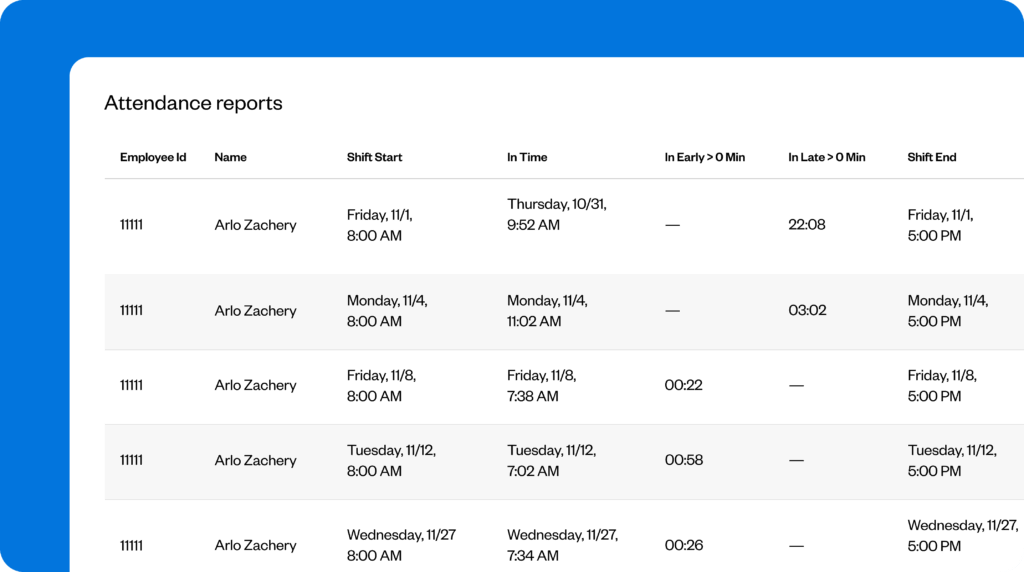
The best attendance tracking tools will also include detailed reporting that lets you view attendance during specific timeframes. Not only do reports help you spot patterns you may not have noticed otherwise, but they also enable you to work from facts rather than feelings when you speak with employees about attendance issues.
Ric Marks, Founder of Ultimate Marks, explains how data changes conversations about attendance:
“Data is a neutral third party. I don’t use it to accuse — I use it to remove ambiguity: ‘I want to show you what I’m seeing so we can solve it together.’ […] When employees can see consistency in the data, the conversation shifts from defensiveness to problem-solving.”
7. Respond to attendance problems fairly and consistently
If attendance issues continue after an early check-in, it’s time to respond more firmly — but in a way that’s still calm, fair, and consistent. If an employee feels singled out or treated differently, the problem will often get worse, not better.
Here’s what to do.
Document the issue
Use a simple, standardized form to record each attendance incident. This keeps everything objective and ensures you’re capturing the facts, not your frustration.
At a minimum, your form should document:
- The dates and times of each absence issue
- What happened (late arrival, missed punch, no-call, no-show absence, etc.)
- Whether the employee followed the call-out process
- Any explanation they gave (briefly, in their words)
- What action you’re taking next (coaching, formal warning, etc.)
Documentation serves two purposes: It creates a clear record if the issue escalates to formal discipline or termination, and it protects you from “they said this” or “they said that” scenarios where an employee claims they were never warned.
Buddy Punch’s guide to writing up employees for attendance issues includes a free template you can use to standardize documentation across your team.
Focus conversations on problem-solving
You’ll approach this more formal discussion the same way you did your earlier conversation: Present the facts, ask the employee what’s still preventing them from following attendance rules, and end with a clear explanation of what will happen next.
First, share all the data: when they were late or didn’t show up, what’s already been communicated, and what resources or information you’ve shared with them, such as the attendance policy or the early conversation you documented. Then have the employee share their perspective and explain why the issues have persisted.
This is the approach Joe Giranda, Director of Sales and Marketing at CFR Classic, takes with his team:
“I prefer using attendance data as an objective ‘mirror’ to reflect reality to the employee, rather than as a weapon for punishment. I present the report to the employee visually by showing dates and times, and I ask them to walk me through their own observation or interpretation of the data. Employees typically don’t realize how significant their absence is until it is compiled in an attendance sheet.”
From there, reiterate the consequences — whether that’s dismissing the employee after one more late arrival, moving them off weekend shifts because they consistently call out of them, or something else.
Follow up with the employee
After the conversation, share the incident report and a summary of your discussion with the employee. Have them sign the report to confirm they’ve read it and agree with what’s documented, what they need to do going forward, and what will happen if they fail to meet expectations.
Again, this protects you if the problem can’t be resolved and dismissal is required.
FAQs
Can you dismiss an employee for poor attendance?
Yes, you can dismiss an employee for poor attendance. However, it must be conducted through a fair, documented process, corrective conversations, and progressive discipline, since most attendance-related terminations occur after employees ignore multiple warnings.
For detailed guidance on this process, see Buddy Punch’s guide on terminating employees for excessive absenteeism.
What’s the difference between tardiness and absenteeism?
Tardiness means arriving late or leaving early but still working part of a scheduled shift. Absenteeism means missing an entire shift without prior approval. Both become patterns when they happen repeatedly within a short timeframe.
How many absences per year are acceptable at work?
This varies by industry and company policy. Many businesses allow six to eight unplanned absences per year before considering them excessive. However, it’s important to focus on patterns within shorter windows; for instance, three absences in two weeks signal a problem even if yearly totals seem reasonable.
How do you track attendance without micromanaging?
A great way to track attendance without micromanaging is through software that tracks clock-ins and flags patterns without constant oversight. For example, Buddy Punch monitors attendance in the background and sends alerts only when issues arise.
Are attendance issues considered misconduct?
Attendance issues are misconduct when they involve unauthorized, willful, or chronic missed shifts, especially after documented warnings. However, involuntary absences due to illness or emergencies are typically treated as performance issues rather than misconduct.
Contributors
- Himanshu Agarwal, Zenius, Co-Founder
- Scott Flores, Empire Parking Lot Services, CEO
- Tracey Beveridge, Personnel Checks, HR Director
- Ric Marks, Ultimate Marks, Founder
- Joe Giranda, CFR Classic, Director of Sales and Marketing

