
How to Write Up an Employee for Attendance Issues Fairly

Written By: Lucy C.
Last Updated January 23, 2026
Conversations about attendance can be difficult, particularly when the reasons are genuine. Unfortunately, though, putting them off can do more harm than good.
That’s because attendance issues must be addressed consistently to avoid escalation. Plus, relying on memory after the fact can lead to mistakes, pushback, or even legal disputes. And most importantly, you won’t get to the root of the issue or identify a potential solution.
So, whether you’re dealing with no-shows, tardiness, or persistent absences, you’ll need clear attendance expectations and accurate documentation to support and manage your workforce.
We spoke to seasoned managers and packed this guide with tried-and-tested tips to make employee attendance write-ups simple and stress-free.
Keep it formal to avoid confusion
Imagine this: One of your team members is late for the third time in a month, disrupting schedules and damaging team morale.
While a one-to-one chat to discuss the issue may seem helpful, using vague language or unclear expectations can put employees on the defensive. And if you don’t actually document the conversation, you’re left open to employee pushback, strained relationships, and disputes.
Instead, approach write-ups for excessive tardiness or poor attendance in the same way you would any other failure to follow company policies, such as breaking the dress code: consistently and with clear documentation to reinforce expectations.
Seasoned managers recommend using a formal write-up to document:
- Employee’s name
- Date of write-up
- Dates of absence, lateness, or no-shows (including day of week)
- Reason noted for absence
- Any action taken by the employee (e.g., visiting the doctor, if lateness is due to medical issues)
- How many periods of absence in the last 12 months (or other suitable time frame based on your attendance policy)
- Reminder of acceptable attendance levels
- Any relevant supporting information provided by the employee
- Employee acknowledgement
This creates a record you can rely on in performance reviews and disciplinary hearings, and serves as a shared reset of expectations with the employee. The goal is to improve behavior, encourage accountability, and minimize the impact of prolonged absences on your business.
You can use a simple template for attendance write-ups, like the one below. Simply click the link, follow the prompt to make a copy of the Google Doc on your account, and then edit the details as necessary.

If behaviors don’t improve after a write-up, you can kick-start your company’s disciplinary policy and, where necessary, even consider termination for excessive absenteeism if the situation doesn’t improve.
Focus on facts, not emotions
How you discuss and record an absence is crucial — including the words you use. Expressing your frustration or assigning blame won’t solve the problem. In fact, it can lead to confrontation rather than accountability.
Landon Murie of Goodjuju Marketing tells Buddy Punch that “the biggest mistake is to react emotionally […] or in a manner that does not draw from a clear attendance policy playbook.”
“When managers rely on ‘how it feels’, e.g., ‘often late,’ rather than time-stamped records linked to pre-communicated expectations, their write-ups become difficult to defend and easier to retaliate against.”
Itay Simshi, Founder of Proven House Buyers, agrees. He explains how easily subjective comments can cause disputes: “I’ve seen write-ups that say things like ‘you’re always late’ or ‘your attendance has been a problem,’ which immediately puts the employee on the defensive and opens the door to arguments.”
That means your opinion shouldn’t come across anywhere in the write-up. It should focus solely on the facts, the figures, and the explanations your employee shares — no matter how frustrated you may feel or how unbelievable the employee’s explanation might be.
Specifically, Simshi notes that “dates, times, and patterns” are key.
“For example:
Arrived 18 minutes late on June 3, 9 minutes late on June 7, and did not call in on June 12.
When you document attendance this way, it removes opinion from the conversation and keeps things grounded in reality.”
Nance Schick, Global Workplace Mediator at Third Ear Conflict Resolution, also reminds us, “Don’t include opinions about the veracity of excuses. That is not the purpose of the write-up. It is to log patterns and to help you address them consistently with all employees.”
So when writing up an employee, focus on what’s relevant and record details step by step, without emotional language. Before finishing the report, take a moment to sense-check it, ensuring the language is neutral and non-accusatory and that it sticks to the facts.
Timely discussions are key
Your employee did not show up for their shift… again. It’s clear that something needs to be done, but you don’t have an accurate record of their previous absences or the impact this has had on others.
Relying on memory alone can lead to mistakes or inconsistent application of your attendance policy. And the longer you leave it, the more subjective the process becomes, making it much harder to demonstrate fairness or accuracy. The conversation can descend into a “he-said, she-said” debate, where disagreements and misunderstandings are hard to resolve. Even worse, you might be accused of favoritism.
“Documentation that is concurrent with the incident is typically given greater weight because there is less opportunity for memories to fail,” says Shick.
Charly Huang of AceBallMarkers agrees that timeliness is of the essence, as “facts, conversations, emails, and witnesses need to be documented” before they become hazy.
That means you should complete employee write-ups as soon as possible — on the same day for lateness or as soon as your employee returns to work following absence.
Look for patterns and trends
“One of the biggest mistakes managers make,” says Huang, “is to look at each case as a singular issue rather than examining trends and individual situations.”
If you’re treating each absence as a standalone event, it’s easy to miss repeated behavior, such as regular lateness on Mondays or absences tacked onto vacation periods.
That’s why good record keeping is so important. In addition to documentation, a reliable scheduling and time tracking app is the best way to monitor absences and lateness.
Buddy Punch, for example, lets you see at a glance which workers have punched in late or punched out early. And you can also view all attendance issues for an individual, job site, or team with simple reporting.
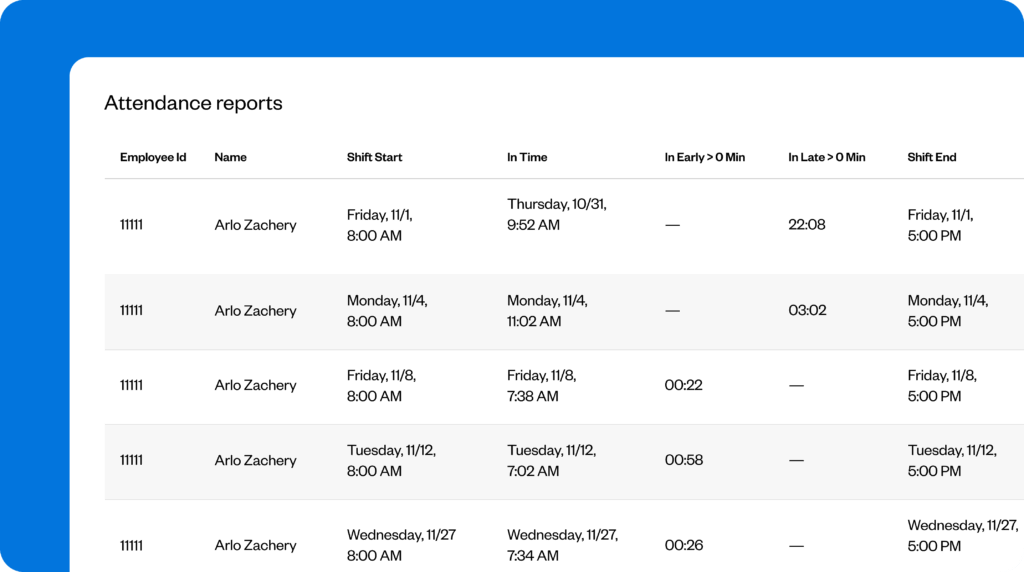
Use reports like this to look for patterns. How many absences have there been? Are the reasons repeated? Could there be a broader context that explains the employee’s pattern of absence?
Listen instead of making assumptions
If a team member is consistently absent, it can be easy to jump to conclusions. You might question their commitment or loyalty, or even label them as unreliable.
But let’s face it, assumptions are often wrong. Whether it’s car trouble, illness, or personal challenges at home, there are many legitimate reasons your employee may be absent. And in reality, they may simply be struggling.
To maintain trust and morale, it’s important you consider their well-being. Schick recommends asking the employee what they believe would help improve their attendance:
“Brainstorm solutions together. Actions suggested and chosen by the employee are more likely to be taken.”
Allow your employee to explain their reasons, and offer support where necessary. Adjustments to their schedule may help, or a simple reminder of your callout procedure might be all they need. If the absences do relate back to common scheduling issues, you may need to update how you share schedules.
If you’re still relying on printed or emailed schedules, it’s probably time to switch to a scheduling app. Improved attendance is just one good reason. You’ll find drag-and-drop scheduling much easier than managing a spreadsheet, and apps like Buddy Punch let employees check their schedule anytime, request shift changes if something comes up, and keep their availability up to date.
Make your attendance expectations clear
Attendance conversations are destined to fail if employees don’t know what’s expected of them. If you don’t communicate expectations and check understanding, you make it impossible for employees to be held accountable.
Instead, during your discussions, remind your employee of your company’s attendance rules. In particular, you should highlight the thresholds for absence and lateness in your policy so they know exactly what will trigger a write-up. The aim is to make sure that no one can say, “I didn’t think it would matter.”
In addition, as Schick suggests, “explain why attendance is especially important in your workplace (e.g., impact on clients or co-workers) and what the next steps need to be.” It’s a good idea to set out the proposed improvements within specific timeframes and underline the implications of continued poor attendance, placing accountability back on the employee.
Standardize your attendance approach to build trust
Inconsistently applying your attendance policy can damage trust and morale. If some team members face action for being absent while others don’t, it might lead to claims of bias.
As Murie explains, the answer is to make sure fairness is baked into the system:
“It doesn’t matter what job they do or how well/badly they’re doing it. When managers use a shared system that monitors attendance patterns, flags recurring issues, and reminds them to take the same steps every time, systemic fairness is built in rather than being subjective.”
Simchi agrees that applying a standard process for everyone helps avoid claims of unfairness. “Whether they’re a top performer or a new hire, I use the same thresholds, same documentation style, and same consequences,” he says.
It’s essential that you make new workers aware of your attendance policy, including how poor attendance will be managed in your business, during onboarding. Your attendance policy should then be applied consistently without exception. Whatever your employee’s role, working hours, or length of service, you should use the same attendance criteria, timelines, and outcomes — every single time.
Need help creating an attendance policy? Check out our employee attendance policy guide and free template.
It’s also crucial that managers are all on the same page. They should agree on clear thresholds in advance, know when a write-up is triggered, and understand the period during which attendance is reviewed.
Create a dialogue without breaching confidentiality
When the wider team is frustrated, under pressure, or struggling with their workload, radio silence about absence isn’t helpful. While it may be tempting to clear up rumors by confirming that a colleague’s absence is genuine — for example, by revealing that they’re going through a divorce or a serious illness — it’s crucial to maintain trust and confidentiality.
Schick has found the following dialogue works well: “Yes, your colleague has been out a lot. We are aware of the situation and are addressing it with her privately, exactly as we would with you. We appreciate your trust in us and are happy to discuss our attendance policies and procedures with you if you have questions about them.”
Get on top of attendance tracking with Buddy Punch
As managers consistently recommend, focusing on objective evidence is the best way to avoid back-and-forth conflicts over attendance. This is where Buddy Punch’s time and attendance tracking software can help.
By offering real-time attendance data, Buddy Punch makes it easy for you to proactively monitor your workforce. You can:
- Create, update, and send schedules with automated schedule updates so your team always knows when and where they’re next on shift.
- Check real-time activity using clear dashboards to show who is currently working.
- Receive instant attendance alerts when employees clock in late, clock out early, or miss a shift.
- Run attendance reports within set timeframes to help identify persistent attendance issues.
- Track individuals for attendance improvements.
Want to see Buddy Punch in action? Try a 14-day free trial or request a demo today.
Contributors
- Landon Murie, Goodjuju Marketing, Founder and CEO
- Itay Simchi, Proven House Buyers, Founder
- Nance Schick, Third Ear Conflict Resolution, NYS Employment Attorney and Global Workplace Mediator
- Charly Huang, AceBallMarkers.com, HR expert and Senior Business Advisor

