

How to Handle No-Call, No-Show Employees (With Policy Examples)

Written By: Christian Rigg
Last Updated January 12, 2026
A no-call, no-show (NCNS) absence can throw off an entire day in minutes. You’re short-staffed without warning, other employees have to cover work, and customers feel the impact immediately.
It’s also a moment when managers tend to either react emotionally or let it slide. Neither option ends well. The better approach is simple: follow a clear, consistent process that’s fair to the employee but also protects the rest of your team and your business.
We spoke with experienced managers to create this guide. You’ll learn how to define a no-call, no-show absence at your company, write a strong policy, and what to do step by step the next time it happens.
Set a clear no-call, no-show policy
When we chatted to Marcus Denning, Senior Lawyer at MK Law, he shared that a clear policy was key in helping him handle NCNS situations.
“I have found success in drafting policies that define the specific timeframe within which employees must notify their supervisors of their inability to come to work and the specific consequences associated with failing to do so,” Denning said. He also noted that a strong policy “does not provide any opportunity” for creative interpretation.
For Itay Simchi, founder of Proven House Buyers, a policy with simple wording was crucial: “When expectations are clear and written in everyday language, there is much less pushback later.”
We completely agree.
Below is a straightforward way to create a no-call, no-show policy (or improve an existing one).
Define exactly when an absence becomes an NCNS
Start with a short definition (2–4 sentences) of what counts as a no-call, no-show absence at your workplace. It should answer 4 questions: who must receive notice, what kind of notice counts, when notice is due, and what happens in emergencies.
Here’s an example you can adapt:
Notice counts only if it’s sent through an approved call-out method listed in this policy and received by the designated primary contact or the designated backup contact.
If an emergency prevents notice by the normal deadline, the employee (or an emergency contact on their behalf) must notify [Company Name] as soon as they reasonably can using an approved method. We review emergency situations case by case before deciding whether the absence qualifies as a no-call, no-show, and we may request supporting documentation.
Detail the call-out process under normal circumstances
This is the bulk of your NCNS policy. It should read like instructions employees can follow quickly when they need to call out under normal circumstances — that is, when they know they can’t make a shift and can give notice themselves. (Your definition above will cover emergencies.)
A solid call-out process explains the following.
When notice is due
You can create one rule for everyone, e.g., “Employees must provide notice at least four hours before shift start.”
Or you can set different rules for certain shifts or roles (e.g., opening shifts or specialized roles) that are particularly tricky to cover. For example: “For opening shifts, employees must provide notice by 8 p.m. the night before their scheduled shift.”
Who the employee must contact
Name one primary contact and one backup contact. For most teams, the primary contact is the employee’s supervisor or manager on duty, and the backup is a store manager, department lead, or HR contact.
If managers rotate frequently or your team is large, consider making the primary contact an “attendance line” for employees to call or a shared attendance inbox for them to email. That prevents call-outs from depending on one person seeing one message.
Also, add a simple escalation rule so employees know when to contact the backup if the primary contact doesn’t respond. For example: “If you can’t reach your supervisor through an approved method within 15 minutes, contact the shift manager.”
What method(s) employees can and can’t use to give notice
List the channels you actually monitor and will accept notice through. Some common options include:
- Phone call or text to a specific number (for example, the primary contact’s work number)
- Text in an official group chat that managers actively monitor and that includes the primary and backup contacts
- Message through a scheduling or workforce app (as long as it’s sent to the correct person)
- Email to a specific address (for example, the primary contact’s work email or a dedicated attendance inbox)
Then, list the channels you won’t accept notice through, such as:
- Telling a coworker (through any method — phone call, text, email, etc.) and asking them to pass it along
- Posting in a general group chat that managers don’t consistently monitor
- Contacting managers/coworkers on social media
- Posting about the absence on social media
- Leaving only a voicemail without using an additional approved method
What employees should share when calling out (Optional)
You don’t have to include this, but it can help ensure you get all relevant information when employees call out. For example, you could ask workers to state their full name, which shift they’re missing (with the date, start time, and location, if relevant), why they can’t attend, and whether they expect to attend their next scheduled shift.
Whether confirmation of receipt is required (Optional)
This can prevent mix-ups when an employee sends a text/email and assumes it was seen or leaves a voicemail and assumes it was heard. It works best for managers who can reliably confirm all call-outs, such as through a scheduling app or a monitored email inbox.
If you adopt this rule, note in your policy that notice only counts once the primary or backup contact has confirmed they’ve received a call/message/text/etc.
State consequences for no-call, no-shows
What happens after a confirmed no-call, no-show is up to your company. The most important thing is that you respond clearly and consistently.
A progressive discipline approach (as we cover in our guide, “Creating an Employee Attendance Policy”) is a good benchmark. Here’s an example:
| Attendance violations (within 12 months) | Disciplinary action |
| 1st | Verbal warning |
| 2nd | Written warning |
| 3rd | Disciplinary meeting |
| 4th | Final written warning or suspension |
| 5th | Termination |
7 steps for handling no-call, no-show absences
Follow these 7 steps when an employee doesn’t show up for work:
1. Confirm it’s not a scheduling issue
Sometimes, an NCNS is actually due to a misread of the schedule. So your first order of business is to confirm:
- Whether the employee was actually scheduled for that specific shift. (Double-check the day, time, and location, if applicable.)
- Whether there were any last-minute schedule changes, such as a shift swap, that were missed.
- Whether the employee could have been looking at an old version of the schedule.
If you don’t spot a true scheduling error, move forward with treating the absence as a no-call, no-show.
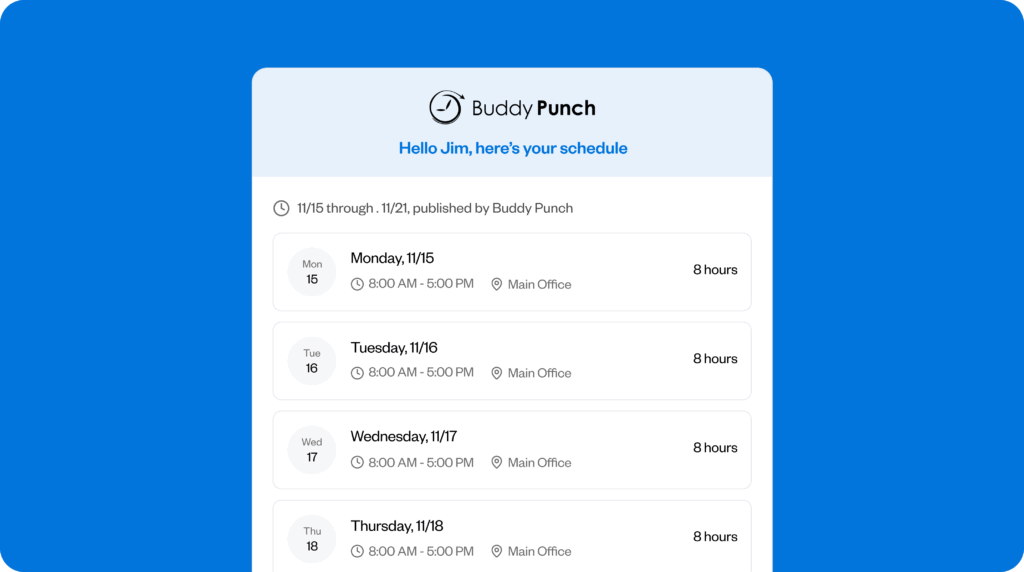
A dedicated employee scheduling app can help you avoid these issues. With Buddy Punch, schedules are delivered straight to workers’ phones and available to them at any time. Plus, they receive automatic push notifications whenever the schedule changes. This eliminates any questions about whether an employee saw the latest version of the schedule.
2. Contact the employee
Next, reach out to the absent worker. How you do this depends on your company’s policies, but a simple approach is to call their work number first, then text if you don’t receive a response, and then escalate if appropriate (e.g., by contacting the employee’s emergency contact after a set amount of time).
The goal is to discover what’s going on and whether the employee is safe, so skip any discussion about attendance rules and consequences for now.
Here’s a sample text you could send:
As Denning advises, remember to “record all attempts to contact the employee (method and time) in order to create an objective chronology.”
3. Find coverage
Don’t wait for the employee to respond before coordinating coverage. Protect the shift ASAP using your regular procedure (such as contacting on-call or back-up staff first, then shifting tasks to employees who are already working, offering voluntary overtime, or adjusting operations as needed).
4. Gather the facts once the employee responds
“The hardest part of handling a [no-call, no-show] fairly is separating emotion from facts,” Simchi told Buddy Punch. “When someone doesn’t show up and doesn’t call, it creates immediate stress for the team and the project.”
Understandably, that kind of stress can lead to big reactions. But seasoned managers understand the value of pausing to step back, gather information, and respond based on what happened, not how they feel in the moment.
So when you hear back from your absent employee, get “their side of the story.” View this as a fact-finding conversation, and ask questions like:
- When did you realize you wouldn’t be able to make your shift?
- Did you try to notify anyone? If so, who did you contact and how?
- What prevented you from following the normal call-out process?
- What kept you from being able to come to work?
- Are you able to work upcoming shifts, and if so, when?
If they state that an emergency prevented them from showing up for work, acknowledge it and set expectations: explain that you’ll review the situation using your NCNS policy and follow up with next steps.
5. Determine if it’s a pattern
Multiple managers we spoke with emphasized the significance of employee history: whether an NCNS was a first-time offense, something that happened infrequently but more than once, or excessive absenteeism, which is a string of missed shifts that indicates a pattern of behavior.
“When one has a good track record, is punctual and takes [ownership of] the error personally, I will treat it as a one-time incident and coach tough on expectations,” Branden Wells, CEO of TrueCraft Construction, told us.
Simchi agreed: “I look at timing and history. A single no-call, no-show from someone who has been reliable for months is handled very differently than the same issue from someone who has been late or absent repeatedly.
What exactly does excessive absenteeism look like? Well, that’s something you’ll have to decide for your business. But the steps for determining whether an NCNS is a pattern are largely the same across companies:
- Look at employees’ attendance records over the last 12 months.
- Confirm whether they properly communicated absences and/or late arrivals.
- Consider whether they take responsibility for any attendance issues and show effort to improve.
Buddy Punch makes this process easy. The scheduling feature includes built-in reports for absenteeism and tardiness, so you can easily spot patterns and take appropriate action quickly.
Simply navigate to Reports → Scheduling: Absence to view your absence report, like this one:

From here, you can select employees, choose the location, department, and role. Then, view reports within Buddy Punch, or export them to CSV or Excel (to analyze or visualize data further) or to PDF (to share with others).

6. Decide consequences using your policy
Once you’ve collected the facts and checked the employee’s history, refer to your policy to choose the appropriate disciplinary action. The goal is for the same situation to lead to the same outcome every time, no matter which employee and manager are involved.
Like Ty Tarchane, founder of Everything Knoxville Remodeling & Handyman, told us: “Most of the time, I see managers emotionally reacting to the situation or improvising the consequences that should follow, which is their biggest mistake. That leads to inconsistency and resentment.”
7. Complete an incident report and follow up with the employee
As Simchi explained to Buddy Punch, “I document everything the same day, in plain language, without judgement. Date, shift, role, and the fact that there was no call and no message.”
He added, “The biggest mistake I see is people skipping documentation because they want to be nice. That usually backfires. When there is no record, the second or third incident turns into a he-said-she-said situation.”
Other managers we spoke with agreed with this approach. “Your documentation of the incident should reflect the facts of what happened,” Denning noted, “as opposed to a reflection of your feelings regarding the employee.”
A good way to make sure documentation is completed fairly and promptly is to use a standardized incident report for missed shifts. (If you don’t already have one, use our missed-shift incident report template below!)
After documenting, follow up with the employee as soon as you can. Remain calm and stick to discussing what you recorded:
- The date, shift, start time, and the fact that you didn’t receive a call or message.
- The consequence or next step your policy calls for.
- Expectations for future shifts.
Simchi also recommended sharing the record with the worker: “When I speak to the employee,I show them the record and frame it as a shared reference point, not an accusation. That approach lowers defenses and keeps the conversation professional.”
A clear record also helps protect your company from liability and shows you’ve done your due diligence if and when the time comes to let somebody go for repeated incidents.
Missed-shift incident report: Free template

Use this free no-call, no-show incident reporting template to document unannounced employee absences. To use the template, simply make a copy of it in Google Docs when prompted, then edit the template as necessary for your team’s needs.
Make no-call, no-shows easier to manage with Buddy Punch
No-call, no-show absences are much easier to handle when you follow a clear process: write an NCNS policy, confirm the absence wasn’t a scheduling mistake, check on the employee’s safety, find coverage, collect facts, look for patterns, and document everything so you can respond fairly and consistently.
Buddy Punch helps teams of all sizes put this approach into practice. You can keep all scheduling information in one place, track attendance and missed shifts, and generate reports to spot repeated issues early. Sign up for a 14-day free trial of Buddy Punch today.
Contributors
- Marcus Denning, MK Law, Senior Lawyer — LinkedIn
- Itay Simchi, Proven House Buyers, Founder
- Eric Turney, The Monterey Company, Sales and Marketing Director — LinkedIn
- Branden Wells, TrueCraft Construction, CEO — LinkedIn
- Ty Tarchane, Everything Knoxville Remodeling & Handyman, Founder — Website

